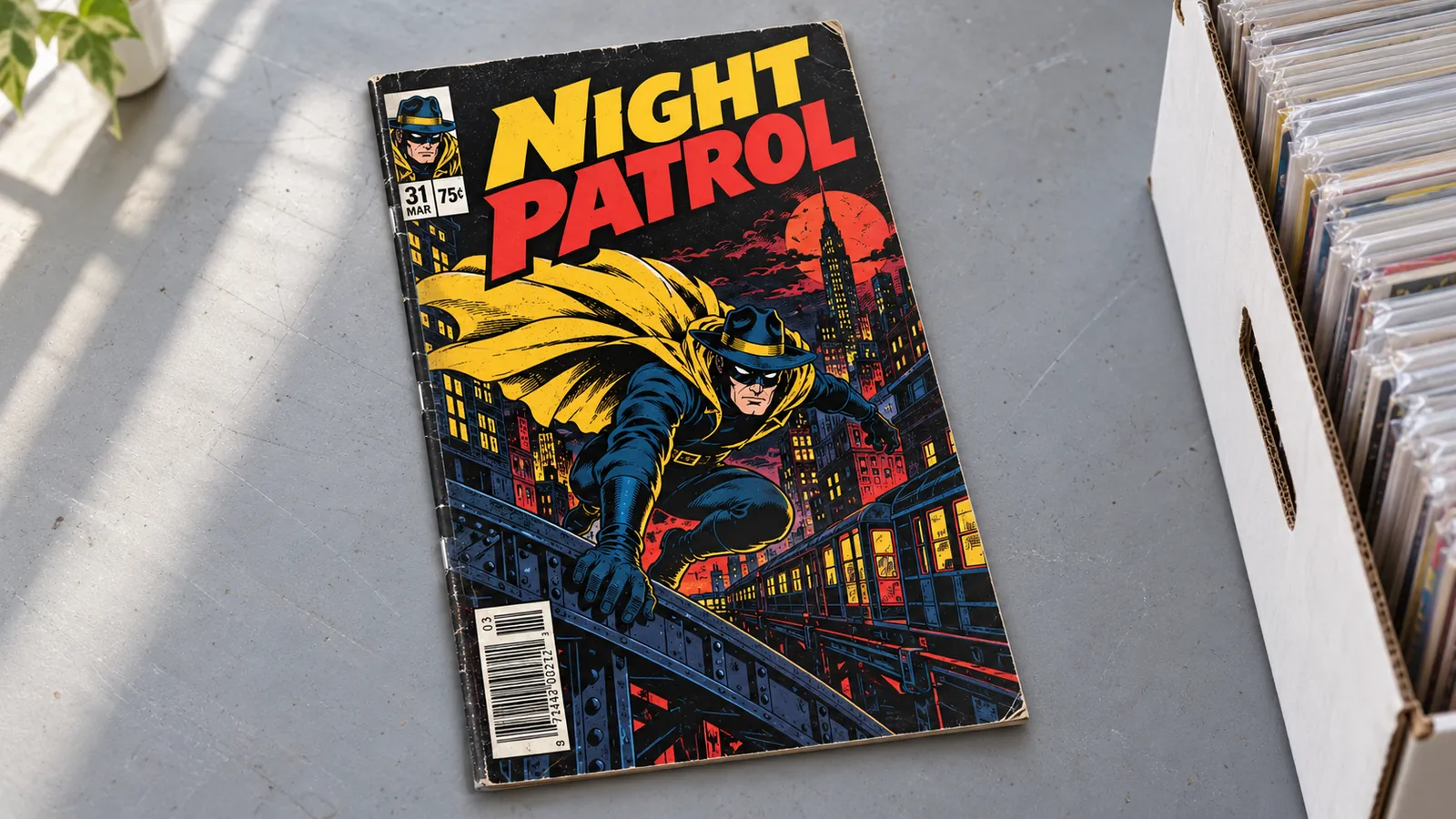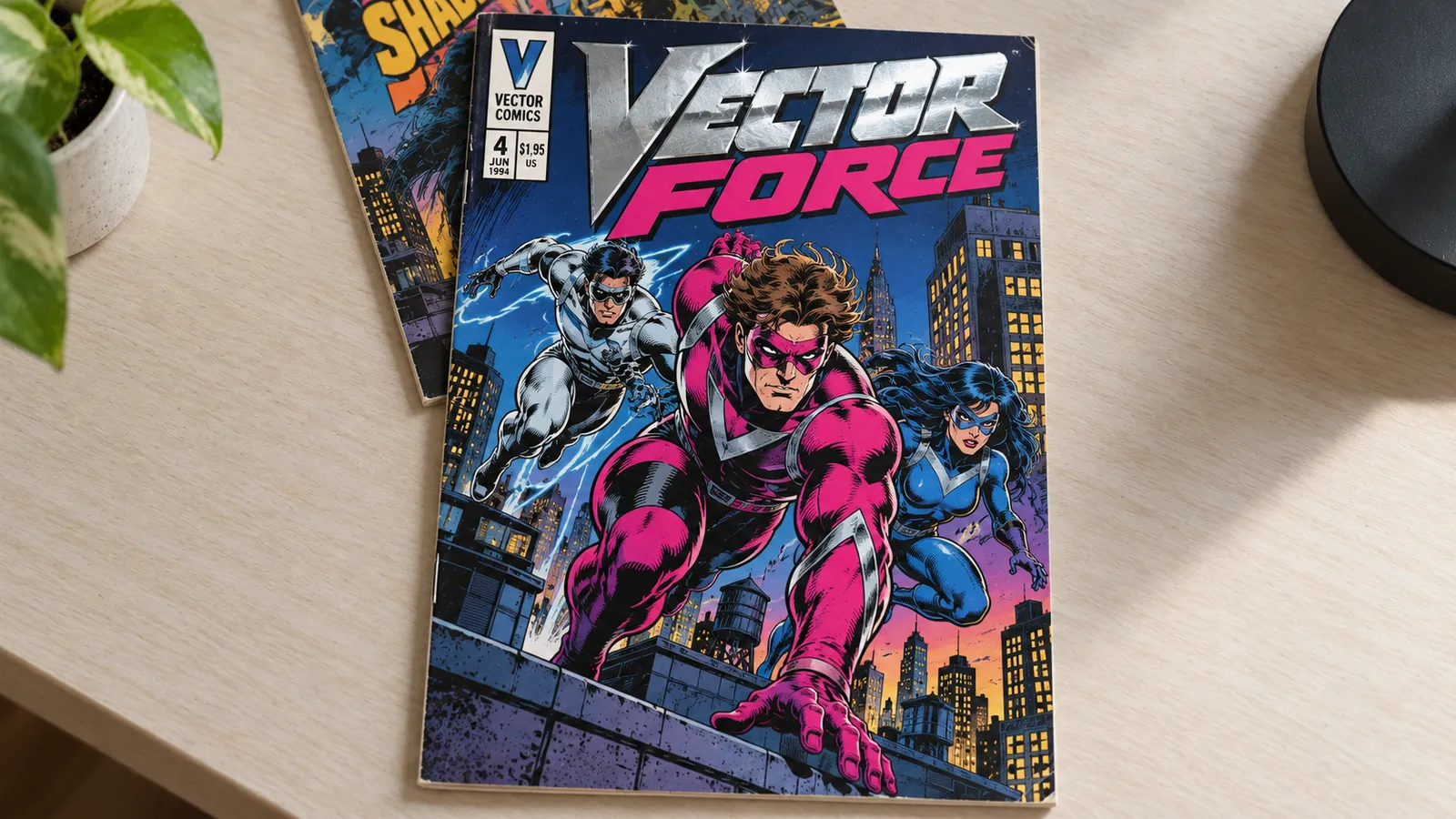
Most 1990s comics are common and sell for little, because publishers printed them in very large numbers. The ones worth money form a short list: documented first appearances such as New Mutants #98, small-press first issues such as Bone #1, and newsstand copies of some issues. Even for those, the edition, the printing and the condition decide what a copy is worth.
Below are ten documented 1990s keys, then the checks to run before you price a copy or drop it in a dollar bin. Values move, so this guide gives no prices; compare recent sold listings for matching copies.
Why most 90s comics are common
Supply is the reason. In the early 1990s, some issues sold by the million: Guinness World Records lists X-Men #1 (Marvel, 1991) as the best-selling single edition of a comic book, with sales of 8.1 million copies.
Publishers also gave buyers reasons to buy more than one copy. X-Force #1 (Marvel, August 1991) came sealed in a polybag with one of five trading cards, so a buyer who wanted every card needed five copies. A book sold in those numbers rarely becomes scarce, however famous it is.
The exceptions follow a pattern:
- Documented first appearances of characters who stayed popular.
- Small-press and self-published books, printed for a much smaller audience than the superhero best sellers.
- Newsstand copies of some issues, which became a shrinking share of sales as comic shops took over.
A key issue is an issue that collectors seek for a reason beyond its story, most often the first appearance of a character or the first issue of a series. Being a key is where value starts; the edition, printing and condition of your copy decide the rest.
Which 90s comics are worth money?
The 1990s books worth checking first are documented first appearances and a few small-press debuts. Each entry below was checked against at least two independent references. The list is not complete, and demand changes over time.
| Issue | Publisher, cover date | Why collectors look for it |
|---|---|---|
| New Mutants #87 | Marvel, March 1990 | First full appearance of Cable |
| Uncanny X-Men #266 | Marvel, August 1990 | First appearance of Gambit in story order |
| New Mutants #98 | Marvel, February 1991 | First appearance of Deadpool |
| Bone #1 | Cartoon Books, July 1991 | First issue of Jeff Smith's self-published Bone |
| The Amazing Spider-Man #361 | Marvel, April 1992 | First full appearance of Carnage |
| Batman: Vengeance of Bane #1 | DC, January 1993 | First appearance of Bane |
| Spawn #9 | Image, March 1993 | First appearances of Angela, Cogliostro and Medieval Spawn, from a script by Neil Gaiman |
| San Diego Comic-Con Comics #2 | Dark Horse, 1993 | First appearance of Hellboy, in a four-page black-and-white story |
| The Batman Adventures #12 | DC, September 1993 | First comic-book appearance of Harley Quinn |
| Preacher #1 | DC (Vertigo), April 1995 | First issue of Preacher and first appearance of Jesse Custer |
Three of these need a note:
- Gambit has two candidates. Uncanny X-Men Annual #14 (July 1990) reached print about three weeks before #266 by mistake, though its story is set later, so listings call either issue his debut.
- Harley Quinn started on television. She debuted in Batman: The Animated Series in 1992; The Batman Adventures #12 is her first comic appearance, a year later.
- Hellboy's debut was a convention comic. It was given away at the 1993 convention, months before his first series, Hellboy: Seed of Destruction.
Confirm the issue number, publisher and cover date in the indicia before you set a copy aside. The indicia is the small block of publication details, usually printed on the inside front cover or the first page. For the decade before, see 80s comics: keys, printings and condition traps.
Newsstand or direct: which edition do you have?
The barcode box on the front cover usually tells you which edition you have. A direct edition is a copy sold to comic shops, which could not return unsold copies. A newsstand edition is the same issue sold through magazine distributors to newsstands, grocery stores and drugstores, which could return them, so publishers marked the two differently.
| Check | Newsstand edition | Direct edition |
|---|---|---|
| Where it was sold | Newsstands, grocery stores, drugstores | Comic shops |
| Unsold copies | Could be returned | Could not be returned |
| Corner box, early 1990s | A standard barcode | Often a blank box, artwork, text or a struck-through barcode |
| Corner box, mid-1990s on | A barcode | A barcode, usually with the words "Direct Edition" beside it |
Newsstand sales shrank through the 1980s and 1990s as comic shops took a larger share. Many newsstand copies went to casual readers, so fewer survive in high grade, and some buyers treat newsstand copies of 1990s keys as scarcer variants. Read the corner box on your own copy, because the markings varied by publisher and year.
How to spot later printings and reissues
Check the indicia first, then the cover. A later printing is a new print run of an issue, usually made after the first one sold out, and buyers price it differently from the first printing. Superman #75 (DC, January 1993) went back to press more than once, and Bone #1 was reprinted after its 1991 debut.
Check every copy in this order:
- Read the indicia. Many later printings say so there, for example "second printing".
- Look at the cover for a printing mark, a changed price or a different corner box.
- Look for reissue wording. Some 1990s keys were reissued years later, for example as facsimile editions that copy the original with a modern price. Reissues usually say so on the cover or in the indicia.
- Name the cover version. A variant cover is an alternate cover for the same issue, and buyers price each version separately.
- Compare with a catalog listing for that issue and printing when anything is unclear.
Foil, hologram, die-cut and polybagged covers
Gimmick covers were common in the early 1990s, and each type has its own weak points. A polybagged comic is one sold sealed in a plastic bag, often with an extra item such as a trading card or a poster.
| Cover type | What to check | How to show it in a photo |
|---|---|---|
| Foil or chromium (a metallic, mirror-like finish) | Scratches, scuffs, fingerprints and creases | Tilt the book under one lamp: glare slides, a scratch stays put |
| Hologram panel | Scratches and creases across the panel | Shoot the panel at two angles |
| Die-cut (shapes cut through the cover) | Bent, creased or torn points along the cut edges | Close-ups of the cut edges in low, side-on light |
| Cardstock (a thick card cover) | Dents at the corners, and hard creases from bends | Each corner tip from 3 to 4 inches away |
| Polybag | Whether the bag is sealed and every extra is present | The book has to come out of the bag for a full inspection |
Superman #75 shows why the bag matters. It came as standard newsstand and direct copies, and as a collector's edition sealed in a black polybag with extras including a black armband, a poster, stamps and a trading card. Buyers treat sealed and opened copies as different items, so check sold prices for both before you open one. If you do open it, keep every insert with the book.
A NuGrade capture needs the book out of the bag, because it includes the centerfold staple seam and a page flip-through. For the full set of shots, see how to photograph a comic for grading.
Condition checks that matter most on 90s books
The checks that matter most on a 1990s book are spine ticks on dark covers, scratches on metallic covers, dings on thick covers and page color. Small flaws separate the top grades: the published grade descriptions call for a flat cover with no surface wear and sharp, square corners at 9.8 NM/MT, and allow no creases, bends or color break at 9.6 NM+. For the tier names, see what VF, FN and NM actually mean.
Stress ticks on dark covers
A spine stress tick is a short line across the spine fold where the cover has flexed. On a black, dark blue or red cover, a tick that breaks the color shows as a white line, and the descriptions allow almost no stress lines at 9.4 NM or 9.2 NM-. Film the spine in raking light, a lamp set low so its light skims the surface.
NuGrade's sample report for Marvel Presents: Guardians of the Galaxy #4 (Marvel, April 1976) shows the pattern. An accumulation of small stress ticks along the spine edge, several showing white color break against the black cover and persistent across adjacent frames from the spine pass, limited it to 7.5 VF-, with a range of 7.0 FN/VF to 8.0 VF. The defect reads the same way on a 1990s cover.
Scratches and glare on foil and chromium
A metallic cover shows every scratch, scuff and fingerprint, and its glare can hide a defect or look like one. Tilt the book slowly under one lamp: glare slides across the surface, while a scratch or crease stays in place. A visible scratch is surface wear, and the descriptions allow none from 9.2 NM- up.
Dings on cardstock and die-cut covers
A corner ding is a small dent at a corner tip. Card covers do not flex like paper, so a knock that would only bend a paper corner can dent or crease card. The descriptions allow only almost imperceptible indentations at 9.6 NM+, so a visible ding keeps a book below that grade, and a thin die-cut point dents as easily as a corner.
Pages, staples and newsstand wear
The published page-quality descriptions note that most comics printed after 1990 have white pages, because pulp paper went out of use around then, so cream or tan pages on a 1990s book are worth recording. Check the staples for rust, and look harder at newsstand copies, which often saw more handling before they sold.
For the full inspection order, follow how to grade a comic at home. Copy this record for each book you pull:
90s BOOK CHECK
Issue, publisher, cover date (indicia):
Key (which first appearance or first issue):
Edition: newsstand / direct / not sure
Printing: first / later / reissue / not sure
Cover version:
Bag: sealed / opened / none; extras present:
Spine ticks and color break:
Corners (TL, TR, BL, BR):
Surface (scratches, scuffs; glare tested by tilting):
Pages and staples:
Matched sold prices (date, edition, grade):
How to price a 90s comic without guessing
Price a 1990s book from sold copies that match yours on every point that changes value. Asking prices show what sellers hope for; sold prices show what buyers paid.
- Match the issue and the cover version.
- Match the edition (newsstand or direct) and the printing.
- Match the format: sealed bag, opened with every extra, or opened without them.
- Match the condition: raw with raw, and graded with graded at the same grade.
- Use several recent sales, not one high or low outlier.
If a copy looks like a top-grade key, do the break-even math in is this comic worth slabbing before you pay for professional grading. For a book with a high value, professional grading is still the right choice.
NuGrade, an AI-assisted grading app for raw comics, gives you a step before that decision: a grade on the 10-point scale with a plausible range, findings that each cite their photo or video frame, and a "why not higher" line that names the limiting flaw. The grade is an opinion limited to what the photos and video show, and restoration stays "Unverified" when the photos cannot establish it. Record the edition and printing yourself. A buyer can open your report at nugrade.app/lookup with no app and no account.
Frequently asked questions
Are 90s comics worth anything?
Most 1990s comics are common and sell for little, because publishers printed them in very large numbers. The exceptions are documented first appearances such as New Mutants #98, small-press first issues such as Bone #1, and newsstand copies of some issues.
Are 90s newsstand comics worth more than direct editions?
For some issues, yes: newsstand copies became a shrinking share of sales, and some buyers treat them as scarcer variants. Compare sold prices for the same edition, because the difference varies by issue and grade.
Should you open a sealed polybagged comic?
Not before you check recent sold prices for sealed and opened copies of that issue, because buyers treat them as different items. A bag cannot be resealed, so if you open one, keep every card or insert with the book.
Is X-Men #1 from 1991 worth money?
Guinness World Records lists X-Men #1 (Marvel, 1991) as the best-selling single edition of a comic, with sales of 8.1 million copies, so ordinary copies are common. Condition and cover version decide whether a copy stands out.
How can you tell if a 90s comic is a first printing?
Read the indicia and the cover for a printing line such as "second printing", which many later printings carry. If neither shows one, compare the cover price, corner box and indicia with a catalog listing for that issue.