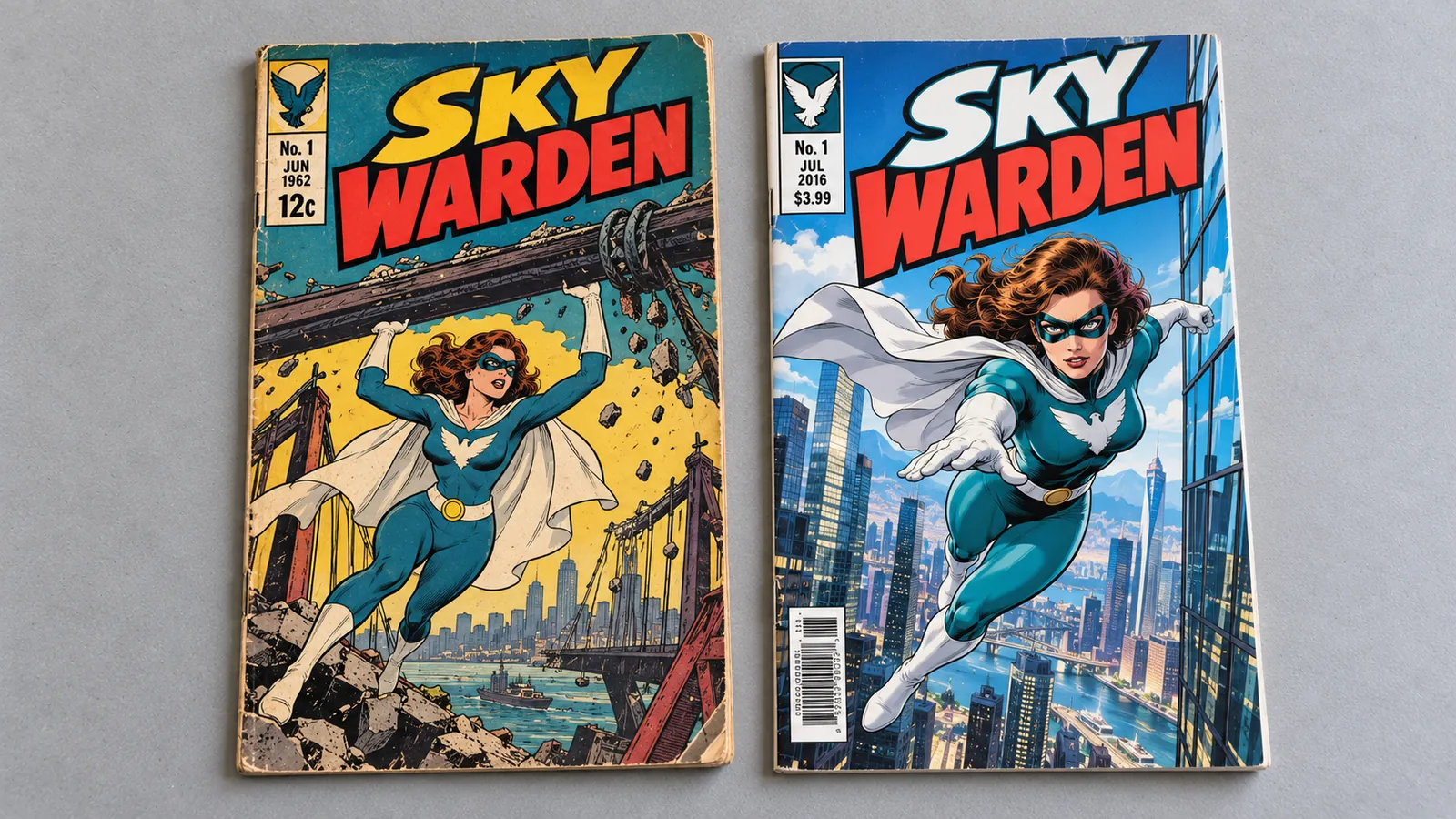
The DC comics most likely to be worth money are first appearances and other documented key issues of major runs, in their original printing and in sound condition. Before you check any value, identify the exact volume. DC has restarted Superman, The Flash, Action Comics and other titles at #1, so the same title and issue number can be two books printed decades apart.
This guide gives no prices. A price only describes a known volume, printing and grade, and those come first.
Identify the volume before the issue number
Identify the volume first, because an issue number alone does not name a book. DC has restarted many titles at #1, some several times, and has brought old numbering back.
A volume is one continuous numbering run of a title. When a publisher restarts a title at #1, a new volume begins, even when the name and the logo stay the same.
Legacy numbering is a title's original issue count, which a publisher can bring back after a relaunch by counting the issues of every volume together.
Action Comics shows both ideas. It kept one count from 1938 until DC restarted it at #1 in 2011, returned to its original count at #957 in 2016, and reached #1000 in 2018. An Action Comics #1 can be from 1938 or from 2011, and the two are different books.
DC's numbering resets, 1959 to 2020
Most DC numbering questions trace back to one of six changes. Find your book's cover date in the table, then check which count it belongs to.
| Cover date | What DC did | What it means for your book |
|---|---|---|
| 1959 | Started a new Flash series at #105, continuing the count of Flash Comics, which ended at #104 in 1949 | The 1959 series has no #1 |
| 1986 to 1987 | After Crisis on Infinite Earths (1985 to 1986), ended the original Superman at #423 (September 1986), renamed it The Adventures of Superman from #424 (January 1987), started a new Superman at #1, and restarted The Flash at #1 | Batman and Detective Comics kept their original numbers |
| 2006 | Gave The Adventures of Superman back its old name at #650 (May 2006) | Two Superman series with different counts overlap from 1987 to 2006 |
| 2011 | Restarted its superhero line at #1 as The New 52, including Action Comics and Detective Comics, which had kept their numbering since the 1930s | A 2011 #1 is a new volume, not a 1930s first issue |
| 2016 | Returned Action Comics to #957 and Detective Comics to #934 under DC Rebirth, and relaunched many other titles at #1 | A number in the high hundreds can be recent |
| 2018 to 2020 | Published Action Comics #1000 (2018) and Detective Comics #1000 (2019), and moved Wonder Woman and The Flash back to legacy numbering with #750 issues in 2020 | Record which variant cover you have |
How to read the volume from the book in your hand
The book itself answers most volume questions. Check it in this order.
- Find the indicia. The indicia is the small block of publishing text, usually on the first page or the inside front cover. Copy the title, issue number and date exactly as printed.
- Compare it with the cover. If the indicia title and the cover logo differ, record both. Then place the cover date in the table above.
- Allow for the cover date. A cover date is usually later than the on-sale date. Batman #232 carries a June 1971 cover date and went on sale in April 1971.
- Check for a barcode. Issue databases list many 1980s and 1990s DC issues as separate variants: a newsstand edition with a barcode and a direct edition for comic shops. Note which one you have.
- Look for a reprint or printing note. Check the cover, the back cover and the indicia for the name of a reprint line or for a second or later printing.
- Confirm the book is complete. Count the pages and check the centerfold, as in the photo-first home grading checklist.
Keep the answers in one record per book:
DC IDENTITY RECORD
Title in the indicia:
Title on the cover logo:
Issue number:              Cover date:
Cover price:               Barcode: Y / N
Volume (year the series began):
Reprint line or printing note:
Pages counted:             Centerfold attached: Y / N
Key status, with two sources:
Four DC runs to check, with their documented keys
These four long DC runs are widely collected and well documented. Each lists its keys by issue and cover year, then the trap it sets.
Batman and Detective Comics
Batman (from 1940) and Detective Comics (from 1937) each kept one count until the 2011 restart. In 2016 Detective Comics returned to its old count at #934 and Batman did not, so always read the cover year next to the number.
| Issue | Cover year | Why it is checked |
|---|---|---|
| Detective Comics #359 | 1967 | First appearance of Barbara Gordon as Batgirl |
| Batman #232 | 1971 | First appearance of Ra's al Ghul |
| Batman #357 | 1983 | First appearance of Jason Todd, who later became Robin |
The trap: DC reissued Batman #232 as a Facsimile Edition in 2019, a new printing that copies the original issue. Check the indicia and the paper before you treat a bright copy as a 1971 book.
Superman and Action Comics
Action Comics follows the table above. Superman is more tangled: the original series became The Adventures of Superman at #424 and took the Superman name back at #650, while a second Superman series ran with its own numbers from 1987 to 2006.
| Issue | Cover year | Why it is checked |
|---|---|---|
| Action Comics #242 | 1958 | First appearance of Brainiac |
| Action Comics #252 | 1959 | First appearance of Supergirl (Kara Zor-El) |
| Superman: The Man of Steel #18 | 1992 | First full appearance of Doomsday |
| Superman #75 (second series) | 1993 | The death of Superman |
The trap: Superman #75 came as a newsstand edition, a direct edition and a polybagged collector's edition, and went back to press. Issue databases list several later printings of The Man of Steel #18 too. Record the edition and the printing; a sealed bag also hides the comic's condition.
The Flash
The Silver Age Flash series started at #105 in 1959 and ran to #350 in 1985. A new series with Wally West as the Flash started at #1 in 1987, and the title returned to its legacy count with #750 in 2020.
| Issue | Cover year | Why it is checked |
|---|---|---|
| Showcase #4 | 1956 | First appearance of Barry Allen as the Flash |
| The Flash #105 | 1959 | First issue of the Silver Age series |
| The Flash #110 | 1959 | First appearance of Wally West as Kid Flash |
| The Flash #123 | 1961 | "Flash of Two Worlds", in which Barry Allen meets Jay Garrick, the Golden Age Flash |
The trap: Barry Allen's first appearance is in Showcase, not in a Flash title, and there is no Silver Age Flash #1 to look for. The Flash #123 also exists as a Facsimile Edition.
The New Teen Titans
The 1980 series ran as The New Teen Titans to #40 and changed its name to Tales of the Teen Titans with #41 (April 1984). In August 1984 DC started a second The New Teen Titans at #1, printed on better paper. Later issues of Tales of the Teen Titans reprinted that series' stories, so two Titans titles ran side by side until 1988.
| Issue | Cover year | Why it is checked |
|---|---|---|
| DC Comics Presents #26 | 1980 | Preview insert that introduced the new team, with the first appearances of Cyborg, Raven and Starfire |
| The New Teen Titans #1 | 1980 | First issue of the 1980 series |
| The New Teen Titans #2 | 1980 | First appearance of Deathstroke |
| Tales of the Teen Titans #44 | 1984 | Dick Grayson first takes the name Nightwing |
The trap: A New Teen Titans #1 can be the 1980 issue, the 1984 issue, or the Millennium Edition reprint of the 1980 issue from 2000. Check the cover date, the indicia and any reprint line's name before you treat a copy as the 1980 original.
Reprints that copy a DC key
DC has reprinted many of its keys in formats that copy the original cover. Rule these out before you compare prices.
| Reprint line | When | What to know |
|---|---|---|
| Famous First Edition | 1974 to 1979 | Oversized tabloid reprints of Golden Age keys, including Action Comics #1, Detective Comics #27, Batman #1 and Superman #1. Most hold a glossy copy of the original cover inside a cardstock outer cover, so a copy without the outer cover still shows the original art. The oversized format gives it away. |
| Millennium Edition | Around 2000 | One-shot reprints of classic issues, such as The New Teen Titans #1 |
| Facsimile Edition | Recent years, including 2026 | New printings of keys such as Batman #232 and The Flash #123 |
DC describes its 2026 Facsimile Editions of The Dark Knight Returns as faithful copies of the 1986 issues, with their original covers, ads and back matter. When a copy looks too fresh for its cover date, compare its size, paper and indicia with the original's.
Why condition decides what a key is worth
Condition decides where a copy sits once its identity is settled, which is why price guides list a key at several grades. On the 10-point scale, the single worst defect sets the ceiling, so one bad area can hold down an otherwise attractive book.
A spine stress tick is a short line across the spine fold where the cover has flexed. When the ink cracks through to the paper, the tick is a color break and shows as a light line against the cover color.
The Green Lantern #59 sample report from NuGrade, an AI-assisted grading app for raw comics, shows this on a 1968 DC book. The cover keeps strong color and good gloss, and it sits flat. But a row of color-breaking stress ticks runs along most of the spine, concentrated at both staples, and the ticks persist across adjacent frames of the spine video. The report grades the book 5.5 FN-, with a plausible range of 5.0 VG/FN to 6.5 FN+, and names the spine as the reason it is not higher.
For context, the published grade descriptions allow a few light stress lines at 6.0 FN and almost none at 9.2 NM-. The report reads "None detected" for restoration, with the note "Photos can miss skilled work.", because competent restoration can be invisible in ordinary light, and its grade is an opinion bounded by the photos and video. It is an example of what photo evidence shows, not proof of how another copy would grade. For the tier names, see what VF, FN and NM actually mean.
What to do with a DC book that checks out
With identity and condition on paper, decide what the book needs.
- Photograph what you recorded. Shoot the indicia with the cover, and take the full capture set from how to photograph comics so the flaws show.
- Compare like with like. Use recent sold listings for the same volume, edition, printing and grade, not asking prices.
- Do the grading math. Run the break-even math for professional grading with your own numbers.
- Choose the route that fits the value. For a high-value key, professional grading and encapsulation are still the right choice. A photo-based report can tell you what the photos show before you ship.
- Share evidence when you sell raw. A NuGrade report has a public link and a short report ID, and a buyer can open it on the report lookup page without an app or an account.
Frequently asked questions
Which DC comics are worth money?
The DC comics most likely to be worth money are first appearances and other documented key issues of major runs, in their original printing and in sound condition. Condition then decides how much any one copy is worth.
How do I tell which volume my DC comic is from?
Read the indicia, the small publishing text usually on the first page or the inside front cover, for the title, issue number and cover date. Then match the cover date to the title's numbering history, because the cover logo can look the same across volumes.
Is the 2011 Action Comics #1 the same book as the 1938 one?
No. DC restarted Action Comics at #1 in 2011 as part of The New 52, so the 2011 issue is a different book from the 1938 original.
Is a Facsimile Edition worth the same as the original issue?
No. A Facsimile Edition is a recent DC reprint that copies the original issue, and it is not the original printing. Check the indicia and look for the reprint line's name before you treat a bright copy as the original.
Should I get my DC key professionally graded?
Run the numbers first: what the book sells for in the grade you expect, against the fees, shipping and wait. For a high-value key, professional grading is still the right route, and a photo-based report can help you decide before you ship.