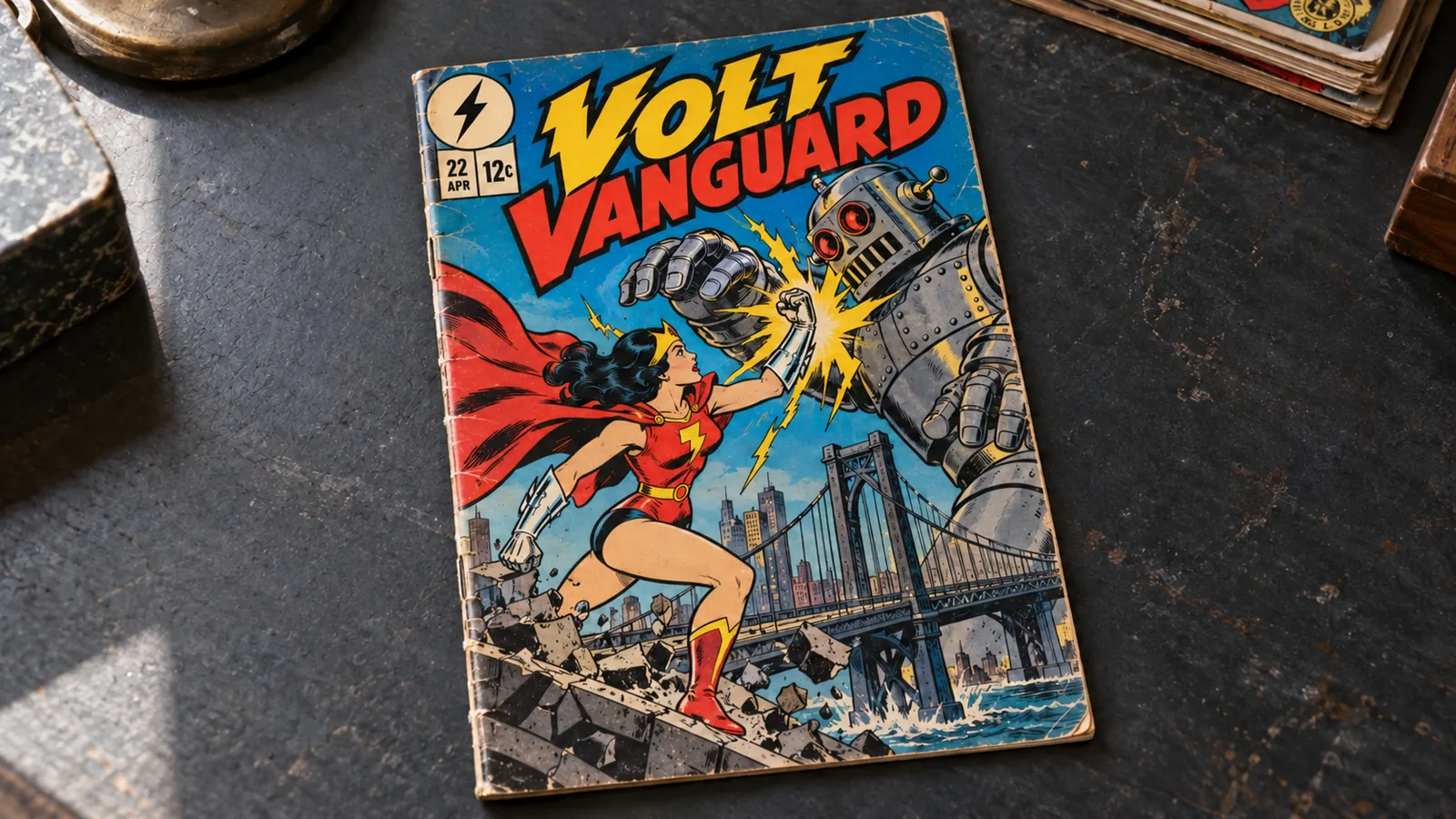
Some Golden Age comics, the American comic books published from 1938 into the 1950s, are worth money, but the title on the cover proves nothing. A copy's value depends on what it is: an original or a reprint, complete or missing pages and coupons, restored or not, and printed on paper that is still supple. Identify and inspect the copy first, and look at prices last.
The most famous Golden Age issues are also the most reprinted, so a famous title is a reason to check harder. And a record sale is one copy, in one condition, sold on one day. It is not a guide to the copy in your hands.
What counts as a Golden Age comic
A Golden Age comic is an American comic book from the era of the first superhero boom, which most collectors date from Action Comics #1, cover-dated June 1938. The end date is a convention, not a fact: some histories close the era around 1951, and some dealers run it to 1955, the year before the Silver Age is usually said to begin. A separate guide covers the keys and the wear to look for on Silver Age comics.
Books of the period were printed on acidic wood-pulp paper, so even a well-kept copy has aged. Early books were often thicker than later ones, too: Action Comics #1 runs to 64 pages plus its covers, against 36 pages, covers included, for a typical 1970s comic.
How to handle a fragile Golden Age comic
Handle an old book as little as possible, keep it flat and supported, and never test the paper by bending it. These steps build on the Library of Congress guidance on caring for comic books.
- Wash and dry your hands, clear a clean, flat table, and keep food and drink away.
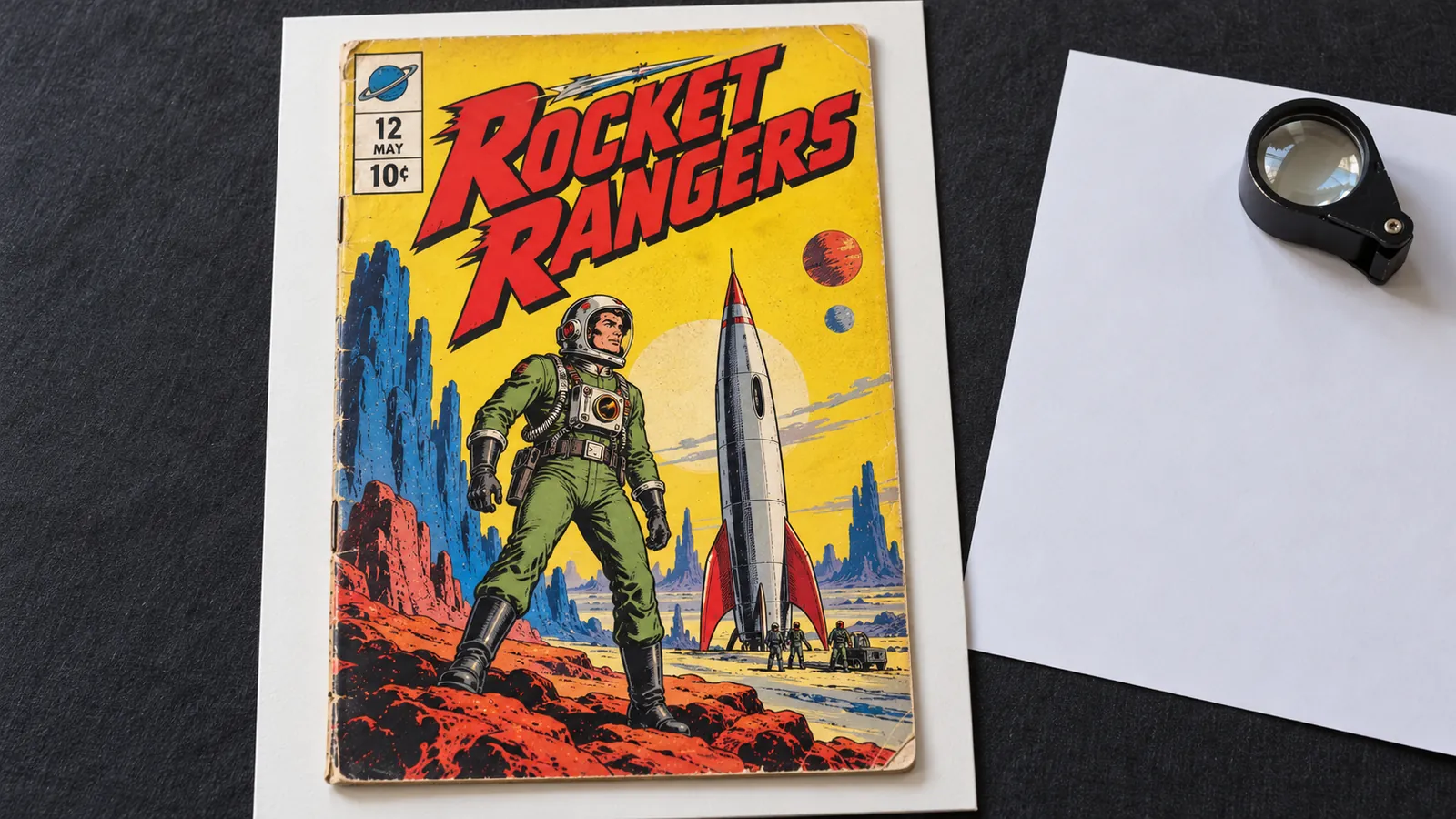
- Move the book flat on a stiff board, never by a corner or the spine.
- Before you turn a page, look at the closed book's edges. Chipped page corners, small splits at the ends of the spine fold, and paper flakes in the bag are signs of brittle paper.
- If you see those signs, or a page cracks as you lift it, stop. Do not flip through a brittle book for any reason, photos included.
- When you open a book with supple pages, support both halves, and never open it past 180 degrees or fold it back on itself.
- Use no tape, glue, rubber bands or paper clips, and do not try to mend a tear or lift old tape. That is work for a paper conservator.
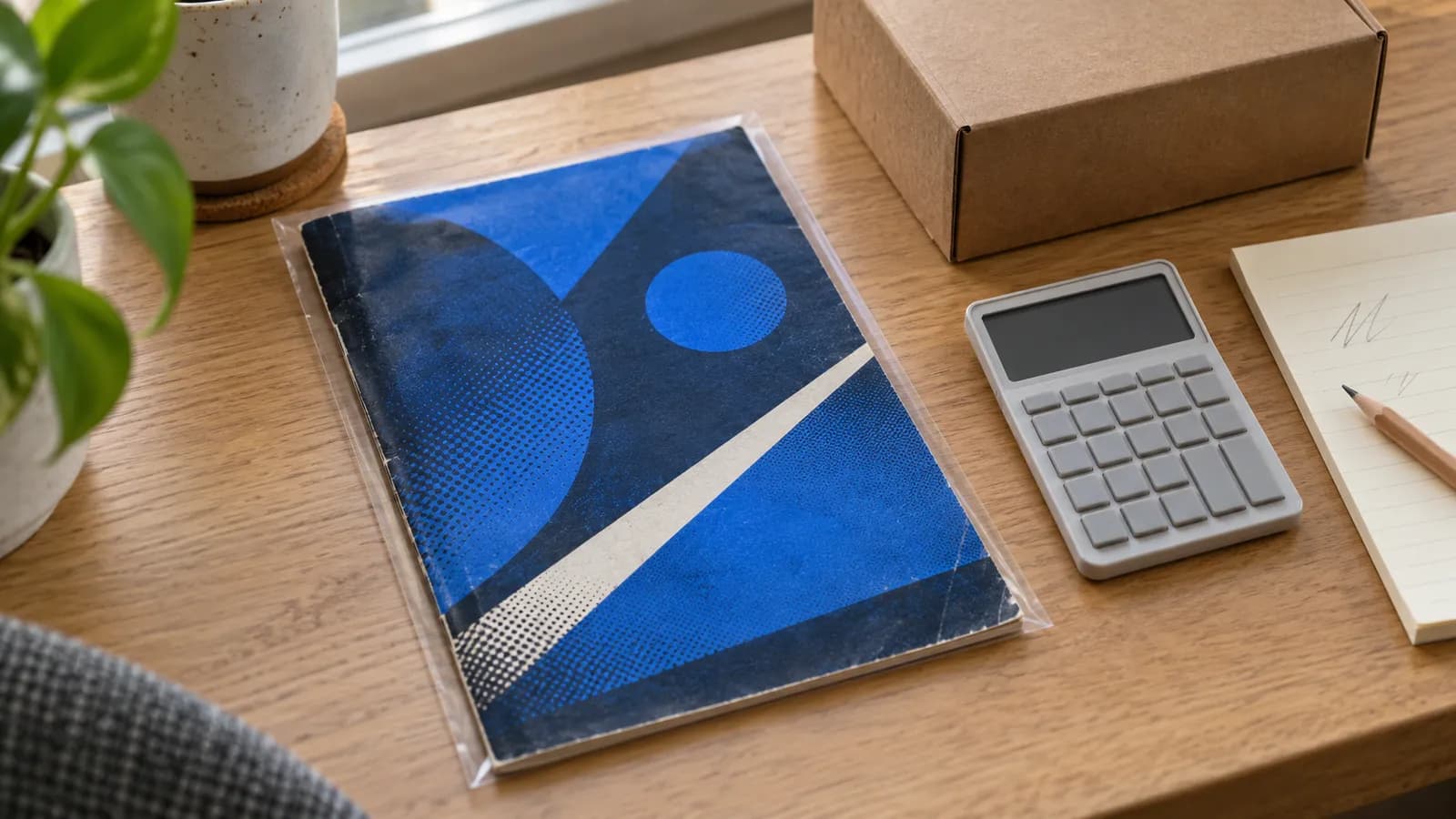
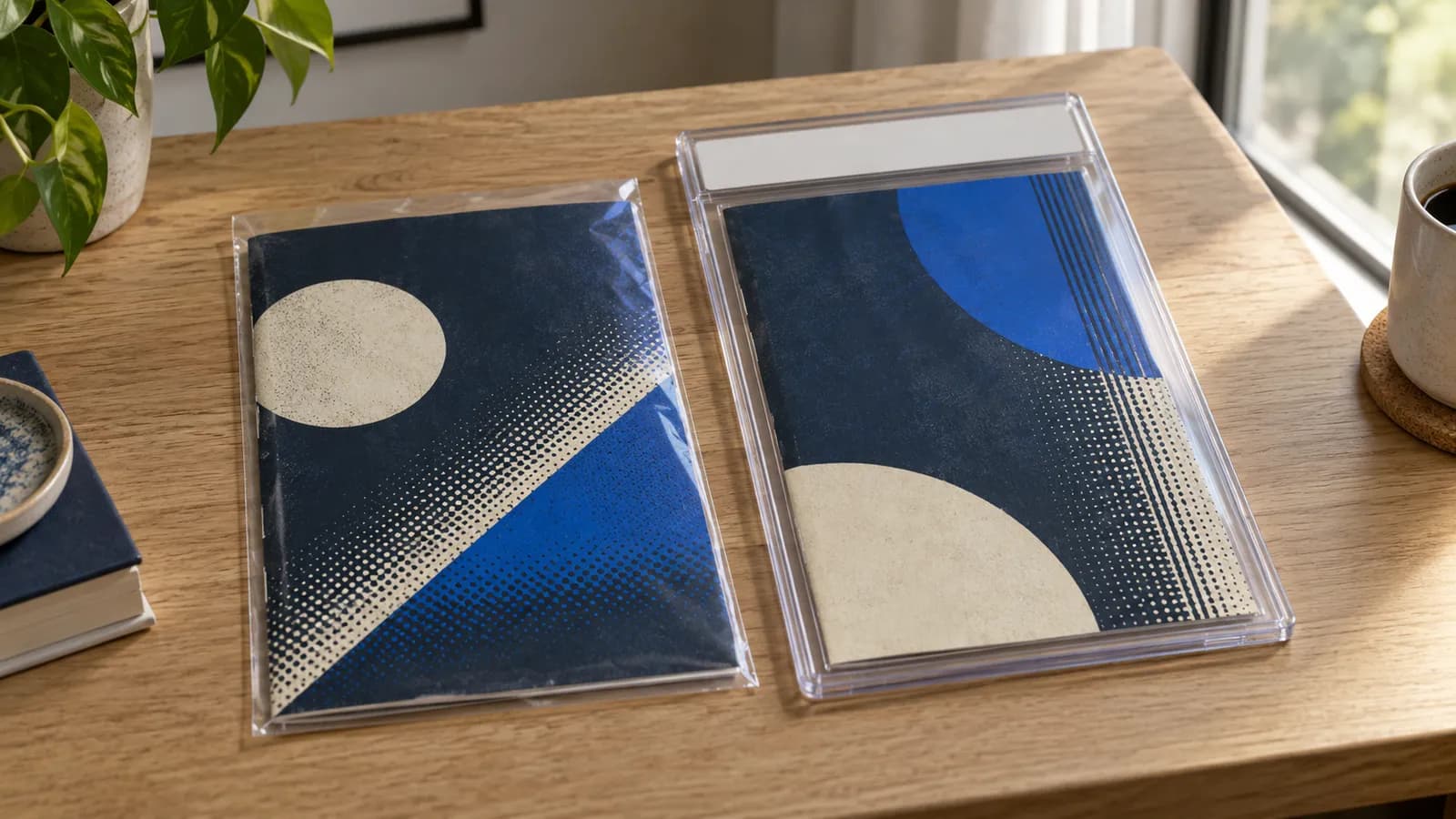
- Store the book in a supportive acid-free, lignin-free enclosure, in a cool room at about 35 percent relative humidity, away from light, vents, attics and basements. Polyester sleeves can build static that lifts crumbs from brittle pages.
Why identification comes before price
Identification comes first because a famous title is not proof of a famous book. The best-known issues have been reprinted again and again, and Action Comics #1 alone has had many reprint and facsimile editions since 1974:
| Edition | Size | What gives it away |
|---|---|---|
| Famous First Edition (DC, 1974) of Action Comics #1, and of Detective Comics #27 | Tabloid, about 10 by 13 1/2 inches | Far larger than the original; the Action Comics #1 edition came with a gold-bordered outer cover that some sellers remove |
| Promotional and anniversary reprints of Action Comics #1 (1976 to 1992) | Comic size, about 16 pages | Only the Superman story; often a sponsor's ad on the back, or "reprint" on the cover or in the indicia |
| Millennium Edition (DC, 2000), including Action Comics #1, Detective Comics #27 and All Star Comics #8 | Modern comic size | A gold foil series logo on the cover |
| Facsimile Edition of Action Comics #1 (DC, 2022) | Modern comic size | On the standard cover, a modern price and barcode instead of the 10-cent price box |
| Superman Day facsimile of Action Comics #1 (DC, 2025) | Full Golden Age size | A modern logo, barcode and price on the cover |
Marvel Comics #1 has a full facsimile too, in a 2019 collector's set from The Folio Society. Even originals vary: most copies of Marvel Comics #1 have the October 1939 date blacked out and a November date added, on the cover and in the indicia, and collectors treat the plain October copies as the scarcer version.
How to tell an original from a reprint
Check with the book flat on the table.
- Read the indicia, the small publishing notice on the first page or the inside front cover. Look for a later copyright year or the word "reprint".
- Measure the book. An original Action Comics #1 is about 7 3/4 by 10 1/2 inches. A book far off its issue's size is almost certainly not an original, but the right size proves nothing, because full-size facsimiles exist.
- Count the pages and compare the count with a catalog listing for that exact issue. A 16-page book cannot be a 64-page original.
- Check both covers for a barcode, a modern price, a series logo or a sponsor's ad.
- Look at the paper. Pages of the era have usually aged to cream or tan, so bright white paper on a claimed original deserves a harder look.
If any check disagrees, have the book examined in hand before you price it.
A few well-documented Golden Age keys
A key is an issue that collectors seek out for a first appearance or another milestone. These five are among the best documented of the era, listed as context, not as a price list.
| Issue | Publisher today | Cover date | Why it is known |
|---|---|---|---|
| Action Comics #1 | DC | June 1938 | First appearance of Superman |
| Detective Comics #27 | DC | May 1939 | First appearance of Batman |
| Marvel Comics #1 | Marvel (then Timely) | October 1939, most copies changed to November | Timely's first comic, with the Human Torch and the Sub-Mariner |
| Captain America Comics #1 | Marvel (then Timely) | March 1941 | First appearance of Captain America |
| All Star Comics #8 | DC | December 1941 to January 1942 | First appearance of Wonder Woman |
Every issue in this table has been reprinted in some form, so treat a copy as a reprint until the checks above prove otherwise.
Record sales of these issues make the news, but a record says little about another copy of the same issue and nothing about the ordinary books of the same years. Those are judged by the same four checks: identity, completeness, restoration and condition.
How to check completeness: pages, coupons and the centerfold
A Golden Age book must be complete before its grade means much: every page, both covers, the centerfold, and any coupon that was printed in it.
Pages. Count against a catalog listing for the exact issue, because page counts varied by title and year. Missing paper costs more than wear: the published grade descriptions expect generally all pages even at 1.0 FR, and a book with large parts gone can be called incomplete.
The centerfold. The centerfold is the innermost sheet, held only by the staples. The descriptions allow it to be loose at 6.0 FN, loose or detached at one staple at 4.0 VG, and missing only at 1.0 FR, if the story still reads.
Coupons. A coupon is a printed form meant to be cut out and mailed, such as a club membership form. A cut coupon is missing paper, and the published descriptions mention cut coupons only at 1.0 FR and 0.5 PR. Check both sides of every leaf for a neat rectangular hole. Grading services handle a missing coupon in different ways, so ask before you submit.
A NuGrade report states completeness only when its page-flip video lets the app count every page, for example "All 36 pages accounted for". Otherwise the report has no completeness line, which is not evidence of missing pages.
Page quality and brittleness on old paper
Page quality is the color and strength of the paper, and on a book this old it can cap the grade by itself. Brittleness is a loss of paper strength: brittle pages crack, chip or split when they flex, whatever their color.
The published page-quality scale rates color and strength separately. Cream to off-white is the most common call for books of the 1930s to the 1950s. Light tan to off-white allows nothing above 8.5, and tan to off-white nothing above 7.5. Strength caps harder. Slightly brittle pages, with small splits at the top or bottom of the spine fold or chipped corners, allow at most 6.5. Brittle pages allow at most 3.5, even when they still look off-white.
One period detail: a few late-1940s books were printed on pink or blue tinted paper, and the scale treats pink as equal to white. A sharp, acidic smell is a clue to aging paper too. NuGrade's survey asks about odor and a brittle or cracking feel, because a camera can detect neither.
Restoration that is common on old books
Restoration includes color touch, piece fill and trimming. An old book has had decades for someone to do this work. The published guidance notes that restored Golden Age books rise in value more than restored Silver Age books.
| Work | What it is | Signs to look for in good light |
|---|---|---|
| Color touch | Paint, ink or pencil added over wear | Flat, smooth color where the print has a fine grain, often over a crease or a worn corner |
| Piece fill | New or donor paper in place of missing paper | A change in tone or texture, with an edge that follows the damage, not the artwork |
| Married cover or pages | Parts from another copy of the same issue | Cover wear or tone that does not match the interior, or staple holes that do not line up |
| Trimming | Edges cut to remove wear | Razor-sharp, square edges on a worn book, or a cover flush with the pages |
| Tear seals and reinforcement | Repairs that hold weak paper together | Thin added paper or adhesive behind a tear or along the spine |
A grader that finds this kind of work grades the book as restored, rated for the quality and the amount of the work. On the published restoration scale, a married cover or married pages count toward restoration when other work is also present. Some structural repairs, such as tear seals done to a high standard, can earn a separate conserved designation instead. A restored book usually sells for less than an unrestored copy that looks the same.
Finding nothing is not proof. Competent work can be invisible in ordinary light, which is why a NuGrade report reads "Unverified" when photos cannot settle restoration, and why a clean check, as on the E-Man #1 sample, reads "None detected" with the note "Photos can miss skilled work." If you inherited the book and do not know its history, say so.
When to get a professional in-hand grade
If the book might be a key, or might be valuable for any other reason, have a professional grading service examine it in hand before you price or sell it. An in-hand grader can inspect the paper, screen for restoration and trimming that photos miss, and seal the result in a tamper-evident holder.
The current comparison of grading services lists which services take comics and what they charge, and the break-even math for grading shows whether grading pays for a given book. Ask the service how it handles fragile paper before you ship.
NuGrade, an AI-assisted grading app for raw comics, fits a different job: a dated, cited condition record of a book with supple pages, made without shipping it. It does not replace in-hand grading, it cannot verify competent restoration, and odor and brittleness come only from your answers. For a brittle book, skip any capture that turns pages and go straight to an in-hand grader.
Frequently asked questions
Are all Golden Age comics worth money?
No. A Golden Age comic's value depends on which issue it is, whether it is an original, whether it is complete and unrestored, and how sound its paper is. A reprint of a famous issue is a different book from the original.
How can you tell if a Golden Age comic is a reprint?
Read the indicia, measure the book, count the pages against a catalog listing, and look for a barcode, a modern price, a series logo or a sponsor's ad. Size alone is not proof, because full-size facsimiles of famous issues exist.
Does a cut coupon lower a comic's grade?
Yes. A cut coupon is missing paper, and the published grade descriptions mention cut coupons only at 1.0 FR and 0.5 PR. Grading services handle a missing coupon in different ways, so check before you submit.
Is it safe to flip through a brittle comic?
No. If pages crack, chip or flake as you lift them, stop, keep the book flat on a board, and let a professional examine it in hand.
Should you get a Golden Age comic professionally graded?
If it might be a key or might be valuable, yes, because an in-hand grader can screen for restoration, trimming and paper problems that photos cannot settle. For an ordinary copy, compare the cost of grading with what the book could sell for first.