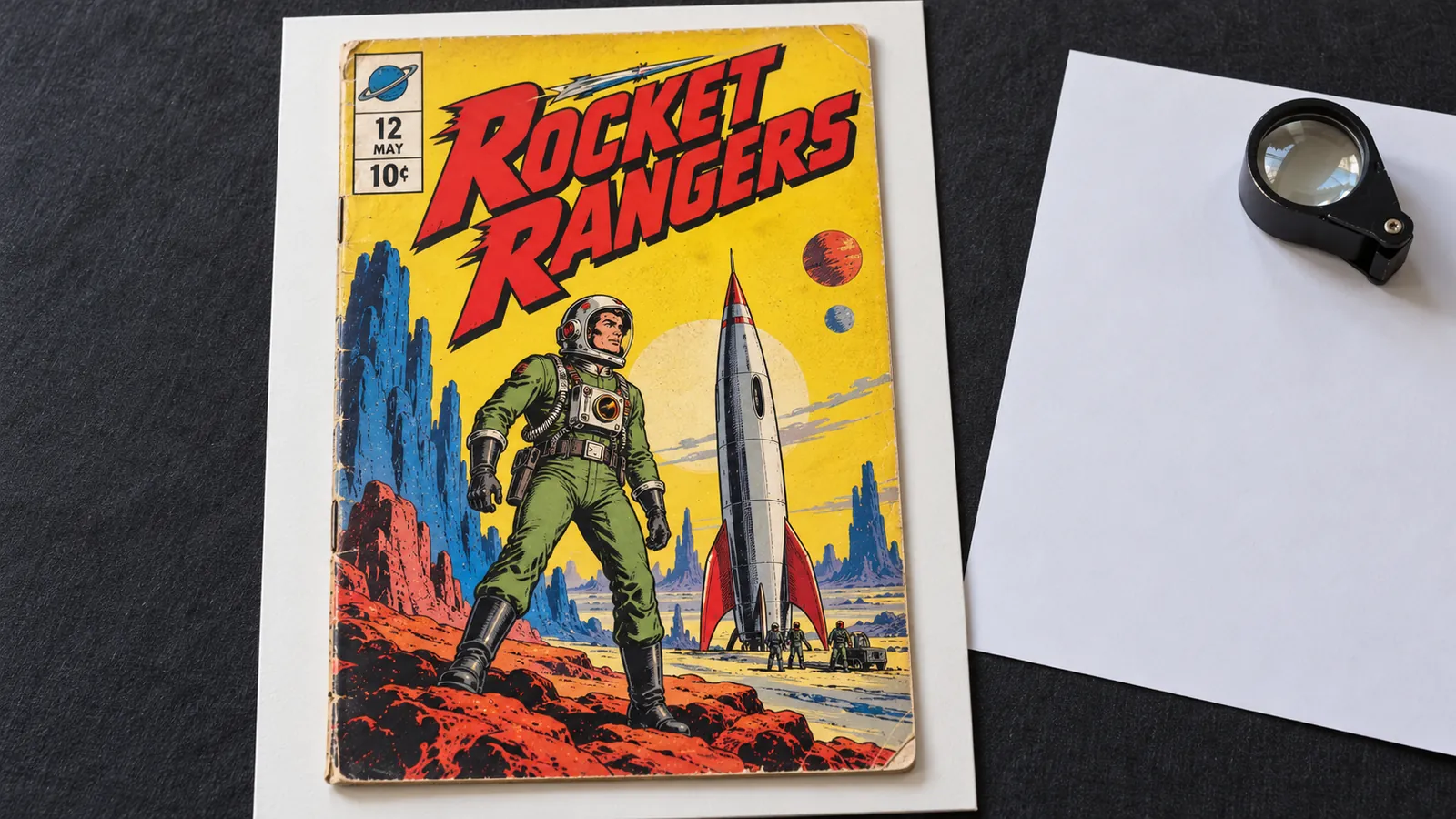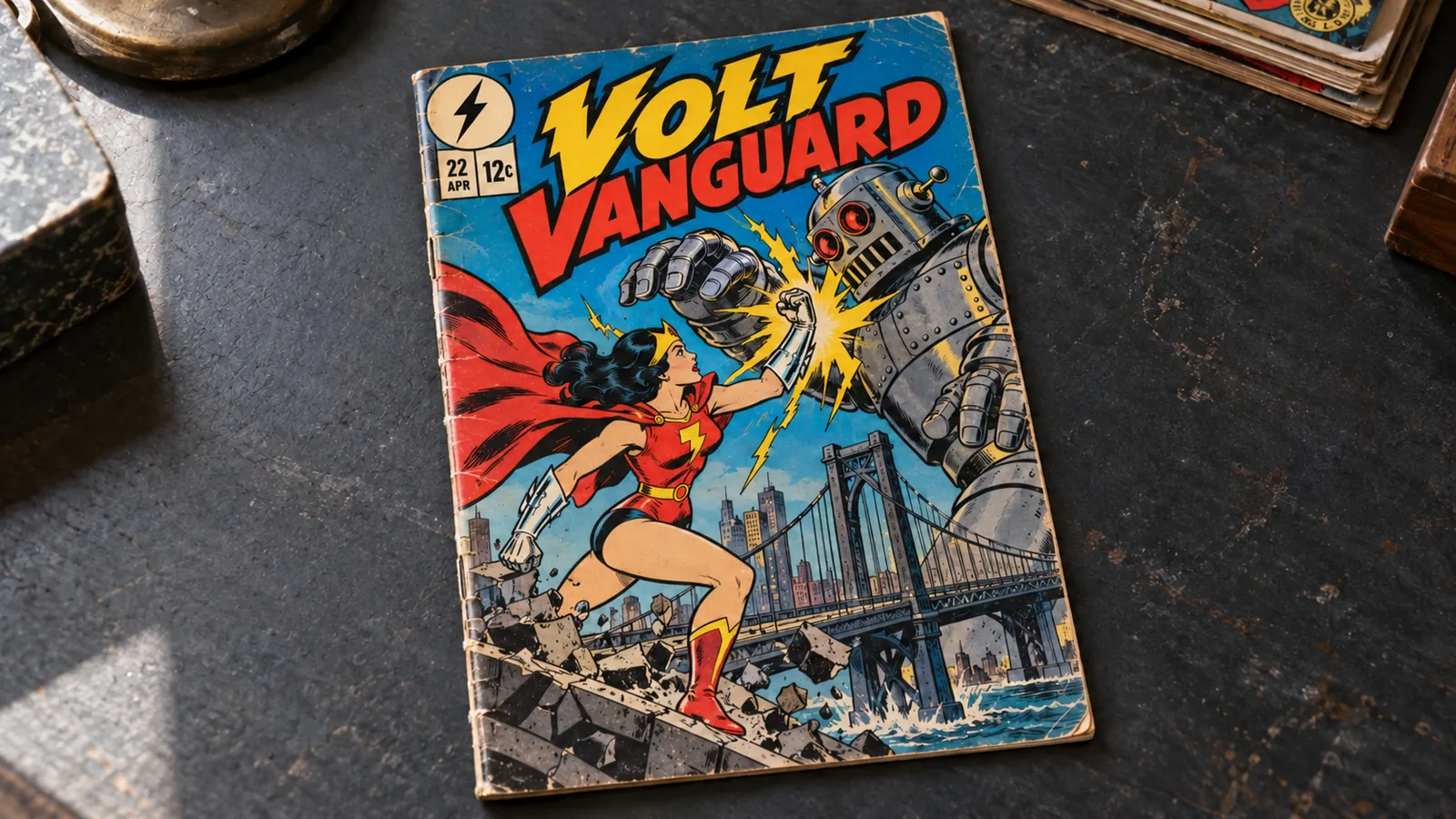
The Silver Age comics most likely to be worth money are the keys: first appearances and first issues from 1956 to about 1970, such as Showcase #4, Fantastic Four #1 and Amazing Fantasy #15. The issue makes a book a key, but your copy's condition sets its grade, and books of that age show wear that can cost several grades: spine stress, rusty staples, tanned pages and old folds.
This guide gives no prices, because they move with grade and market; the math on whether grading pays needs your own numbers.
What counts as a Silver Age comic
A Silver Age comic is an American comic book from the period that collectors conventionally date from 1956 to about 1970. The start is tied to DC's Showcase #4 (1956), which introduced a new Flash; the end date varies by source, often 1969 or 1970. The dates are a collectors' convention, so your copy will not say "Silver Age" anywhere.
Read the indicia instead: the small print on the first page or inside the front cover gives the publisher and the cover date. Catalogs and price guides list issues by cover date, which usually ran a few months ahead of the on-sale date. For the era before this one, see how to identify a Golden Age comic before you price it.
Which Silver Age comics are worth money: the keys
The Silver Age comics most often worth money are key issues. A key issue is an issue that collectors seek for a milestone such as a first appearance, an origin or a first issue. The eleven below are among the most widely documented; each issue number, cover-date year and first appearance was checked against a comics catalog and a general encyclopedia.
| Issue | Publisher | Cover-date year | First appearance |
|---|---|---|---|
| Showcase #4 | DC | 1956 | Barry Allen as the Flash (the usual start of the Silver Age) |
| Showcase #22 | DC | 1959 | Hal Jordan as Green Lantern |
| The Brave and the Bold #28 | DC | 1960 | The Justice League of America |
| Fantastic Four #1 | Marvel | 1961 | The Fantastic Four |
| The Incredible Hulk #1 | Marvel | 1962 | The Hulk |
| Amazing Fantasy #15 | Marvel | 1962 | Spider-Man |
| Tales of Suspense #39 | Marvel | 1963 | Iron Man |
| Strange Tales #110 | Marvel | 1963 | Doctor Strange |
| The X-Men #1 | Marvel | 1963 | The X-Men |
| The Avengers #1 | Marvel | 1963 | The Avengers |
| Fantastic Four #52 | Marvel | 1966 | Black Panther |
The list is a starting point; other first appearances, origins and first issues of the period count as keys too. Ordinary issues of the period are relatively easy to find, which is why the published restoration guidance advises against restoring Silver Age books other than keys.
Is your copy an original, a reprint or a pence copy?
Confirm it before you grade anything, because famous Silver Age keys have been reprinted and some originals exist in a British price variant. Both can look right at a glance.
Reprints and facsimile editions
A facsimile edition is a modern reprint that reproduces an old issue as it first appeared, often with its original ads. Marvel published an Amazing Fantasy #15 Facsimile Edition in 2019, and DC published The Brave and the Bold #28 Facsimile Edition in 2020; earlier reprints of famous keys exist too.
Because a facsimile copies the original cover closely, the cover alone does not prove a book is an original. Compare the indicia and the cover details with a catalog listing of the original issue, which also lists its known reprints.
British pence copies
Some 1960s Marvel comics were printed in the US with a British pence price instead of a cents price. These are period copies that buyers treat as separate price variants. The 1960s DC imports usually have a British price stamp on a cover with a printed cents price. A stamp does not make the copy a separate printing. Check the printed price and any stamp before you compare sales. Describe both when you list the book.
The wear to look for on a 1960s comic
On a 1960s comic, look hardest at the spine, the staples, the page color, any fold down the middle and, on Marvel books, the top-left corner and the trimmed edges. The table gives each one's place and its effect in the published grade descriptions.
| Wear | Where to look | Effect in the published descriptions |
|---|---|---|
| Spine stress and color breaks | The spine fold, above and below each staple | Almost no stress lines at 9.4 NM; a minor spine color break at 8.0 VF; a severe one at 6.0 FN |
| Staple rust | Both staples, outside and at the centerfold | No rust at 9.8 NM/MT and up; slight rust migration at 7.0 FN/VF; rusted staples at 3.0 GD/VG |
| Staple tears | The cover paper at each staple | Only the slightest at 9.0 VF/NM; minor at 6.0 FN; moderate at 2.0 GD |
| Tanned or brittle pages | Page edges and page centers | Light tan to off-white caps the book at 8.5; slightly brittle pages cap it at 6.5 |
| Subscription fold | A straight line down the middle, top to bottom | With color break, a book-length crease, first described at 3.0 GD/VG |
| Clipped corner box | The top-left corner of a 1960s Marvel cover | Named in the 2.0 GD description |
Spine stress and color breaks
A spine stress tick is a short line across the spine fold where the cover flexed; when it breaks the color, it shows white where the ink cracked to the paper. Set a lamp low to one side and look hardest above and below each staple, where stress lines tend to sit. On a light spine a break can hide, so move the lamp until the line catches the light; the home grading checklist has the full routine.
Rusty staples and rust migration
Rust migration is rust from a staple that has stained the paper around it. Check both staples outside the cover, then open the book at the centerfold, support both halves, and check them from inside. Do not clean or replace a rusty staple yourself: the published restoration scale counts that as a conservation repair, which is work to disclose.
Tears at the staples
A staple tear is a small tear in the cover paper where a staple passes through it. With the book open at the centerfold, check the paper at each staple for slits and confirm that the centerfold is held at both staples. A centerfold detached at one staple appears in the 4.0 VG description.
Tanned pages and page quality
Page quality is the color and suppleness of the interior paper. The published page-quality descriptions note that many Silver Age books have cream to off-white pages, and that early Silver Age DC books show evenly cream pages more often than others of their time.
Judge the color at the edges and in the middle of the page, because the designations describe both. Tan to off-white pages cap a book at 7.5, and brittle pages cap it at 3.5 whatever their color. Look for brittleness instead of testing for it: small splits at the ends of the page fold and chipped page corners are the signs.
Subscription folds
A subscription fold is a book-length line down the middle of a comic that was folded in half lengthwise to be mailed to a subscriber. Under low side light it runs straight from top to bottom, near the center of the back cover.
If the fold has broken the color, it counts as a crease, and the published descriptions first allow a book-length crease at 3.0 GD/VG. A fold with no color break is milder, and a professional press can sometimes relax it; see what pressing can and cannot fix.
Two checks for 1960s Marvel books
A clipped corner box. On some 1960s Marvel books, someone cut the small price box out of the top-left corner of the front cover. The published descriptions name this case: such a copy can still grade 2.0 GD if it would otherwise grade higher, so one cut can hold the book at that tier.
Marvel chipping. Marvel chipping is a row of small chips and tears along the trimmed top, bottom or right edge of a cover, usually blamed on a dull trimmer blade at the bindery and named for the Marvel books where collectors often report it. It is a production flaw, not handling damage, but it still counts: the published descriptions allow only subtle bindery and printing flaws at 9.4 NM, and more as the grade falls.
A condition example: Green Lantern #59 from 1968
NuGrade, an AI-assisted grading app for raw comics, publishes a sample report for Green Lantern #59 (DC, 1968) that shows several of these checks on one late Silver Age book. It was graded on September 30, 2026 from phone photos and two short videos. The findings below are quoted from the report; the layout is a condition record.
CONDITION RECORD
Book:      Green Lantern #59 (DC, 1968)
Pages:     All 36 pages accounted for

VISIBLE FINDINGS (worst first)
Spine      LIMITING. Multiple short color-breaking
           stress ticks along the spine edge, concentrated
           at both staple positions and persistent across
           adjacent frames.
Spine      Stress ticks and light spine wear at the lower
           staple and toward the bottom of the spine.
Corners    Bottom-left corner tip blunted, with small
           color flecks exposing paper along the bottom
           edge.
Corners    Top-left corner slightly blunted, with light
           edge wear along the top edge.
Corners    Faint white wear flecks at the bottom edge
           near the bottom-right corner.
Edges      Small nicks and edge wear along the spine-side
           edge of the back cover.
Edges      A small nick on the right edge of the back
           cover.
Cover      Light surface abrasion and faint shelf wear in
           the green field near the bottom-left, with no
           crease through the image area.
Production The cover edge sits slightly proud of the page
           block at the top-right, consistent with a mild
           bindery overhang.
Staples    Clean.
Pages      Cream to Off-White.

OWNER SURVEY   Nothing disclosed.
RESTORATION    None detected. Photos can miss skilled work.

RESULT
Grade 5.5 FN-, range 5.0 VG/FN to 6.5 FN+
Why not higher: a row of color-breaking stress ticks
runs along most of the spine length, concentrated at
both staples, and limits the book to 5.5 (FN-).
Nine findings produced one grade. The corners and edges show wear of their own, but the color-breaking ticks at both staples set the limit, and the report names them as the reason the grade is not higher. Restoration reads "None detected", with the note "Photos can miss skilled work.", because photos in ordinary light can hide good restoration. Treat the example as a demonstration of what photo evidence can show, not as proof that a photo grade matches an in-hand one.
When a Silver Age book needs professional grading
For a key, or any book whose value justifies the fee, professional third-party grading is the right route: an in-hand grader can check for restoration that photos miss, and the book is sealed in a holder with its grade. See the current comparison of comic grading services, and run the break-even math first.
A photo-based report fits the steps before that: choosing which books to send, describing a raw book for sale, or recording condition. NuGrade turns seven photos and two short videos into a grade on the 10-point scale with a plausible range and findings that each cite their photo or frame. A short survey covers what the camera cannot see, such as odor, brittleness and pressing. The book stays with you, and buyers can open the report at the NuGrade lookup page with its ID or QR code, with no app or account.
The grade is an opinion limited to the evidence in the photos and video. It does not replace professional grading, and defects too small for the photos to show can still exist.
Frequently asked questions
What years does the Silver Age of comics cover?
Collectors conventionally date the Silver Age from 1956, the year of DC's Showcase #4, to about 1970. Sources differ on the end point, usually giving 1969 or 1970.
Which Silver Age comics are worth money?
The keys are the Silver Age comics most likely to be worth money: first appearances and first issues such as Showcase #4 (1956), Fantastic Four #1 (1961) and Amazing Fantasy #15 (1962). The grade of a given copy then decides where its value falls.
How can you tell if a Silver Age key is a reprint?
Compare the indicia and cover with a catalog listing of the original issue, which also lists known reprints. Facsimile editions copy the original closely; Marvel issued one of Amazing Fantasy #15 in 2019, and DC one of The Brave and the Bold #28 in 2020.
What is a pence copy of a Silver Age comic?
A printed pence variant is a US-printed comic with a British pence price in place of the cents price. Some 1960s Marvel comics have these variants. They are period copies, not reprints. The 1960s DC imports usually have a British price stamp on a cover with a printed cents price. A stamp does not identify a separate printing.
Do rusty staples lower a comic's grade?
Yes. The published grade descriptions require rust-free original staples at 9.8 NM/MT and above, and describe rusted or replaced staples at 3.0 GD/VG. Cleaning or replacing a staple counts as a conservation repair, so disclose any such work.