Comic book page quality grading rates a comic's interior paper with two separate calls. The color call places the page edges and middle on a ladder from White through Off-White, Cream and Tan to Brown. The structure call says whether the paper is supple, slightly brittle or brittle. Either can cap the grade: Tan to Off-White pages top out at 7.5 VF-, and brittle pages at 3.5 VG-.
Judge color against a known white. Judge strength by damage that has already happened, never by bending a page to see whether it cracks.
What page quality means on a comic
Page quality is a grader's description of a comic's interior paper: how far it has darkened, and whether it still bends without cracking. It covers the inside pages only. The cover is judged with the cover defects, and spots such as foxing, water stains and rust marks count as defects of their own, not as page color.
Professional graders record page quality as its own call, apart from the number on the 10-point grading scale. For the number itself, see what VF, FN and NM actually mean.
The two calls compare like this:
| Color call | Structure call | |
|---|---|---|
| The question | How far has the paper darkened? | Does it still bend without cracking? |
| The words | White to Brown, with steps between | Supple, slightly brittle, brittle |
| Where to look | Page edges, then the middle | Page corners, outer edges, ends of the spine fold |
| The evidence | Eyes or a photo, against a known white | Visible chips, flakes and splits; how the paper feels |
| Ceilings | Light Tan to Off-White 8.5, Tan to Off-White 7.5 | Slightly brittle 6.5, brittle 3.5 |
Color and strength often decline together as paper ages, but neither proves the other. The published page quality scale describes Dark Tan and Brown pages that show no brittleness, and white or off-white pages with a brittle patch along the spine.
The page quality ladder, from white to brown
The ladder runs from White, paper that looks almost as it did when printed, down through Off-White, Cream, Light Tan, Tan and Dark Tan to Brown. Most names also tell you where the aging sits.
In a two-part page quality name, the first color describes the page edges and the second describes the middle of the page. Light Tan to Off-White means light tan edges around an off-white middle. Cream, Light Tan, Tan, Dark Tan and Brown on their own mean one even tone from the edges to the middle. The table follows the published page quality scale.
| Page quality call | Edges | Middle |
|---|---|---|
| White | As printed, or nearly | As printed, or nearly |
| Off-White to White | Very slight aging | White |
| Off-White | Light aging | White or very lightly aged |
| Cream to Off-White | Aged to cream | White or off-white |
| Cream | Cream | Cream |
| Light Tan to Off-White | Light tan, well past cream | Off-white |
| Light Tan to Cream | Light tan | Cream |
| Light Tan | Light tan | Light tan |
| Tan to Off-White | Tan | Off-white |
| Tan to Cream | Tan | Cream |
| Tan | Tan | Tan |
| Dark Tan to Off-White | Very dark | Off-white |
| Dark Tan | Very dark | Very dark |
| Brown to Off-White | Extremely dark | Off-white |
| Brown to Tan | Extremely dark | Tan |
| Brown | Extremely dark | Extremely dark |
| Brown / Brittle | Extremely dark, with early chips or edge tears | Extremely dark |
The edges usually age first. The Library of Congress explains in its overview of paper deterioration that paper absorbs acid-forming pollutants from the air, which is why old pages are often browner and more brittle at the edges than in the middle.
The published scale also notes what is typical by era: White on most comics printed after 1990, when pulp paper went out of use; Off-White to White on many books from the mid-1970s to the late 1980s; and Cream to Off-White most often on books from the 1930s to the 1950s and on many Silver Age books.
How page quality caps a comic's grade
Page quality works as a ceiling. A page call can stop a book at a set grade however clean the cover is, and when another defect already holds the book lower, the lower ceiling decides.
| Page call | Highest grade on the published scale |
|---|---|
| White | 10.0 GM, the only call allowed at 10.0 |
| Off-White to White | 9.9 MT |
| Off-White | 9.8 NM/MT |
| Cream to Off-White, Cream | Below 9.8, apart from rare exceptions |
| Light Tan to Off-White | 8.5 VF+ |
| Tan to Off-White | 7.5 VF- |
| Slightly brittle, any color | 6.5 FN+ |
| Brittle, any color | 3.5 VG- |
The published scale prints no ceiling for the other light tan, tan, dark tan and brown calls. The grading method of NuGrade, an AI-assisted grading app for raw comics, holds the other light tan calls to 8.5 and the tan and dark tan calls to 7.5.
An example with illustrative numbers: a copy whose cover and corners would support 9.0 VF/NM, but whose pages are Tan to Off-White, grades no higher than 7.5 VF-. With slightly brittle pages, the same copy stops at 6.5 FN+. If its spine ticks already hold it to 6.0 FN, neither page call changes the grade.
Why phone photos change page color
Phone cameras change colors on purpose. White balance is the camera's correction for the color of the light, so that white things look white. Auto white balance makes that correction from whatever is in the frame, and old paper can fool it:
- A frame full of aged paper. The camera can read cream pages as warm light and correct them toward white.
- Warm bulbs. If the camera leaves some of a warm lamp's cast, white pages can look cream.
- Mixed light. A window on one side and a lamp on the other give one page two colors.
- One correction per shot. Two photos of the same page, or of two books, can disagree.
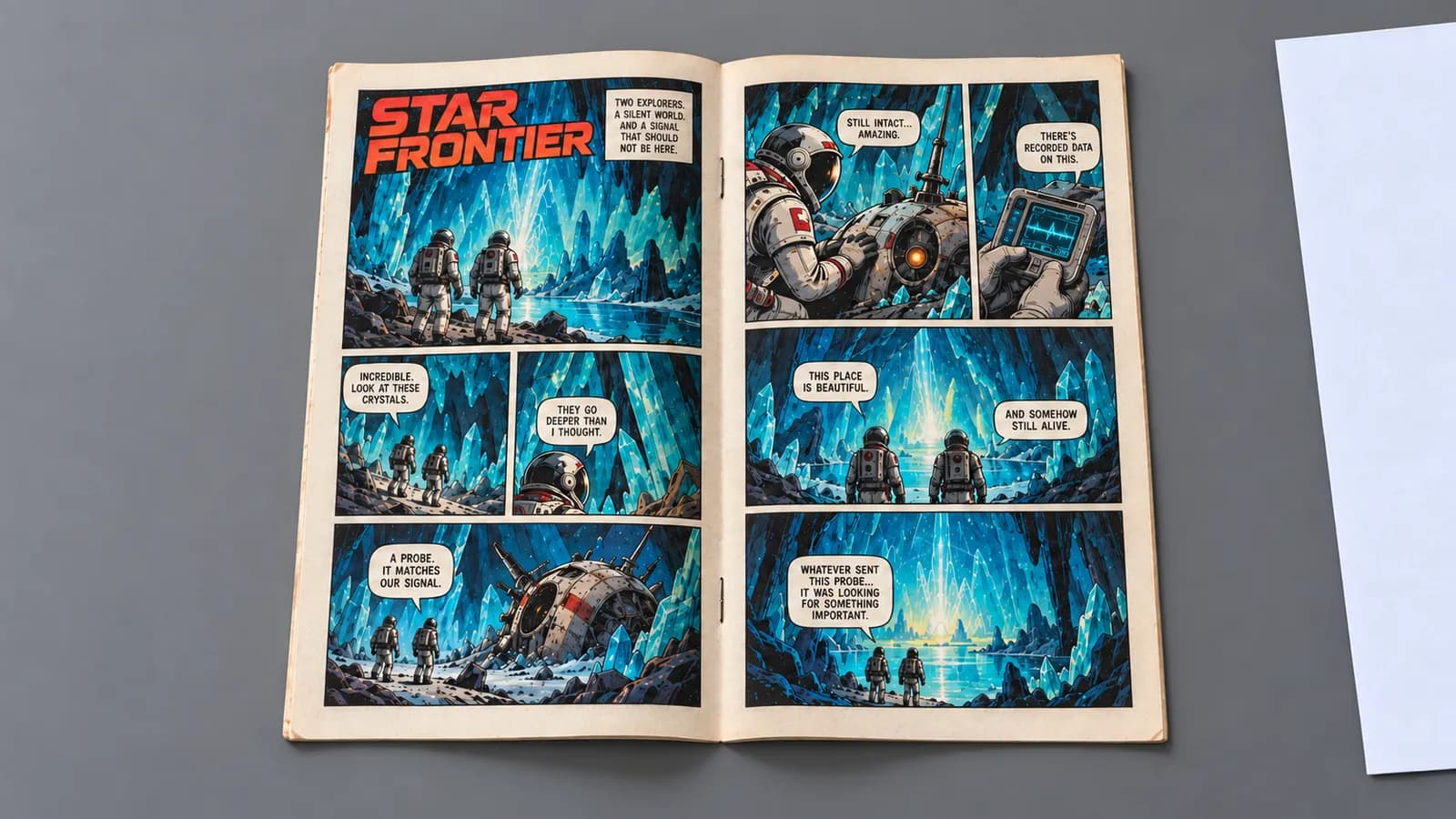
The fix is a known white in the same frame. A sheet of white printer paper beside the page gets the same correction as the page, so you judge the page against the sheet, not against your memory of white. If the sheet looks cream, the whole photo runs warm.
NuGrade's method follows the same logic. Without a known white in the frame, the highest page color it will call from photos is Off-White to White, because camera color alone cannot prove White. When a white sheet or index card appears in the page-flip frames, the method uses it as the anchor for the call.
How to check page color at home
Compare the paper with a known white under one steady light, at three places in the book, edges first and then the middle. Nothing has to bend further than a normal page turn.
- Set one light. Use indirect window light or a single lamp, with other lights and the flash off, and keep that setup for every book you compare.
- Place the reference. Lay a clean sheet of plain white printer paper beside the open book, not on the page. Use the same sheet, or the same pack, each time.
- Open gently. With clean, dry hands, open to a spread near the front and support the spine. Do not press the book flat or open it past 180 degrees.
- Read the edges. Compare the top, bottom and outer page edges with the sheet.
- Read the middle. Compare unprinted paper near the middle of the page, such as the gaps between panels, with the sheet. Ink hides the paper's own tone.
- Repeat twice. Check the centerfold spread and one near the back, and note any page that differs. At the centerfold you can also check whether the centerfold is attached.
- Write the call. Name the edges first and the middle second, photograph each spread with the sheet in frame, and keep the originals unedited.
Record each book like this:
PAGE QUALITY NOTE
Book:
Light:                 window / one lamp
White sheet in frame:  Y / N
Front spread    edges:            middle:
Centerfold      edges:            middle:
Back spread     edges:            middle:
Color call (edges to middle):
Brittleness signs:     none seen / crumbs in bag /
                       chipped corners / splits at fold
Odor:                  none / acidic / musty / not known
For the full capture set, the lighting and the page-flip video, see how to photograph a comic for grading.
How to spot brittle pages without bending them
Look for damage that has already happened instead of causing new damage. Brittleness is a loss of strength in the paper: brittle paper cracks, chips or splits where supple paper would bend. Those signs show by eye, with the book flat.
- Crumbs in the bag. Loose flakes of page paper in the bag or sleeve. The Library of Congress warns that static in polyester sleeves can lift crumbs from brittle comics.
- Chipped corners and edges. Small pieces missing from interior page corners or edges. The published scale counts minor corner chipping as slightly brittle, though a bindery chip made when the book was trimmed is a printing defect instead.
- Splits at the fold. Short splits at the top or bottom of the interior pages' spine fold, easiest to see at the centerfold. Slight splits mean slightly brittle; heavy, multiple splits mean brittle.
- Cracks as a page turns. If an edge cracks or flakes as you turn a page, stop.
Never fold a corner or flex a page to test the paper. On brittle paper, the test makes the split or the missing corner you were looking for, and a missing corner is a defect of its own.
If you see the signs, handle the book as little as possible. As of October 2026, the Library of Congress guide to caring for comic books recommends storage at room temperature or below, about 35 percent relative humidity, little light, and no attics or basements. A paper conservator can neutralize acid in fragile paper, and the Library notes that such treatment works best while the paper still has significant strength.
Three sample reports, one page quality call
Three public NuGrade sample reports, all graded on September 30, 2026, carry the same call, Cream to Off-White, on books from three publishers printed between 1968 and 1976. They show what photo evidence can support, not proof of accuracy.
| Book | Published | Grade | Why not higher |
|---|---|---|---|
| Green Lantern #59 | DC, March 1968 | 5.5 FN- | Color-breaking stress ticks along the spine, concentrated at both staples |
| E-Man #1 | Charlton, October 1973 | 9.2 NM- | A slight miswrap with a narrow unprinted strip along the front spine edge, and a small dark mark at the left edge of the back cover |
| Marvel Presents: Guardians of the Galaxy #4 | Marvel, April 1976 | 7.5 VF- | Small stress ticks along the spine, several showing white color break against the black cover |
Three things stand out. First, era sets what is common, not what a copy has: the published scale says many books from the mid-1970s to the late 1980s have Off-White to White pages, yet the 1976 book got the same call as the 1968 one.
Second, the page call limited none of these grades. E-Man #1 reached 9.2 NM- with Cream to Off-White pages, while spine ticks and production findings set the grades.
Third, each report lists page color and page structure as separate areas, both clean, and the Guardians #4 report describes "supple cream to off-white pages." Odor and a brittle feel come from the owner's survey answers, because no photo shows them.
Anyone can open these reports, or any NuGrade report by its ID, at the report lookup with no app or account. A NuGrade grade is an opinion limited to the evidence in the photos and video. It does not replace professional grading, which is still the right route for a high-value book.
Frequently asked questions
What is the best page quality for a comic book?
White is the top of the ladder and the only page call allowed on a 10.0 GM book. Most comics printed after 1990 have White pages, while older books usually carry Off-White or a darker call.
Is cream to off-white good page quality?
It is a normal call for many Silver Age and older books, and the published page quality scale sets no ceiling for it below 9.8. All three NuGrade sample reports carry it, including E-Man #1 at 9.2 NM-.
Can white pages be brittle?
Yes. Brittleness is a loss of strength, not a color, and the published page quality scale notes that pages can look white or off-white yet split heavily along the spine. Look for chips, flakes and splits instead of judging strength by color.
Can yellowed comic pages be made white again?
Treatments exist, but the published restoration scale counts interior lightening as restoration, so a lightened book is graded as restored. De-acidification, which the same scale lists as conservation, neutralizes acid to slow further aging.
Why do my photos make comic pages look whiter than they are?
Your phone's auto white balance corrects for the color of the light, and a frame full of cream paper can be corrected toward white. Put a sheet of white printer paper in the same frame and judge the page against the sheet.