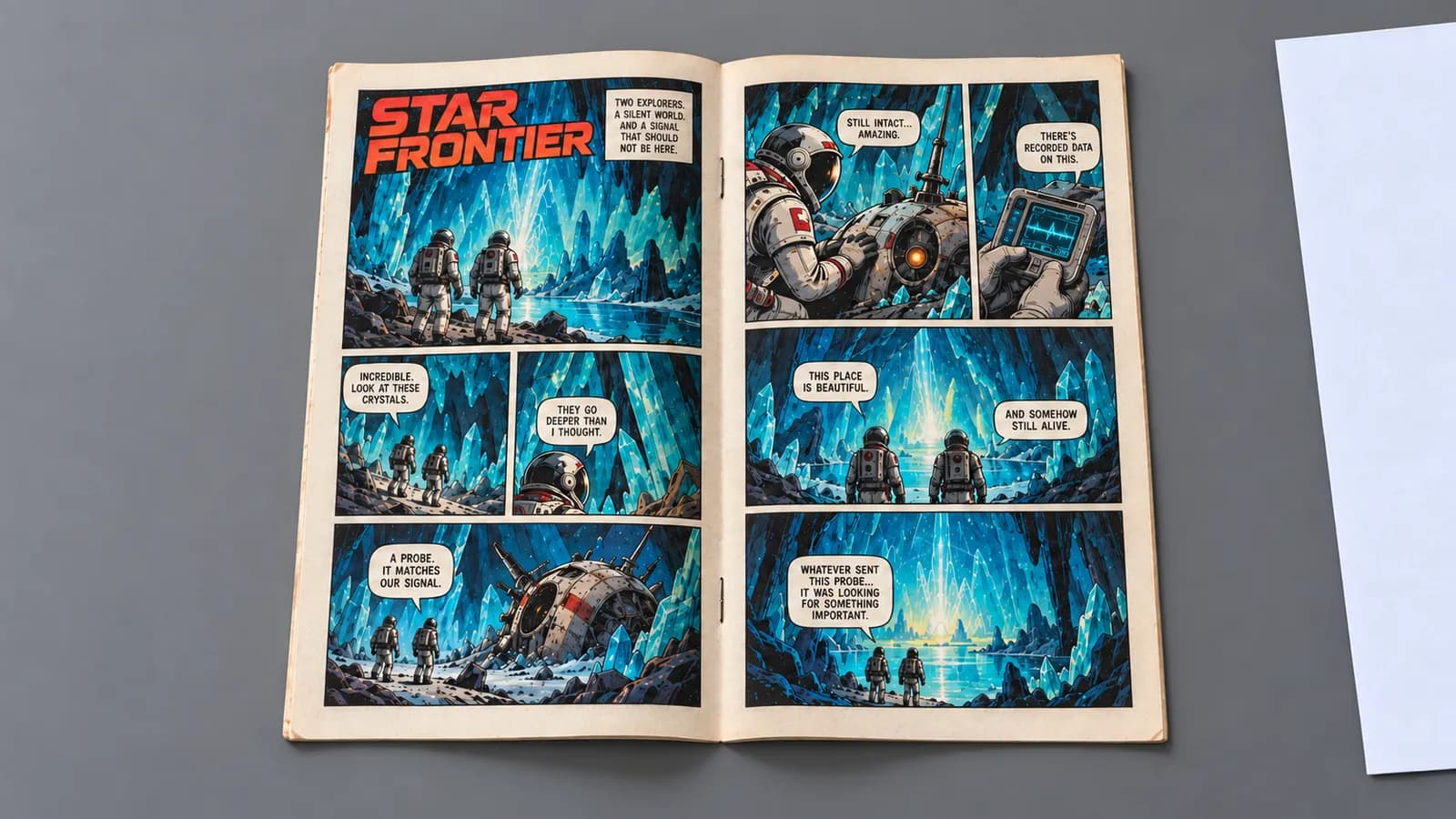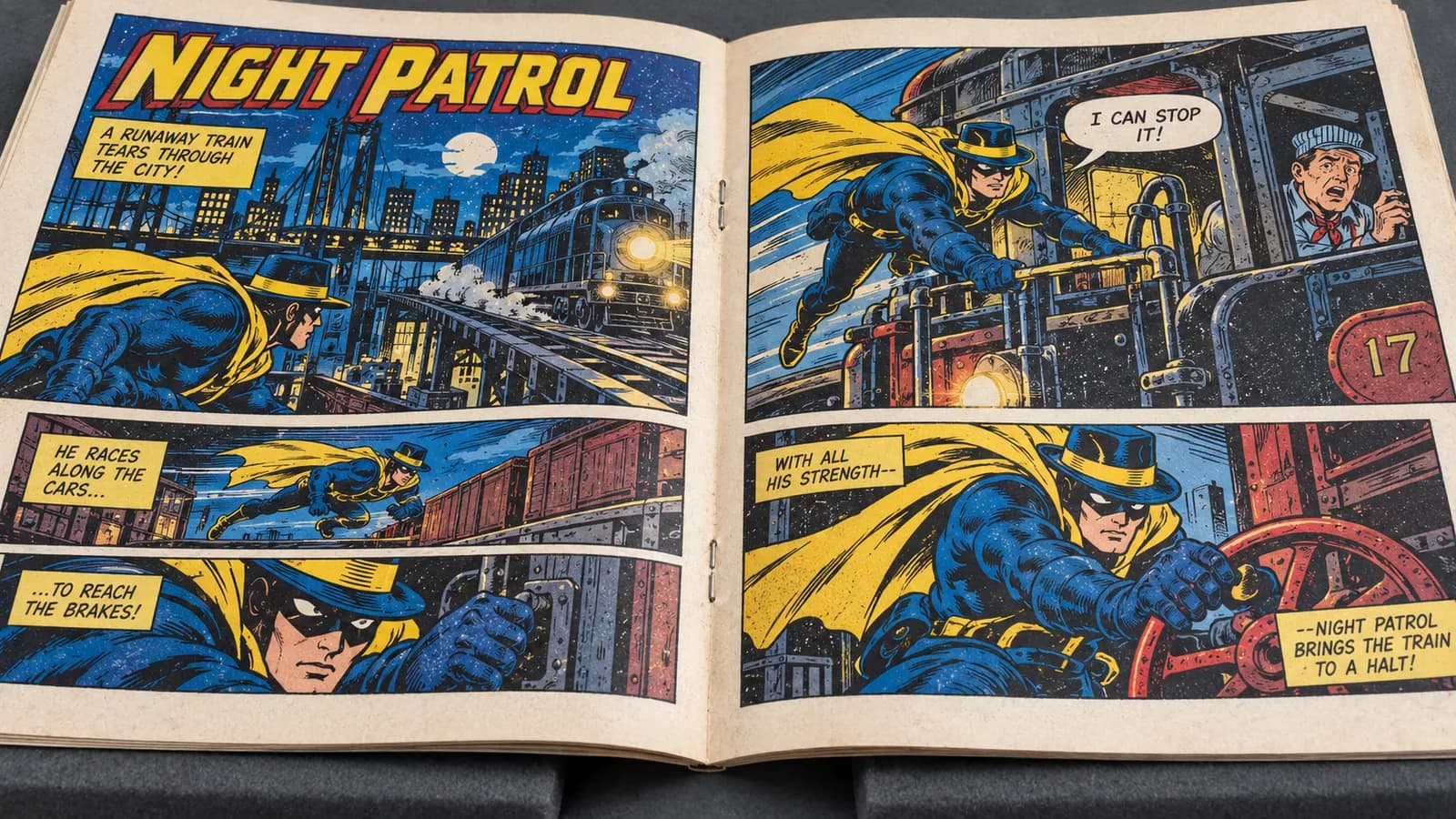
To check whether a comic's centerfold is attached, open the book to its middle pages with clean, dry hands, support both halves, and look at both staples. At each one, the folded staple legs should lie flat, the paper around them should be whole, with no tear running from the holes, and the sheet should sit square in the fold. Never pull a page to test it.
The check matters because the published grade descriptions name the centerfold directly: mostly secure at 8.0 VF, possibly loose at 6.0 FN, and detached at one staple at 4.0 VG. A careful look cannot tell you how firmly the paper holds, and neither can a photo, so record what you saw instead of testing it.
What is a comic's centerfold, and why does it come loose?
A comic's centerfold is the innermost sheet of a stapled book: one sheet folded in half to make four pages, at the exact middle. A 36-page comic is nine of these sheets nested together, with the cover on the outside and the centerfold at the core.
Each staple goes through the spine fold from the outside. Its flat top, the crown, sits on the spine. Its two legs pass through every sheet and fold flat against the center spread, so the center spread is the only place where you can see how the legs hold the pages.
The paper around each leg takes strain whenever the book is opened too wide, folded back or rolled. Over years of handling, a hole can stretch or tear until the paper slips free. Rust stains and weakens the paper at the same spot, and brittle paper tears there sooner. A square-bound book, with a flat glued spine, has no staples and no centerfold in this sense.
Attached, loose or detached: the four states
A centerfold that is present sits in one of four states, each with a plain name for a listing.
| State | What you see at the center spread | Where the grade descriptions first mention it |
|---|---|---|
| Secure | Both pairs of legs flat, small neat holes, the sheet square in the fold | Not mentioned above 8.0 VF; 8.0 VF and 7.0 FN/VF call it mostly secure |
| Loose | Still on both staples, but a hole is torn or stretched, so the sheet shifts | 6.0 FN |
| Detached at one staple | Torn free of one staple; the sheet hangs from the other and may sit crooked | 4.0 VG |
| Detached | Free of both staples; the sheet lies loose in the middle of the book | 2.0 GD |
A loose centerfold is still held by both staples, but the paper at one or both holes has torn or stretched enough that the sheet moves. A centerfold detached at one staple has torn completely free of that staple and hangs from the other. A missing centerfold first appears at 1.0 FR, and only when the book is still readable.
Because the worst defect sets a ceiling on the grade, a centerfold detached at one staple can hold an otherwise clean copy near 4.0 VG by itself. Treat the right-hand column as where each state starts to appear, not as an exact cutoff; a grader weighs the whole book.
How to check the centerfold without damaging it
Check the centerfold with the book supported, opened only as far as you need, and with your eyes rather than your fingers. As of October 2026, the Library of Congress comic book care guidance says to handle comics with clean hands and never to open one past 180 degrees or fold it back on itself. Its book handling guide recommends freshly washed, dry hands without lotion, and does not advocate gloves for paper.
- Wash and dry your hands, skip the lotion, and clear a clean, flat table away from drinks.
- Slide the book out of its bag on its backing board, holding the board rather than the book.
- Lay the book flat, front cover up.
- Lift the front half at about the middle and let the back half rest on the table. Support the raised half with your palm, and open no wider than you need to see both staples.
- Find the center spread. It is the only spread where you can see the staple legs lying flat along the fold.
- Look at the top staple, then the bottom one. Check that both legs lie flat, that the paper around each leg is whole, and whether the metal or the paper shows rust.
- Look along the fold between the staples for a split, and check that the sheet sits square, with its edges in line with the page beneath it.
- Close the book the way you opened it. Then look at the spine, where the staple crowns sit, for rust and for tears in the cover at each staple.
- Write down what you saw, and what you did not test.
Never tug, lift or wiggle the center sheet to see whether it holds. A hole that has torn partway needs little force to tear through, so a pull test can turn a loose centerfold into a detached one. Describe what you can see, and say what you did not test.
Staple rust, staple tears and staple pulls
Most centerfold problems start at a staple, so look at each staple twice: inside at the center spread, where the legs lie, and outside on the spine, where the crown sits. Rust and tears can show on one side and not the other.
- Staple discoloration is dulling or darkening of the metal itself, with no rust spreading into the paper.
- Rust migration is rust that has spread from a staple into the paper around it, as an orange-brown stain.
- A staple tear is a small tear that starts at a staple hole, on the cover or on an inside sheet. At the center spread, it shows as a split running out from the hole.
- A staple pull, also called a staple pop, is a staple that has pulled through the paper, leaving the area around it torn or creased.
| Staple condition | Where the grade descriptions first mention it |
|---|---|
| Original, clean, no rust | Required at 9.8 NM/MT and above |
| Original, with only the slightest discoloration | 9.6 NM+ |
| Only the slightest staple tears | 9.0 VF/NM |
| Slight rust migration | 7.0 FN/VF |
| Rusted or replaced staples | 3.0 GD/VG |
| Missing staples | 2.0 GD |
Staple tears grow in the descriptions as the grade falls: very slight at 8.0 VF, minor at 6.0 FN, and minor to moderate at 4.0 VG. Pressing will not help, because it flattens bends and dents but cannot remove rust or mend a tear; see what pressing can and cannot fix.
Replaced staples, repairs and married centerfolds
Some centerfolds are attached because someone fixed them, and that is a disclosure question.
Replaced staples. The published restoration scale lists cleaned or replaced staples among conservation repairs, and the grade descriptions require original staples at 9.6 NM+ and above. Look closer at bright staples in a book whose paper has aged, a rust ring around a staple with no rust on it (a possible sign of cleaning or replacement), and extra holes along the fold. Careful work can show nothing at all.
Reinforced or reattached sheets. Tear seals, reinforcement and piece reattachment are conservation repairs on the same scale. At the center spread, look for a thin strip of tissue along the fold or around a staple hole, with a sheen or texture unlike the paper beside it. Tape, by contrast, is an amateur repair.
Married centerfolds. A married centerfold is a center sheet taken from another copy of the same issue. The published restoration scale counts married pages toward a book's restoration when other work is also present, and a buyer should be told either way. Look for page tone or wear that differs from the pages on either side, and for extra holes near the staples. NuGrade's survey asks about married pages because photos may not show them.
What a centerfold photo can and cannot prove
A sharp photo of the seam is strong evidence for what sits on the surface and weak evidence for how firmly anything holds. Keep the two apart, in your own listings and in a seller's photos.
| What you check | A sharp seam photo shows | It cannot settle |
|---|---|---|
| Attachment | Whether the sheet sits on both staples, square in the fold | How firmly the paper holds; a sheet free at one staple can rest in place |
| Staple holes | Torn or stretched paper at the legs | A short tear that runs under a folded leg |
| Rust | Rust on the legs, a ring around the holes, stain in the paper | Rust on the legs between other sheets, until it stains a visible page |
| The gutter | The fold between the staples | A split deep in the fold that the opening angle hides |
| History | Extra holes, a bright staple in an aged book | Careful staple replacement, or a well-matched married sheet |
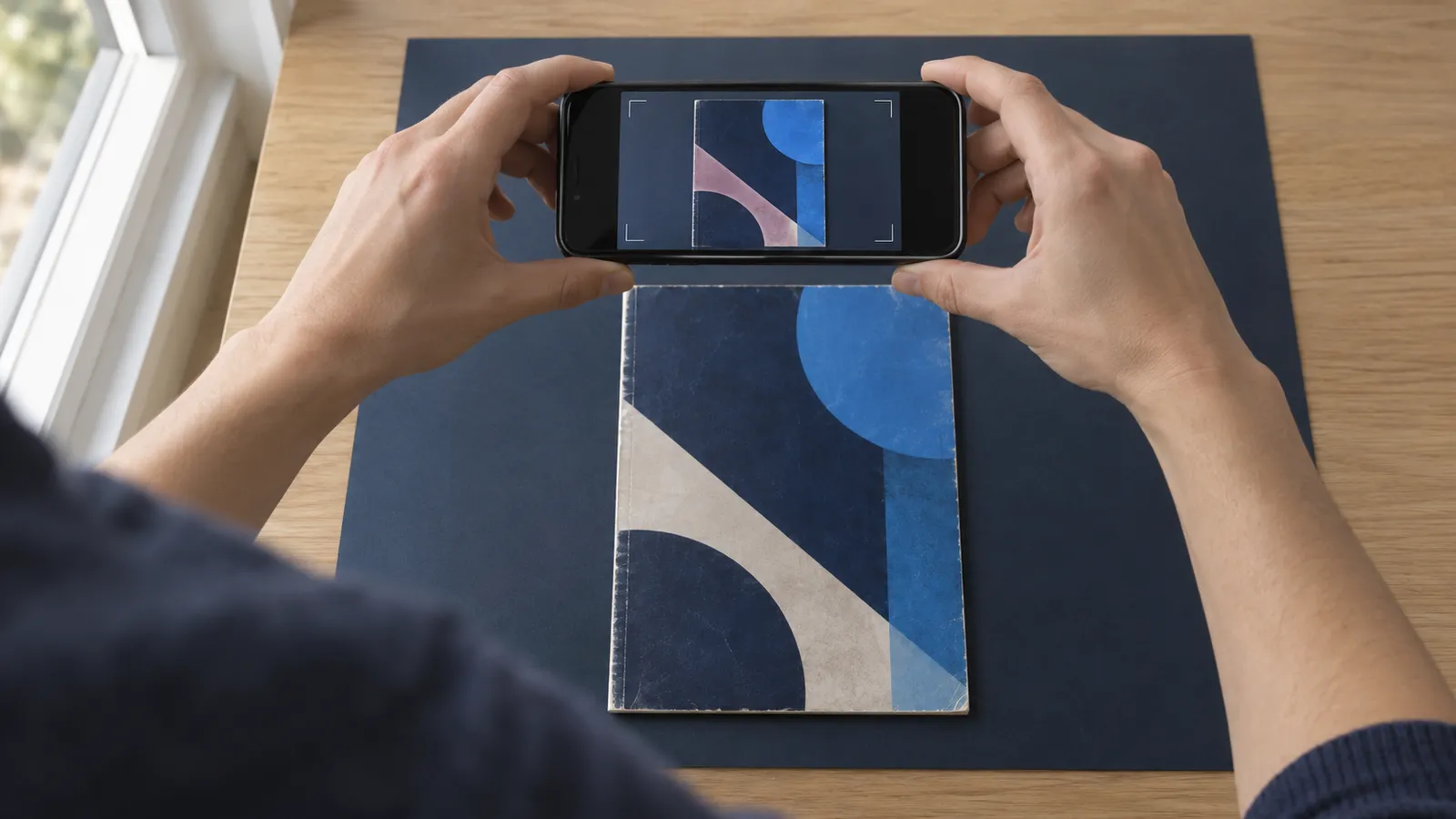
For your own photo, turn the book so the fold runs top to bottom in the frame, fit both staples and a little page on each side, and angle the lamp so the metal does not flash white, because glare hides rust. The full setup is in how to photograph a comic for grading.
NuGrade, an AI-assisted grading app for raw comics, works inside the same limit. Its guided capture includes one photo of the centerfold staple seam, and the report judges the staples from it. In all three sample reports, the Staples area reads Clean, with no defects observed in the centerfold and staples photo, and the homepage lists each report with the checks Original staples and Centerfold attached. Those checks come from the photo, not from a pull test.
The Guardians of the Galaxy #4 report shows why both staple views matter. Its further small stress lines near the lower staple position are visible in a frame from the spine pass, the outside view, while its Staples area, judged from the inside, is clean. All three reports list restoration as Unverified; photos in normal light can hide careful work. A buyer can open any NuGrade report at the lookup page and see the centerfold photo behind the call.
What to do if the centerfold is loose or detached
Leave the sheet in place and do not try to fix it at home. The Library of Congress advises against tape or glue on comics, and tape costs grade: the descriptions first allow minor, unobtrusive tape at 4.0 VG, well below the 6.0 FN where a loose centerfold first appears.
- Keep the book bagged and boarded so the sheet stays seated.
- Do not bend the staple legs, pull the staples or add new ones.
- Store it somewhere cool and stable, with relatively dry air. The Library of Congress suggests room temperature or below and about 35 percent relative humidity, away from attics and basements. Steel staples rust faster in damp air.
- For a valuable book, ask a professional paper conservator first, and plan to disclose the work.
A short record keeps what you saw apart from what you did not test:
CENTERFOLD AND STAPLES (example entry, not a real book)
Top staple:    legs flat; hole clean; no rust
Bottom staple: legs flat; 1/8 in tear from the hole along
               the fold; light rust ring, no migration
Centerfold:    on both staples; square in the fold
Outside:       both crowns centered; slight discoloration
Not tested:    attachment strength (not pulled)
Not visible:   the gutter between staples at this angle
Listing line:  Centerfold attached at both staples; 1/8 in
               tear at the bottom staple hole, light rust,
               no migration. Checked by eye, not pulled.
For the rest of the book, use the at-home grading checklist, and for page color and brittleness, see what off-white, cream and brittle pages look like.
Frequently asked questions
What does a loose centerfold mean on a comic?
A loose centerfold is still held by both staples, but the paper at one or both staple holes has torn or stretched, so the center sheet shifts at the fold. The published grade descriptions first mention a loose centerfold at 6.0 FN.
Does a detached centerfold lower a comic's grade?
Yes. The published grade descriptions first mention a centerfold detached at one staple at 4.0 VG and a fully detached one at 2.0 GD, so on an otherwise clean book it can be the flaw that limits the grade.
Should you tape or glue a loose centerfold?
No. The Library of Congress advises against tape and glue on comic books, and the grade descriptions treat tape as an amateur repair that first appears at 4.0 VG. Leave the sheet in place, and for a valuable book ask a paper conservator.
Should you wear cotton gloves to handle a comic?
No. For paper, the Library of Congress recommends freshly washed, dry hands without lotion and does not advocate gloves, which reduce your sense of touch and make page turning clumsy.
Can a photo prove a centerfold is attached?
No. A sharp photo shows whether the sheet sits on both staples and whether the holes are torn or rusted, but it cannot show how firmly the paper holds or a tear hidden under a staple leg.