To ship a raw comic book, photograph and date it first, then put it in a fresh bag and board and close the flap with tape that touches only the bag. Sandwich it between two rigid boards larger than the book, pad it in a sturdy box so nothing moves, add a water layer, weigh the parcel, and ship it tracked and insured for its value.
A raw comic is a comic that is not sealed in a grading service's hard plastic holder. Its bag keeps off dust but adds no stiffness, so the packing has to supply it.
How to pack a raw comic, step by step
Pack from the inside out: bag and board, board sandwich, water layer, box, padding. No tape and no adhesive should touch the book at any stage.
- Photograph and date the book on the day you pack it. The pre-ship record below lists the shots.
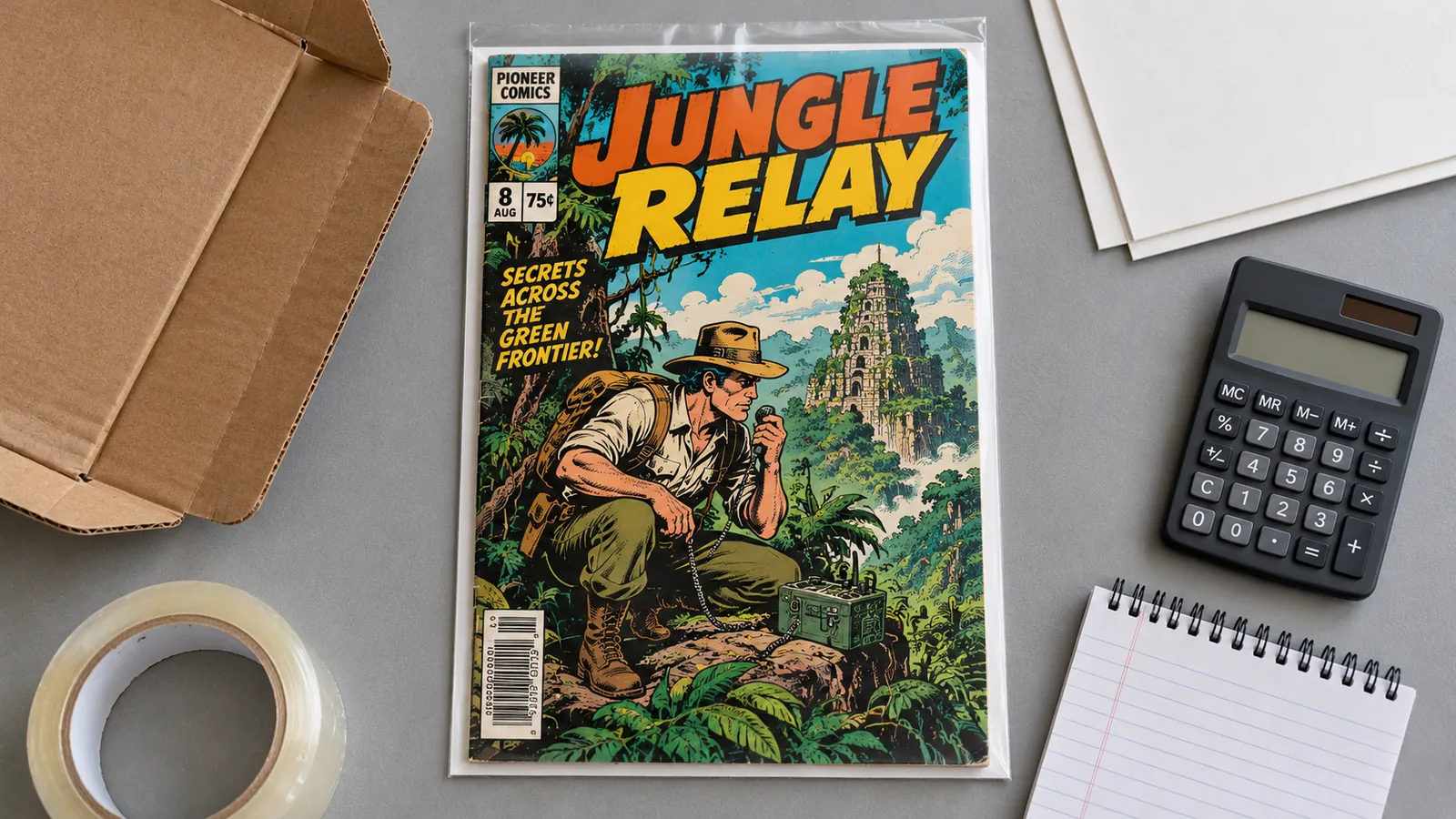
- Use a fresh bag and board that fit. Bags and boards come in sizes for different eras of comics. Use the size the book slides into without forcing: a tight bag bends corners on the way in, and in a loose one the book slides and its corners tap the end of the bag. A new bag is clear, and a new board is flat. Put the board behind the back cover.
- Close the flap away from the book. Fold the flap over to the back of the bag and hold it with one short strip of tape that touches only the bag. If the flap has its own sticky strip, fold it so the strip lands on the outside of the bag, never against the cover.
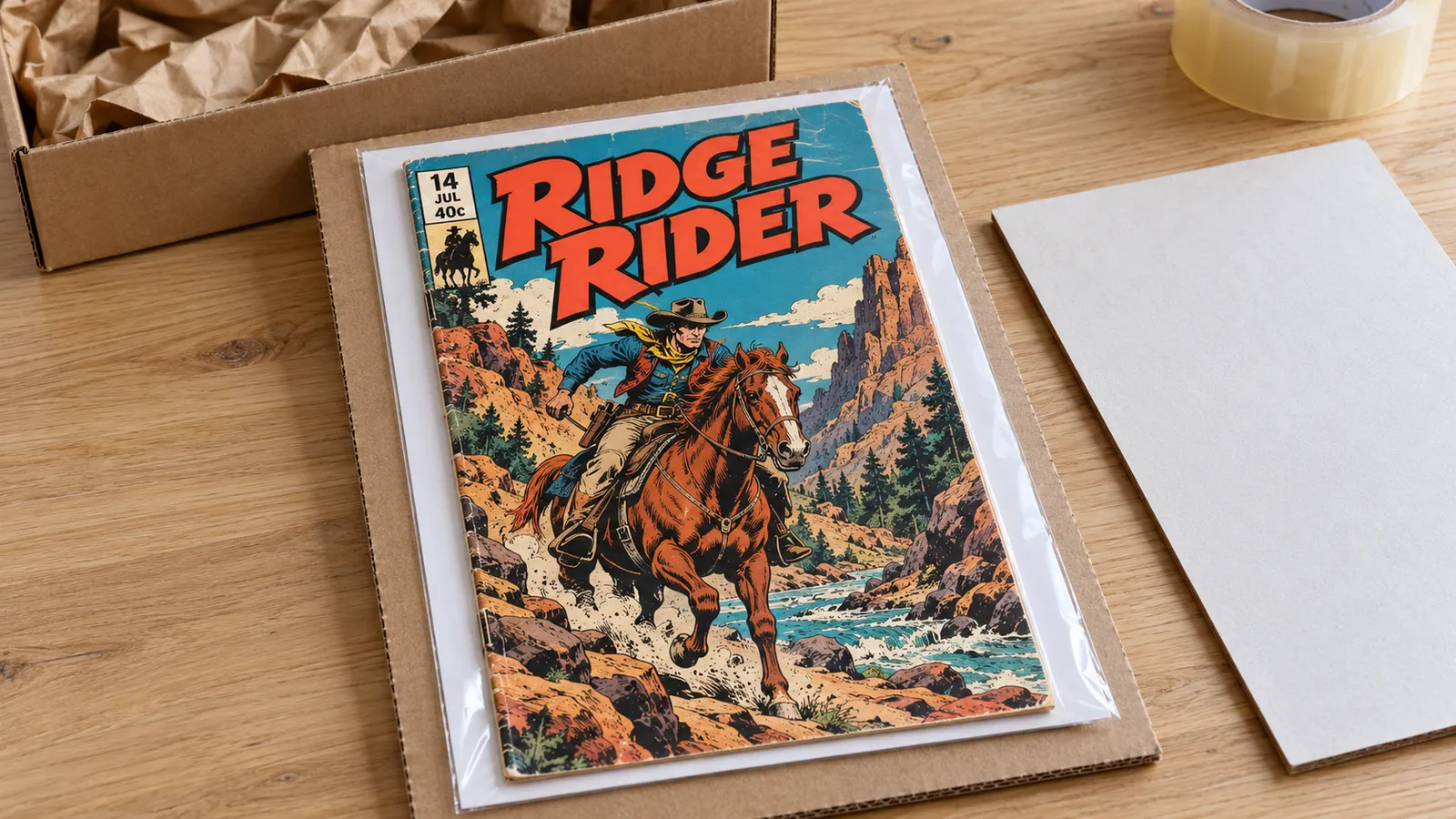
- Make a board sandwich. Cut two pieces of corrugated cardboard about half an inch larger than the bag on every side. Lay the bagged book in the center of one, put the second on top with its ribs running the other way, and tape the two boards together on all four sides. The tape touches only cardboard.
- Test the sandwich. Hold it by one end. If it droops or flexes, add a third board.
- Add a water layer. Seal the sandwich in a plastic bag or plastic wrap. Wet cardboard can stain and ripple the book inside it.
- Box it with padding on every side. Choose a box with stiff walls and sound corners, about an inch larger than the sandwich on each side, and fill the gaps with packing paper, air pillows or bubble wrap. Close the box and shake it gently: nothing should move.
- Seal, label and weigh. Tape every seam, put the label on the largest flat side, and weigh the packed parcel on a kitchen or postal scale. Buy postage for the real weight and size.
A board sandwich is a bagged comic taped between two rigid boards that are larger than the bag. Corrugated cardboard bends easily along its ribs but resists bending across them, so crossing the ribs makes the pair stiff in both directions. The margin keeps the book's corners inside the board edges, where a knock lands on cardboard first. Fold the end of the last strip of tape back on itself as a pull tab, so the buyer can open the sandwich without a blade.
Box, rigid mailer or envelope: which to use
A rigid comic mailer is a folding corrugated mailer cut to comic size, and for a lower-value book it can stand in for both the sandwich and the box.
| Container | When it fits | What to watch |
|---|---|---|
| Board sandwich in a box | Any book, and the default for a valuable one | Padding on every side, so the sandwich cannot slide |
| Rigid comic mailer | One or a few books of modest value | Slack inside, flexing walls, and a missing water layer |
| Box inside a second box | A key issue or a high-grade copy | Extra weight and size, so weigh and measure first |
| Padded or bubble envelope alone | Not recommended | It bends, so it stops scuffs but not creases |
What damages a comic in transit, and what it costs the grade
A parcel damages a comic in four common ways: it bends, the book moves inside it, a box corner is crushed, or water gets in.
| What happens to the parcel | What it does to the book |
|---|---|
| It bends in a mailbag or under heavier parcels | Corner creases, a crease across the cover, new stress lines at the spine |
| The book slides in its bag, or the sandwich slides in the box | Blunted or dinged corners where they hit the bag end or the box wall |
| The box is dropped on a corner | The crushed box corner pushes into the book's corner |
| It sits in rain or on a wet step | Stains, rippled pages, a warped board |
Corners and the spine matter most because the published grade descriptions are strict about them near the top of the 10-point scale. A 9.4 NM corner is square and sharp, with at most the slightest blunting, and the 9.0 VF/NM description allows no corner crease at all. Even at 8.0 VF, an unnoticeable 1/4-inch crease passes only if it does not break the color, and the 9.4 NM and 9.2 NM- descriptions allow almost no spine stress lines. One corner crease from a bent parcel can drop a sharp book below 9.0 VF/NM.
How to record the condition before you ship
A pre-ship record is a set of dated photos and notes that shows a book's condition and its packing on the day it ships. If a buyer reports damage, it shows what was there before and how well the book was packed.
- Shoot the book out of its bag, unless its pages are brittle and flaking: front cover, back cover, spine, the four corners up close, and a slow page flip. How to photograph a comic so the flaws actually show covers the light and the angles.
- Put a slip of paper with the date and the order number beside the book, not on it, in the first shot.
- Keep the original files. They carry the date and time the phone took them, and a copy sent through a chat app can lose that data.
- Photograph the taped sandwich, the open box with its padding, and the sealed box with the label.
- Write down the weight, the service, the tracking number and the insurance amount, and keep the postage receipt.
Record the flaws that left the printer with the book, too. The NuGrade sample report for E-Man #1 records a small dark mark at the left edge of the back cover, likely a bindery or printing artifact, which a buyer could mistake for damage from the trip. The report for Marvel Presents: Guardians of the Galaxy #4 records a short crease with color break at the top-right corner tip. A dated close-up of each corner is what tells an old crease from a new one.
A NuGrade report is a fixed snapshot of the book on its report date, so shoot fresh photos if the book has been handled since. To write up the findings, use the condition record in the home grading checklist.
PRE-SHIP RECORD
Book (title, issue, year):
Order number:              Buyer:
Report ID and date (if any):
Photo date:
Book photos: front / back / spine / 4 corners / page flip
Known flaws (size, place):
Packing photos: sandwich / open box / sealed box with label
Packed weight:             Box size:
Service:                   Tracking number:
Insured for:               Signature required: Y / N
Ship date:                 Postage receipt kept: Y / N
Tracking, insurance and signature: choose by value
Ship every comic with tracking, insure it for what it sold for, and require a signature when the book is valuable. Insurance pays money, not the book, so the packing still matters most.
| The book | Tracking | Insurance | Signature |
|---|---|---|---|
| Inexpensive and easy to replace | Yes | Know what the label already includes | Not needed |
| A book whose loss would hurt | Yes | For the full sale price | Worth considering |
| A key issue or a high-grade copy | Yes | For the full sale price | Yes |
Send the buyer the tracking number on the day you ship. A required signature keeps a valuable parcel from being left at the door and gives you a delivery record.
In the US, two Postal Service rules matter, as of October 2026. Comics cannot go by Media Mail: the Media Mail notice says those packages may not contain advertising, and that comic books do not meet that standard. The insurance page says Priority Mail and USPS Ground Advantage include up to $100 of insurance, that more is available up to $5,000, and that insurance covers only the actual value of the contents.
Postage, supplies and insurance all come out of the sale price; what you actually keep after selling a comic works through those costs. For a valuable raw book, ask first whether it should be professionally graded; is this comic worth slabbing? runs the numbers.
How to ship several comics in one box
Ship several comics as one stack: each in its own bag and board, stacked with books of the same size, sandwiched between two rigid boards and padded so the stack cannot shift.
- Give a smaller book its own sandwich, because in a stack of larger bags it can slide.
- A heavy stack hits harder when the box drops, so use a stronger box and more padding.
- List every book in the pre-ship record, and insure the parcel for the total.
What to do when a comic arrives damaged
If a comic arrives damaged, photograph the box before you open it, then each layer and the book as you unpack, keep every piece of packing, and contact the seller. Do not try to fix the book.
- Photograph the unopened box on all six sides, with the label readable in one shot, plus close-ups of any crushed corner, tear, puncture or water mark.
- Open it on a clean table. Cut only the box tape, keep the blade shallow, and work from the side away from the book. Film the opening if you can.
- Photograph each layer as it comes out: the padding, the plastic, the taped sandwich, then the bagged book.
- Photograph the book in the listing's views: front, back, spine and the four corners, plus a close-up of each new flaw with a ruler beside it.
- Write down what changed, with size and place, for example "a 1/2-inch crease at the bottom-right corner, breaking color, not in the listing's corner close-up." If the listing had a NuGrade report, open it by its ID at nugrade.app/lookup and compare finding by finding.
- Keep the box, the packing and the book as they arrived. Do not press, flatten or tape anything.
- Message the seller with the photos. If you bought through an online marketplace, open a case through its own process, and check its deadline.
As of October 2026, the US Postal Service's claims page says:
- The sender or the recipient can file a claim for insured mail.
- A damage claim must be filed no later than 60 days after the mailing date, and the person who files needs the original mailing receipt.
- Clear photos of the damage help the claim.
- Save the packaging and everything in the package, undamaged items included, until the claim is settled. You may be asked to take the whole package to a Post Office for inspection.
- The Postal Service may not legally pay for uninsured mail that is lost or damaged.
The box photos also show what failed. A crushed box with a clean book means the packing worked; a clean box with a newly creased book means the book bent or moved inside, so the next parcel needs a stiffer sandwich or more padding.
If you are the seller, compare the buyer's photos with your pre-ship record, and say which flaws your dated photos show and which are new. Keep the sale record: the claims page accepts a sales receipt or a printout of the online sale as proof of value.
Frequently asked questions
Can you ship comic books by Media Mail?
No. As of October 2026, the US Postal Service says Media Mail packages may not contain advertising and that comic books do not meet that standard. Use a tracked parcel service instead.
Should you tape a comic bag shut before shipping?
Yes, but tape only plastic to plastic. Fold the flap over to the back of the bag and hold it with a short strip of tape that touches only the bag, so no tape or adhesive can reach the cover.
Is a bubble mailer safe for shipping a comic?
Not on its own. A padded envelope bends, so it stops scuffs but not creases. Put the bagged book between two rigid boards, then into a box or a rigid comic mailer.
How much insurance should you buy for a comic?
Insure it for what the buyer paid, since that is the value you can prove. As of October 2026, the US Postal Service says its insurance covers only the actual value of the contents, and some of its services include up to $100.