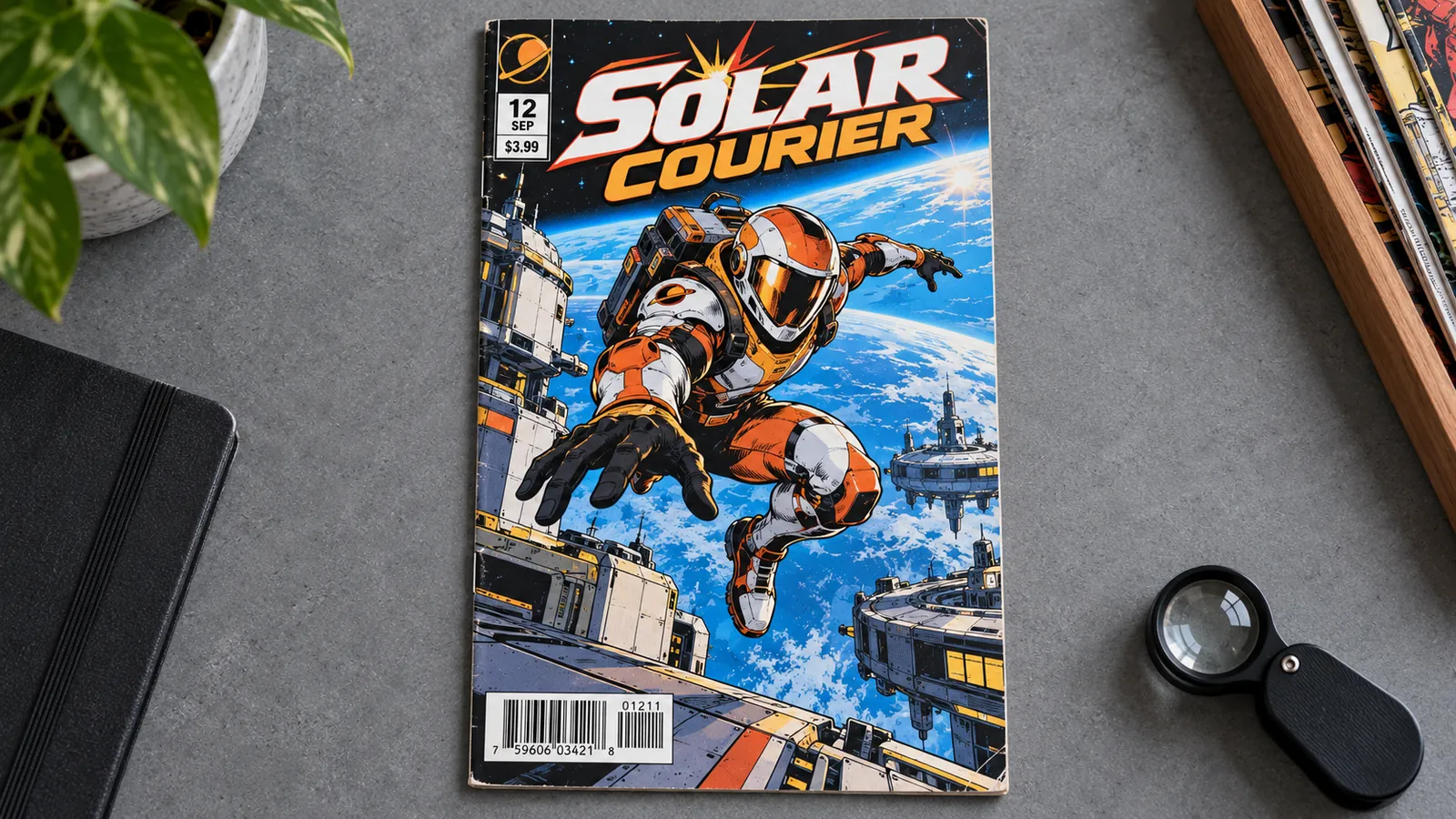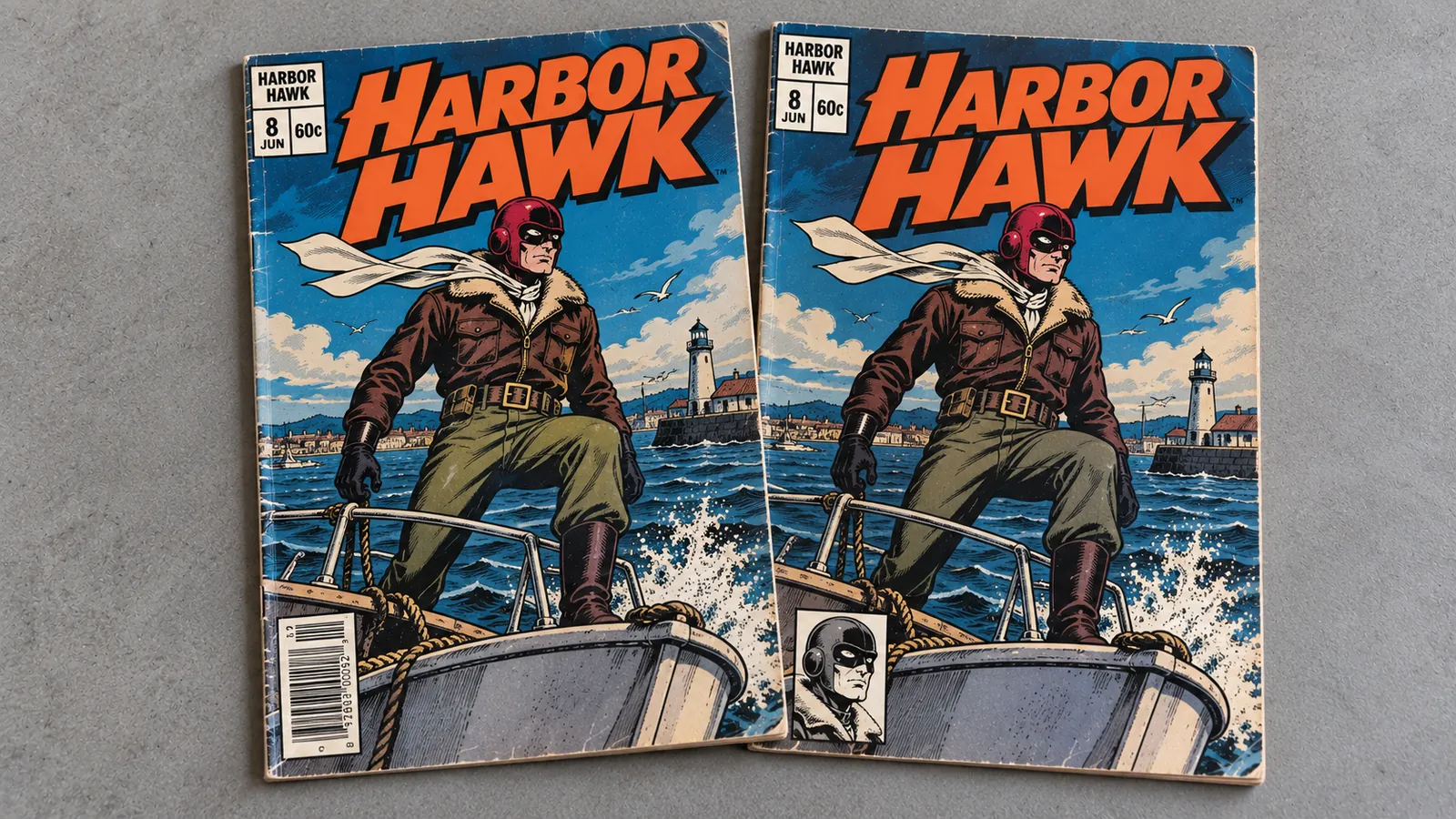
Newsstand and direct editions are the same comic, sold two ways. Newsstand copies went to stores that could return unsold copies, and from the mid-1970s they carry a scannable UPC barcode. Direct editions went to comic shops, which could not return them. From 1979 (Marvel) and 1980 (DC) to the mid-1990s, a direct copy shows a slash through the barcode, or art, a logo or words in its place.
Keep two questions apart. Which edition you hold is a fact you can usually check on the cover. Whether that edition sells for more is a market question about one issue at one grade, and the answer can be no difference at all.
What newsstand and direct editions are
The two editions differ in how they were sold, not in what they are. A newsstand edition is a copy distributed through the returnable newsstand system, to newsstands, drugstores, supermarkets and other magazine sellers. A direct edition is a copy sold through the direct market. The direct market is the network of distributors and comic shops that buy comics from publishers on non-returnable terms.
For decades most comics were sold the newsstand way. Unsold copies went back for credit, as whole copies, torn-off covers or only the top third of the cover, and most returns were pulped. In the early 1970s, convention organizer and dealer Phil Seuling began buying comics from publishers for comic shops on new terms: a deeper discount, but no returns.
For years a shop copy looked exactly like a newsstand copy, and some unsold shop copies found their way into the newsstand returns for credit. Marvel answered in 1979, and DC in 1980, by marking the direct copies on the cover. The story pages usually match. On later books the two editions can differ in little more than the wording in the barcode box.
How to tell newsstand from direct, era by era
Read the cover date first, then the barcode box. The barcode box is the small panel, usually near the lower left corner of the front cover, where a newsstand copy prints its UPC (Universal Product Code) barcode. What the box can tell you depends on the era.
| Era (Marvel and DC cover dates) | Newsstand copy | Direct copy | Can you tell them apart? |
|---|---|---|---|
| Before 1976 | No barcode | Looks the same | No. Every copy looks alike |
| 1976 to mid-1979 (DC: to 1980) | UPC barcode | Same barcode | No, apart from multipack copies |
| Mid-1979 (DC: 1980) to the mid-1990s | Plain, scannable barcode | A slash through the barcode, or a blank box, art, a logo or words instead | Usually, from the box |
| Mid-1990s to 2013 (Marvel) or October 2017 (DC) | Barcode without direct-market wording | Barcode with words such as "Direct Edition" or "Direct Sales" | Usually, if you read the words |
| After that | No newsstand edition from these two publishers | Barcode | The question rarely comes up |
Marvel left newsstand distribution in 2013. DC shipped its final newsstand editions in August 2017, with October 2017 cover dates. Use the cover date, not the shipment date, with the table above.
To read your copy:
- Find the cover date on the cover or in the indicia, the small publication notice on the first page or inside the front cover.
- Find the barcode box. On some wraparound covers it moves to the back cover.
- Match the cover date to a row in the table.
- Read the box exactly: a plain barcode, a barcode with words beside it, a slash, art, a logo or a blank box.
- Write down what you saw as well as your conclusion. A buyer can check "Spider-Man head in the box"; nobody can check "direct" on its own.
Marvel: a slash, then a Spider-Man head
Marvel's first marked direct copies, from mid-1979, keep the barcode but print a slash through it. They also show the price and issue number in a diamond rather than the usual square box. From 1980, many direct copies carry a Spider-Man head in the box in place of the barcode, and later issues use other characters, logos or words.
DC: logos and words in the box
DC's marked direct copies begin in 1980, with a logo, art or words in the box where the newsstand copy has its barcode. In the 1990s, DC direct copies switched to a working barcode labeled "Direct Sales."
Other publishers
Other publishers split their print runs at different times, and some issues were sold only to comic shops. An issue that had no newsstand edition cannot be a newsstand copy, whatever its barcode looks like.
When the cover cannot settle it
Sometimes the honest answer is "not established." Write that instead of a guess in these cases:
- The box is missing or covered. A torn or clipped corner, a price sticker or tape over the box removes the evidence. Do not peel a sticker to look, because peeling can tear the cover.
- The era shows no difference. Shop copies from before Marvel's 1979 change or DC's 1980 change look exactly like newsstand copies. Calling a 1975 book a "newsstand edition" tells a buyer nothing they can check.
- The book sits on a boundary. Sources differ by a month or two on when each publisher started to mark direct copies. On a book cover-dated near the change, a plain barcode does not prove a newsstand copy.
- A barcode alone is not proof. Some issues sold only to comic shops carry a plain barcode with no direct-market wording.
- A diamond is not a newsstand mark. Late-1970s Marvel copies made for multipacks, sold several to a sealed bag, also show the price and issue number in a diamond. Newsstand copies of that time use a square box.
Record the gap the same way you would record any other unknown. An example:
Edition:   not established
Why:       lower-left corner torn away, box missing
Era:       1980s cover date, so both editions existed
Why newsstand copies often show more wear
Newsstand copies passed through more hands before anyone bought them, so high-grade copies can be harder to find. Distributors bundled and delivered them, store staff unpacked and racked them, and customers browsed them on the rack. Each step was a chance for a bent corner, a stress line along the spine or a crease. Direct copies went to comic shops, which sold mostly to collectors.
The edition does not change how a copy is graded. The published 10-point grade descriptions describe defects, not distribution, so a newsstand copy and a direct copy with the same flaws earn the same grade. A color-breaking stress tick at the spine limits a newsstand copy exactly as it limits the direct copy beside it.
So inspect a newsstand copy the way you would inspect any copy. The inspection order for grading a comic at home works the same for both editions.
Is a newsstand copy worth more? Check matched sales
Not automatically. The edition is a fact about your copy; a premium is a pattern in the sales of one issue at one grade, and it can be zero. Check sold prices of matched copies before you price yours or pay extra for someone else's.
The expectation has a real basis. As comic shops grew through the 1980s and 1990s, newsstand copies became a smaller share of each print run, so for many later issues the newsstand copy is the scarcer one. But scarce is not the same as wanted. Demand differs by issue and by grade, and a scarcer edition with few buyers need not sell for more.
To compare matched copies:
- Match the issue, printing and cover exactly. Leave out price variants, later printings and facsimile editions.
- Confirm each edition from a photo of the barcode box, because a listing title is not evidence. For a book from before the marked editions, skip this step: there is no edition to match.
- Match the condition: the same grade and label type for graded copies, and your own reading of the photos for raw copies.
- Use sold prices only, and note the date of each sale.
- Collect several sales for each edition, then compare the middle of each group, not the single highest sale.
- Compare the sample sizes and price spreads, too. Overlap alone does not rule out a premium. With few sales, record the difference as uncertain.
MATCHED SALES: ONE ISSUE, ONE GRADE
Issue, printing, cover:
Grade (label type, if graded):
                      NEWSSTAND        DIRECT
Sale 1 (date):
Sale 2 (date):
Sale 3 (date):
Middle of group:
Box seen in photos?   Y / N            Y / N
Result: premium / no clear difference / too few sales
For where to find sales and how to clean them up, see how to find honest comps and do the grading math.
Price variants and other editions are separate questions
The edition tells you how a copy was distributed. Other labels answer other questions, and one copy can carry several at once: a 1980s copy printed for Canadian newsstands with a Canadian cover price is both a newsstand copy and a price variant.
| Label | What it means | Where to check |
|---|---|---|
| Price variant | A copy printed with a different cover price for a test market or another country, such as Marvel's 30-cent and 35-cent test copies of 1976 and 1977, Canadian-priced copies of the 1980s, or UK copies priced in pence | The cover price, against the standard US price for that issue |
| Later printing | A new print run of the same issue | The indicia, or a printing note on the cover |
| Multipack copy | A copy made to be sold several to a sealed bag | Markings that vary by publisher and year, such as the late-1970s Marvel diamond |
Answer each question from the book itself, one at a time. A price variant, a later printing or a multipack copy has its own sales history, so it needs its own matched sales. For the small add-on code beside the main barcode on many later books, see what the five extra barcode digits tell you.
How to describe the edition when you sell
State what the cover shows, show it in a photo, and leave value claims to the sales record. A buyer can check "Spider-Man head in the barcode box" in seconds. Nobody can check "rare newsstand."
EDITION NOTE
Book:       title, issue number, publisher, cover date
Printing:   first or later (from the indicia)
Edition:    newsstand / direct / not established
Evidence:   what the barcode box shows
Price:      standard / price variant (which)
Photo:      front cover, barcode box sharp and in frame
Photograph the whole front cover straight on, with the box free of glare. The guide to photographing comics for grading covers the light and the angles.
NuGrade, an AI-assisted grading app for raw comics, keeps the front cover photo with each report, so a buyer who opens the report on the report lookup page sees the box along with the grade. The grade describes condition, not the edition, so put the edition line in your listing too. Give that line its source, the way the Marvel Presents: Guardians of the Galaxy #4 sample report states that its cover date and publisher were read from the front cover and the indicia. A NuGrade grade is an opinion limited to what the photos and video show, and it does not replace professional grading.
Frequently asked questions
What is the difference between newsstand and direct edition comics?
They are the same comic sold through two systems. Newsstand copies went to stores that could return unsold copies, while direct editions went to comic shops on non-returnable terms. From 1979 (Marvel) and 1980 (DC), direct copies are marked in the barcode box.
How can you tell if a comic is a newsstand edition?
Check the cover date, then the barcode box. On an issue that also had a direct edition, a plain scannable barcode with no direct-market wording points to the newsstand copy, while a slash, art, a logo or words such as "Direct Edition" point to the direct copy.
Are newsstand comics worth more than direct editions?
Not automatically. Compare sold prices of matched copies, with the same issue, printing and grade and the edition confirmed from photos, and treat any gap as true only for that issue at that grade.
Is a comic from before 1979 a newsstand or a direct edition?
For Marvel and DC, the question does not apply. Copies sold to comic shops before Marvel marked its direct copies in 1979, and DC in 1980, look identical to newsstand copies, so record the printing and any price variant instead.
Do newsstand and direct editions have different pages inside?
Usually not. The two editions normally share the same story pages, and the visible difference is in the barcode box.