Some early-1990s Valiant comics are worth money, but many issues sold in very large numbers, and the value usually sits in one exact version of a book. Before you look up prices, check four things: the year and publisher in the indicia, whether a mail-away coupon is still in the book, whether the copy is a gold edition, and the surface of any chromium cover.
Then compare your copy only with sold copies of the same version in a similar grade. Valiant titles and issue numbers have been reused for almost thirty years, and coupons and gold editions split some issues into separate items.
Which Valiant is it: the original, Acclaim or a relaunch?
Check the publisher and the date in the indicia first, because the same Valiant title and issue number can come from three different eras. The indicia is the small block of publishing information, usually on the first page or inside the front cover, that names the publisher and gives the cover date.
Valiant's superhero line began with Magnus Robot Fighter #1, cover-dated May 1991, and new titles such as Harbinger (January 1992) and X-O Manowar (February 1992) followed. Acclaim Entertainment, a video game publisher, bought the company in 1994 and restarted several titles at #1 in 1996 and 1997 under the Acclaim Comics name. After Acclaim's collapse, Valiant Entertainment acquired the characters and began a new relaunch in May 2012, and it has restarted titles at #1 again since.
X-O Manowar shows how far this goes:
| X-O Manowar #1 | Publisher | What it is |
|---|---|---|
| 1992 (cover date February) | Valiant | The original series |
| 1996-97 | Acclaim Comics | Acclaim's relaunch |
| 2012 | Valiant Entertainment | The first book of the 2012 relaunch |
| 2017 | Valiant Entertainment | A new ongoing series |
| 2020 | Valiant Entertainment | Another new series |
Bloodshot is the same: the chromium-cover Bloodshot #1 is cover-dated February 1993, and Valiant Entertainment's Bloodshot #1 from 2012 is a different comic. A search for either #1 can return sales of every version, so filter by year first.
Coupon issues: is the coupon still in the book?
On several Valiant issues, the most important check is inside the book: a coupon that readers were meant to cut out and mail in. A mail-away issue is a comic that a publisher sent by post in exchange for coupons, instead of selling it in stores.
| Coupons printed in | Mailed in for | What to check |
|---|---|---|
| Magnus Robot Fighter #1 to #8 (May 1991 to January 1992) | Magnus Robot Fighter #0, sent with a trading card | The coupon and the trading card in each of #1 to #8, and the card with #0 |
| Harbinger #1 to #6 (1992) | Harbinger #0 with a pink cover | The coupon in each of #1 to #6, and which #0 you have |
| Harbinger Renegade #1 to #4 | Harbinger Wars 2 #0, mailed out in December 2017 | The coupon in each of #1 to #4 |
Harbinger #0 comes in two main versions: the pink-cover copy mailed to readers who sent in all six coupons, and a later blue-cover printing that came sealed in a bag with the Harbinger trade paperback. They are different items, so look up their sales separately. Each Harbinger coupon also carried one panel of a short comic strip about the character Toyo Harada, so a cut coupon took a piece of that strip with it.
A cut coupon is a defect, because part of an interior page is gone. The published grade descriptions mention cut coupons only in their two lowest grades, 1.0 FR and 0.5 PR. Treat a coupon-cut copy as a different item from a complete one when you compare sales.
A full page count does not settle the question. On a report from NuGrade, an AI-assisted grading app for raw comics, a line such as "All 36 pages accounted for" means the page-flip video matched the number of pages the issue was printed with. A cut coupon leaves its page in place, so open the book to the coupon page and look.
A coupon in the book does not prove an original copy either. In 2021, Valiant announced a limited facsimile reprint of Harbinger #1 (1992), sold through one retailer, that includes the original mail-away coupon. A facsimile edition is a later reprint made to reproduce an original issue. Before you treat a Harbinger #1 as a 1992 copy, check the indicia and both covers for reprint or facsimile wording.
Gold editions: which gold version do you have?
A gold edition is a special version of an issue with a gold logo or gold finish, and some issues have more than one, so match the logo and the finish to the exact version before you compare sales. Each gold version sells as a separate item from the regular copy.
Valiant ran a gold logo program in the early 1990s, and collector references describe the gold copies as incentives for retailers and promoters, not ordinary rack copies. For example, Eternal Warrior #1 (cover-dated August 1992) exists as a regular edition and as two gold editions, one with a flat gold logo and one with an embossed gold logo. The X-O Manowar #0 gold edition (August 1993) has a chromium cover that wraps around to the back.
To tell them apart, compare your copy with catalog photos of every version, looking at the logo color, whether the logo is raised (embossed) or flat, and the cover finish. When you compare sales, check which gold version each listing shows, not just the word "gold" in its title.
Chromium and foil covers: check the surface
A chromium cover is a cover with a mirror-like metallic finish. The version is easy to identify, so spend your time on the surface: scratches and scuffs on a mirror finish can set the grade, and they are hard to judge in a photo.
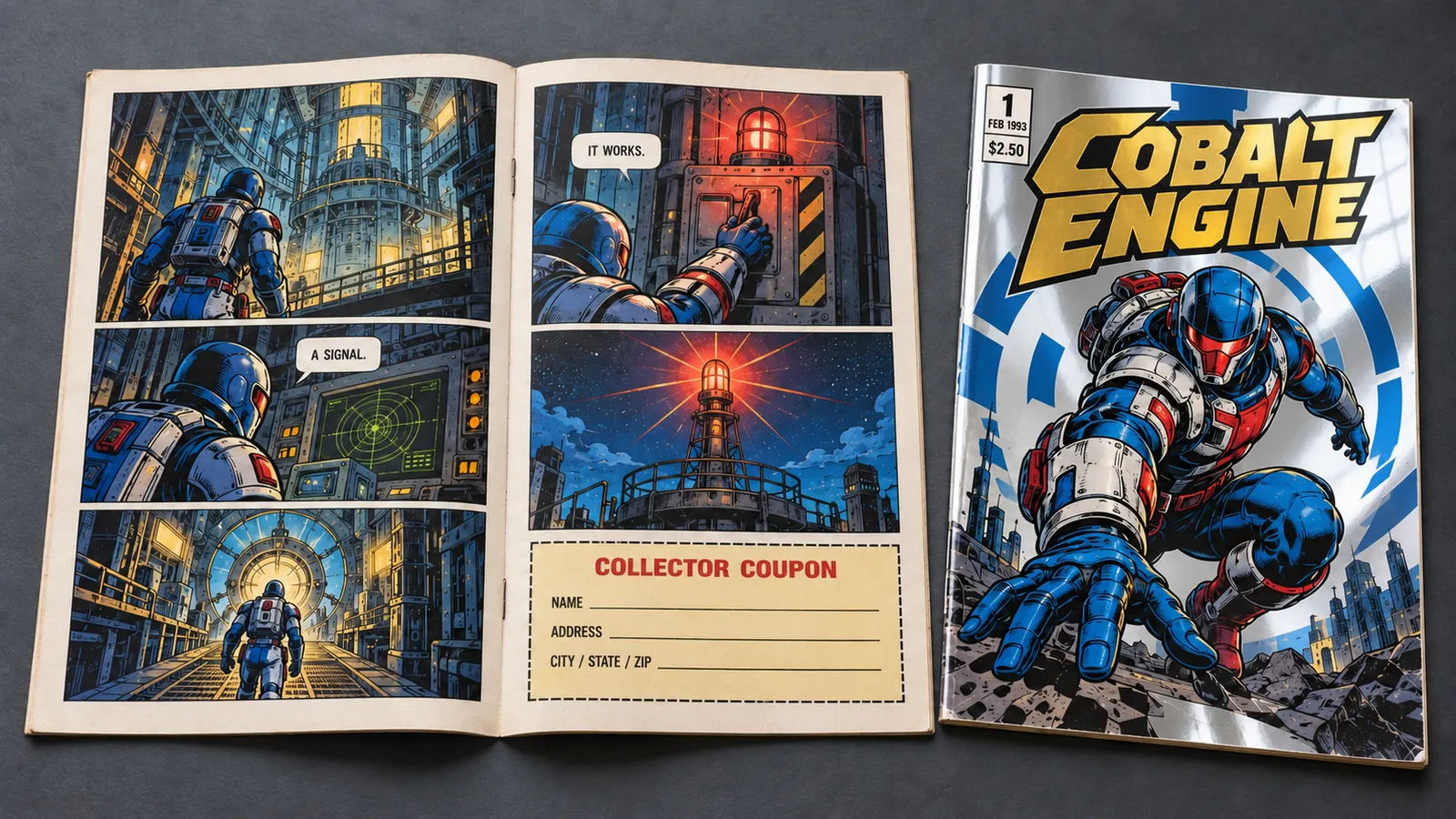
Valiant introduced its chromium covers with Bloodshot #1, cover-dated February 1993, and used them on later issues such as the X-O Manowar #0 gold edition. Chromium issues sold in very large numbers, so the finish alone does not make a copy scarce. Valiant Entertainment also used chromium variant covers on later series, including the Armor Hunters titles, so a chromium cover does not prove an early-1990s copy.
The published grade descriptions allow no surface wear at 9.2 NM- and above, and only wear you can barely see at 9.0 VF/NM. On a mirror finish, a light scratch, a scuff or a small dent shows clearly, so surface wear can decide whether a chromium copy reaches the top of the scale.
To inspect a chromium or foil cover:
- Handle the book by its edges, because fingerprints show on a mirror finish. Do not rub the cover to clean it.
- Lay the book flat on a dark, non-glossy surface, away from overhead light.
- Set a lamp low to one side, so the light skims across the cover.
- Move the lamp slowly. A scratch or dent stays in place, and a reflection slides across the cover.
- Repeat from the other side and along the spine. Note each mark with its size and place, for example "a 1/2 inch hairline scratch above the logo".
A straight-on photo of a chromium cover mostly shows reflections. For the angles and light that show the surface, see how to photograph a comic so the flaws show.
Write down the version before you look at prices
Record the version in a fixed order, so you compare your copy only with sales of the same thing:
- Read the indicia: title, issue number, cover date and publisher.
- Name the edition: regular, gold (and which gold), mail-away, facsimile or another variant.
- Check completeness: the coupon, any insert such as the trading card with Magnus Robot Fighter #0, and every page.
- Inspect the cover surface, under moving light if it is chromium or foil.
- Estimate a grade band and name the defect that limits it, as in how to grade a comic at home.
- Only then look for sold copies that match every line.
VALIANT VERSION RECORD
Title and issue:
Cover date (indicia):
Publisher (indicia):
Edition: regular / gold (flat or embossed) / mail-away /
         chromium / facsimile / other:
Coupon: present / cut / none printed
Insert or card: present / missing / none issued
Cover surface: scratches, scuffs, dents (size, place):
Limiting defect:
Grade band:            to
Matched sales (date, edition, coupon, grade, raw or graded):
How to compare sold prices for a Valiant comic
Use only completed sales of copies that match your record on every line: the same issue and year, the same edition, the same coupon status and a grade inside your band. Asking prices tell you what a seller hopes for, not what a buyer paid.
Keep raw and graded sales apart. A raw copy listed as "near mint" carries the seller's opinion, while a graded copy carries a grade from an in-hand inspection, so the two sell differently. Write the date next to every sale, because prices for a given version move over time.
If you find only a few matching sales, say so and keep a wide range rather than borrowing prices from another version. A gold edition is not a comparison for a regular copy, and a 2012 #1 is not a comparison for a 1992 #1. For a full method to find honest comparable sales and do the break-even math, see is this comic worth grading. The same matching problem comes up with 1970s price variants, covered in Bronze Age comics: keys, price variants and condition.
Is a Valiant comic worth professional grading?
Professional grading makes sense mainly when the version is confirmed and the copy looks high grade, because it costs money and time. For a common issue in average condition, the cost can be more than grading adds.
The candidates are the specific versions above, complete with their coupons and inserts, with a clean surface under moving light. For those, a careful home check comes first, then the break-even math.
A photo report is a first step that keeps the book in your hands. NuGrade gives a grade on the 10-point scale with a plausible range and findings tied to the photo or video frame each came from, and a buyer can check the report on the report lookup page. It is an opinion limited to what the photos and video show. It does not replace professional grading for a high-value copy, and good restoration can stay hidden in ordinary light.
Frequently asked questions
Are 1990s Valiant comics worth money?
Some are, but many issues from 1992 and 1993 sold in very large numbers. The copies that draw interest are specific versions, such as mail-away issues and gold editions, in high grade and complete with their coupons. Check recent sold prices for copies that match yours.
How can you tell an original Valiant comic from a later relaunch?
Read the indicia, the small print on the first page or inside the front cover, for the publisher and the cover date. The same title and number exist from the original early-1990s line, the Acclaim Comics relaunch of 1996 and 1997, and Valiant Entertainment's series from 2012 on.
Does a cut coupon lower the value of a Valiant comic?
Yes. A cut coupon is a defect because part of an interior page is missing, so compare a coupon-cut copy only with other coupon-cut copies. Harbinger #1 to #6 and Magnus Robot Fighter #1 to #8 each carried a coupon.
What is a gold edition Valiant comic?
A gold edition is a special version of an issue with a gold logo or gold finish, which collector references describe as incentive copies for retailers and promoters. Some issues, such as Eternal Warrior #1 from 1992, have more than one gold version, so match the exact one.
How should you handle a comic with a chromium cover?
Hold it by the edges, keep it in a bag with a backing board, and inspect it under a low lamp that you move slowly. A mirror finish shows scratches, scuffs and fingerprints, and a straight-on photo can hide them in reflections.