AI comic grading and human grading differ mostly in what each can examine. A person with the book in hand can tilt it under any light, feel and smell the paper, and measure it. An AI grader sees only the photos and video, but a good one ties every finding to its evidence. Compare the two by their findings first and their numbers last.
NuGrade, an AI-assisted grading app for raw comics, publishes this blog, so run the comparison below on our reports too. This post makes no accuracy claims for NuGrade or for people; it shows you how to find out why two opinions on one book differ.
How AI and human comic grading differ, side by side
A person in hand has more evidence; a photo-based AI grade has fixed inputs and, at its best, a record that someone else can check.
| Photo-based AI grade | A person with the book in hand | |
|---|---|---|
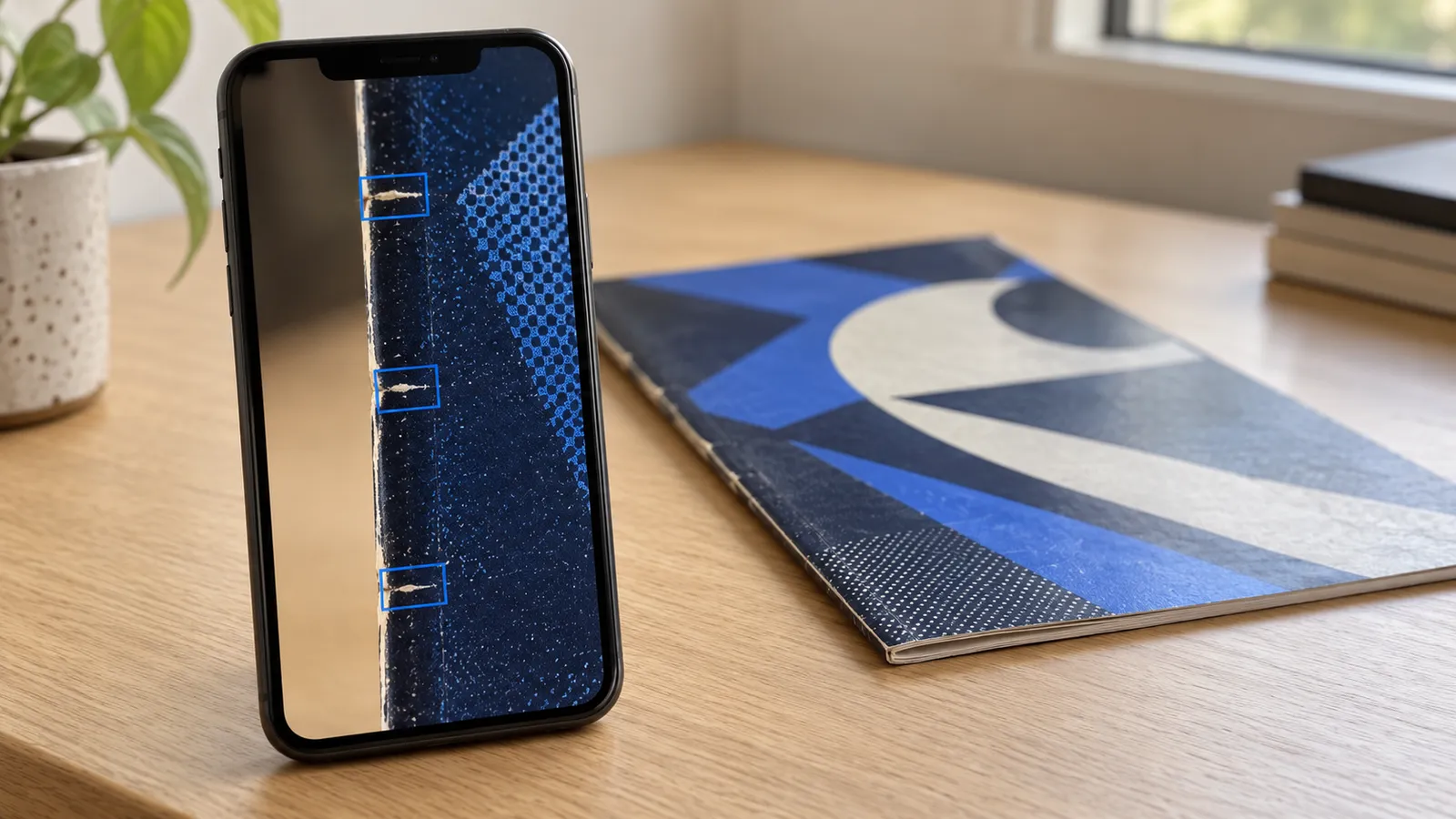
| Light | The light the owner had; NuGrade's spine and page-flip videos add changing angles | Any angle, as often as needed, at the exact spot |
| Touch and smell | None; odor and brittleness come only from the owner's survey answers | Can feel whether the paper is supple and smell acidic or musty paper |
| Measurement | Proportions in a photo; a trim of a small fraction of an inch can be too small to measure | A ruler beside the book: crease length, tear size, the book's height and width |
| Restoration | Can flag obvious work; competent work can be invisible in photos, so NuGrade marks restoration Unverified when photos cannot establish it | Can examine a suspect area closely, though skilled work takes training to find |
| Coverage | Only what was captured; NuGrade requires both covers, four corners, the staple seam, a spine pass and a page flip | Whatever the person looks at; a quick look can skip the back cover or the staples |
| Consistency | NuGrade uses one written method and stamps its version on each report; the result still moves with the photos | Experience that no written method holds; the standard can shift with the light, the hour and the person's stake in the book |
| Speed | NuGrade's capture takes under three minutes for a prepared book; a push notification and an email say when the report is ready | Minutes, if a collector or a shop is at hand; a grading service means shipping the book out and back |
| Record | NuGrade: findings by area, each with its photo or frame, a plausible range and the flaw that limits the grade | Whatever the person says or writes; an informal opinion often leaves no record |
Neither column wins outright. Consistency is not accuracy: a written method can repeat one misreading on every book, and an inconsistent person can still be right about the book in hand.
The record is what makes a check possible. A finding with a cited photo can be tested by you, a second person or a buyer, and anyone can open a NuGrade report from its ID on the lookup page. For what each free and paid route gives back, see free and cheap grading options.
Why AI and human grades disagree
Disagreements usually trace to one of three causes: different evidence, a book on a grade boundary, or a different standard for manufacturing defects. Name the cause before you argue about the number.
The evidence was not the same
The simplest cause is that one side saw something the other did not. In hand, a person can find a hairline spine tick that shows only with the lamp low, pages that flake at the corners, a musty smell or an edge that measures short. Every NuGrade report says so: defects smaller than the photos resolve may exist and would lower the grade if confirmed in hand.
It runs the other way too. The capture always includes the back cover, the staple seam and a page flip-through, so a photo grade can record a mark on an ad page that a quick look through the bag skipped. A person may also know the book was pressed or cleaned, while NuGrade has only the owner's survey answers on that.
The book sits on a grade boundary
A boundary judgment is a call between two neighboring grades on findings that both sides accept. The Marvel Presents: Guardians of the Galaxy #4 sample report graded 7.5 VF-, with a range of 7.0 FN/VF to 8.0 VF. Its limiting flaw is an accumulation of small stress ticks along the spine, several breaking color against the black cover. The standard 10-point scale allows a moderate defect or an accumulation of small ones at both 8.0 VF and 7.5 VF-; what separates them is how attractive the book still looks.
So a person who accepts every finding could still say 8.0 VF, and that would be judgment, not a missed defect. When the photos cannot settle an area, a NuGrade report says so. A person also has to make a call on a borderline book, so ask which way they went and why. For the tier names, see what VF, FN and NM actually mean.
Manufacturing defects are counted differently
A manufacturing defect is a flaw the book left the printer or bindery with, such as a miswrap (a cover that rides to one side of the pages), an off-center cut, a bindery tear or a printing error. Some collectors ignore these because no handling caused them.
The published grade descriptions do not. The standard scale lists manufacturing defects next to handling defects in its top tiers, and only a 10.0 GM is free of both. The longer descriptions allow subtle bindery or printing flaws at 9.4 NM and a limited number of minor ones at 9.2 NM-. NuGrade reports list these flaws in their own Production area, so you can see them apart from handling wear.
How to compare an AI grade with a human opinion
A fair comparison holds the book and the evidence constant and keeps the numbers hidden until the findings are written.
- Use one copy, in one state. Confirm it is the same copy with a mark you can find in the report's photos and on the book, such as a crease or an arrival date. Do not press, clean or otherwise change the book in between.
- Decide what you are testing. If the person grades from the same photos and video, a gap tests judgment. If they hold the book, a gap can come from evidence or judgment.
- Get the findings before any number. Ask the person to list each defect with its size and place, and the worst one, before naming a grade; the at-home inspection order works as a script. Do not show them the AI grade first, because a number heard early can pull the findings toward it.
- Compare the limiting flaw first. The limiting flaw is the single worst defect, the one that sets the ceiling on the grade. If both name the same flaw, a one-step gap is likely a boundary call; if not, look at the evidence for both.
- Line up the rest by area. Mark each finding as seen by both, AI only, person only, or both at a different size. For an AI-only finding, open the cited photo or frame and find the spot on the book.
- Write down each disagreement and its cause: evidence, boundary, manufacturing standard, disclosure or a different copy.
- Ask a second person, blind. A blind second opinion is a grade from someone who has seen neither the first grade nor the report. Give them the same evidence and ask for findings first. If the two people agree with each other but not with the AI, look hard at the evidence; if they also disagree with each other, the book may sit on a boundary.
- Compare the numbers last. Check whether each human grade falls inside the AI report's plausible range, the span the grade could move if the uncertain findings went the other way.
A comparison sheet you can copy
Fill in the findings before anyone shares a grade, and the grades last.
AI VS PERSON: ONE BOOK
Book (title, issue, publisher, date):
Same copy? Mark found in both:
AI report ID and date:
Person and role:
Person's evidence:        same photos | book in hand
Saw the AI grade first?   yes | no

FINDINGS (fill before any grade is shared)
Area          AI finding        Person's finding    Match?
Cover
Corners
Edges
Spine
Staples
Interior
Page color
Restoration
Production

LIMITING FLAW
AI:
Person:
Same flaw?   yes | no

DISAGREEMENTS (cause: evidence | boundary |
manufacturing | disclosure | other copy)
1.
2.
3.

GRADES (fill last)
AI grade and range:
Person's grade:            Inside the range? yes | no
Blind second person:       Inside the range? yes | no
What to do when two grades are one step apart
Find the one finding that drives the step, then settle it on the book. Do not split the difference: there is no 9.3 on the scale, and an average is a grade neither opinion supports.
The E-Man #1 sample report (Charlton, 1973) graded 9.2 NM-, with a range of 8.5 VF+ to 9.4 NM. Its only two findings are production flaws: a slight miswrap that leaves a narrow unprinted strip along the front spine edge, and a small dark mark at the left edge of the back cover, likely a bindery or printing artifact. The other areas read clean, and restoration reads None detected, with the note that photos can miss skilled work.
The second opinions below are hypothetical examples, not real grades of this copy.
| Hypothetical second opinion | Ask first | What the answer tells you |
|---|---|---|
| 9.4 NM, one step up | Did you count the miswrap and the back-cover mark? | If they were set aside as factory flaws, the gap comes from a manufacturing standard, and the question becomes whether these flaws are subtle (fits 9.4) or minor (fits 9.2) |
| 9.0 VF/NM, one step down | What did you find that the report does not list? | If it is a defect seen in hand, such as a fine spine tick, the gap is evidence; a defect the photos did not resolve is still a defect |
| 8.0 VF, outside the range | Is this the same copy, in the same state? | A gap beyond the range points to a missed defect, a different copy, a changed book or a different reading of the scale |
In each case, the next step is one finding, checked on the book at that spot. Once it is settled, the gap closes or becomes a boundary call you can state openly, such as "9.2 or 9.4, depending on how you count the miswrap."
What a fair comparison cannot tell you
A comparison tells you why two opinions differ on one book. It cannot tell you which grader is more accurate in general, and agreement does not prove a grade right.
Accuracy needs many books chosen before anyone grades them, in-hand reference grades from independent professionals, and a count of how often the reference grade landed inside the stated range. A few books you picked cannot supply that; for the questions to ask about any published figure, see what a photo grade can miss. Two opinions can also share a blind spot: competent restoration can be invisible in photos and easy to miss in a quick look.
A NuGrade grade is an opinion limited to the evidence in the photos and video. It does not replace professional grading or encapsulation, and defects smaller than the photos can show may exist. For a valuable book, professional in-hand grading remains the reference: it adds trained examination, restoration screening and a tamper-evident holder that is itself part of the resale value. Use the comparison to decide whether a book is worth sending for professional grading, not as a stand-in for it.
Frequently asked questions
Is AI comic grading as good as human grading?
Neither is better across the board. A person with the book in hand has more evidence, including touch, smell and measurement, while a photo-based AI grade sees only the photos but can tie every finding to its evidence. For a valuable book, professional in-hand grading remains the reference.
Why do AI and human comic grades differ?
A gap usually has one of three causes: one side saw evidence the other did not, the book sits on a boundary between two grades, or the two count manufacturing defects such as a miswrap differently.
How do you compare an AI grade with a human grade fairly?
Use the same copy and the same evidence, get the person's findings before any grade is shared, and compare the limiting flaw first. Then record each disagreement with its cause and ask a second person to grade the book blind.
What should you do when two comic grades are one step apart?
Find the single finding that drives the step and check it on the book at that spot. If both opinions agree on every finding, the step is a boundary judgment, which a grade range already expresses.
Can a person check a NuGrade report finding by finding?
Yes. Each finding cites the photo or video frame it came from, so a person can open that evidence and find the same spot on the book.