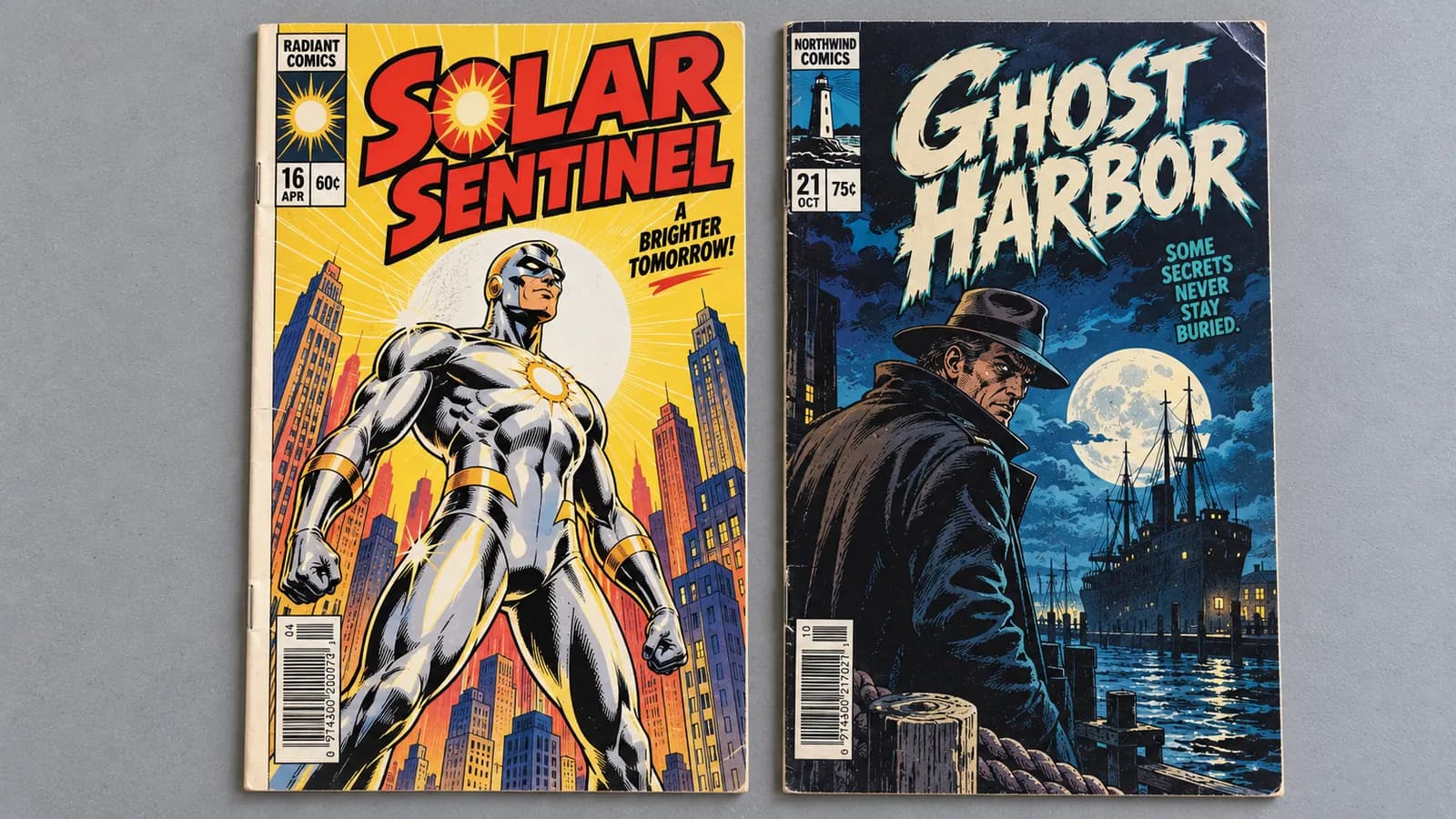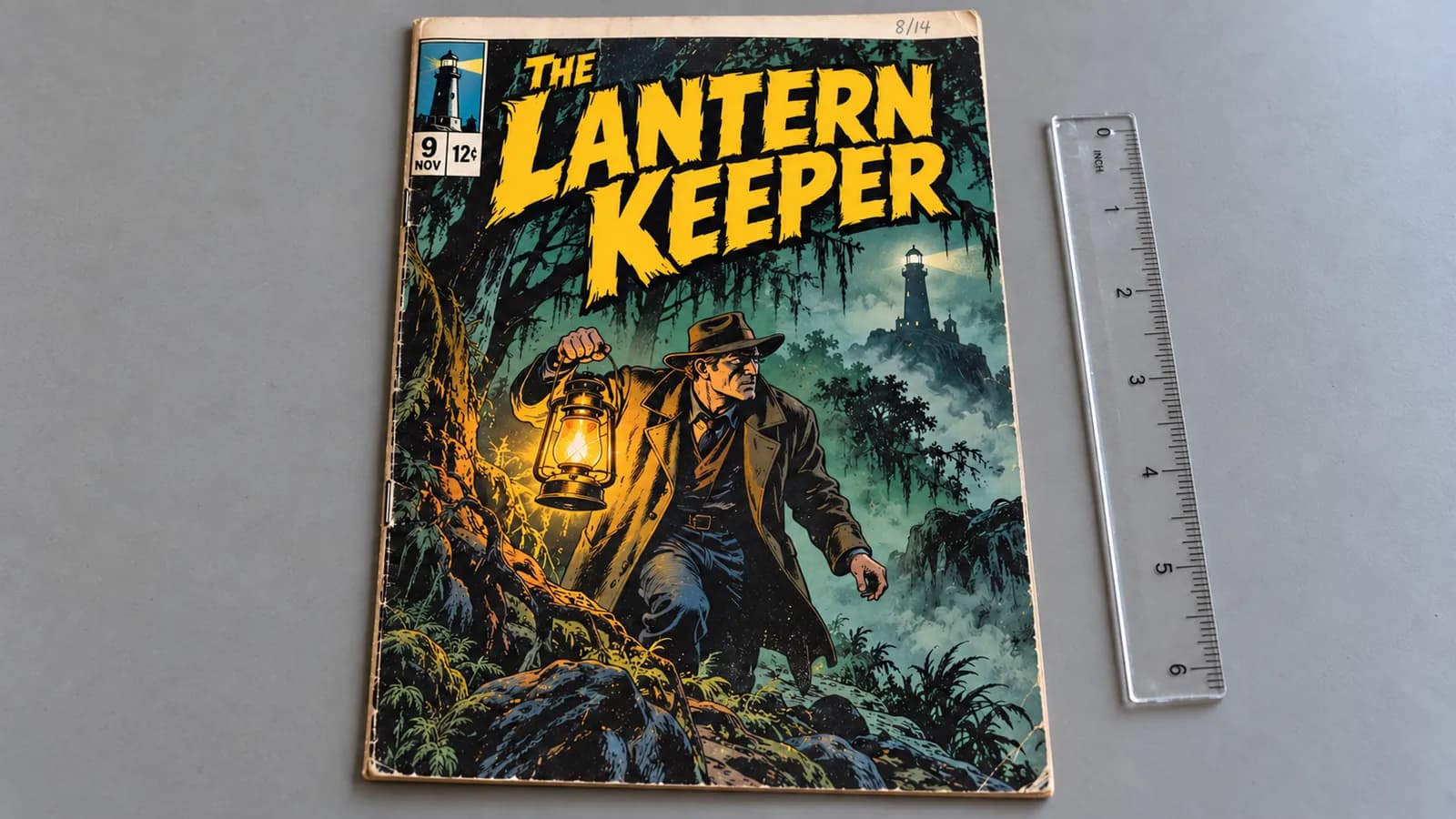
An arrival date is a date that a newsstand, store or local wholesaler penciled, inked or stamped on a comic's cover when the copy came in. The published grade descriptions accept a small, light arrival date in an out-of-the-way spot as high as 9.9 MT, and several at 9.0 VF/NM. Store stamps, names, initials and prices get no such allowance above 4.0 VG.
Marks like these are history, and some help date a release or trace a copy, but a grade measures condition. A mark's cost depends on what it is, where it sits and how much it draws the eye. A cut coupon costs far more than any mark. Never erase or peel off a mark.
What is an arrival date, and who wrote it?
An arrival date is a record of when one copy reached one seller. Newsstand comics were sold on a returnable basis, so a seller needed to know how long a copy had been on the rack, and sellers often wrote or stamped the date of arrival on the cover.
You will see it as a month and day in pencil, an inked date or a rubber-stamped date, sometimes with a letter or number beside it. It usually falls before the cover date, because publishers printed cover dates later than the real on-sale date. Two copies of the same issue can carry different dates, because shipments reached different sellers on different days.
Do not confuse an arrival date with the printed date on the cover or in the indicia. Those are on every copy; an arrival date belongs to one copy.
How do arrival dates affect a comic's grade?
A small, light arrival date in an unobtrusive spot does not lower the grade under the published descriptions, even near the top of the scale. A stamped date gets the same allowance as a penciled one, as long as it is small and out of the way. The allowance widens as the grade drops:
| Grade | What the published descriptions accept |
|---|---|
| 10.0 GM | Not listed as acceptable; no owner signatures inside either |
| 9.9 MT to 9.2 NM- | Small, light dates in pencil, ink or stamp, in a spot that does not draw the eye |
| 9.0 VF/NM | Several light dates |
| 8.5 VF+ to 5.0 VG/FN | A stamped or inked date is allowed |
| 4.0 VG and below | Arrival dates, store and name stamps, and initials do not affect the grade |
Read the conditions as well as the grades. At the top of the scale the date must be small, light and out of the way, so a large, dark stamp across the artwork loses the allowance and is judged on eye appeal, like other writing.
These descriptions are a hobby convention, and each grading service applies its own standard, so graders can weigh a borderline mark differently. For whose convention the scale is, see what VF, FN and NM actually mean.
How other marks are graded
Above 4.0 VG, the descriptions give no allowance to any writing or stamp except an arrival date, so other writing and stamps count as defects. Their cost depends on medium, place, size and how much they distract.
| Mark | Usually made by | How grading treats it |
|---|---|---|
| Store stamp or name stamp | A shop, a newsstand or an owner | A defect above 4.0 VG; no effect at 4.0 VG |
| Name or initials | An owner | A defect above 4.0 VG; initials have no effect at 4.0 VG |
| Pencil price | A used-book shop, a dealer or a seller | Not named in the descriptions; graded as writing |
| Check mark, letter or number | A distributor, a seller or an owner, often unknown | Graded as writing |
| Distributor stripe | A regional distributor | Often treated as part of the book's history |
| Price sticker or its residue | A store or a seller | Not named in the descriptions; judged by what it hides or leaves |
| Cut coupon or cut-out stamp | A reader | Missing paper, first accepted at 1.0 FR |
Store stamps, name stamps and pencil prices
A store stamp is a shop's or newsstand's name, sometimes with an address, stamped in ink on a cover. A name stamp is an owner's name from a rubber stamp. A pencil price is a price that a used-book shop, a dealer or a seller wrote on the cover or an inside page.
Place and medium decide most of the cost. A small stamp in a back-cover margin draws the eye less than one across the front artwork, and light pencil on an inside page costs less than dark ink on the cover.
Names, initials and check marks
An owner's name or initials count as writing. The 4.0 VG description lists initials among the marks with no effect, the 10.0 GM description rules out owner signatures inside the book, and the 0.5 PR description includes covers defaced with indelible markers, paints or dyes. A creator's autograph is a separate subject with its own rules.
A check mark, a single letter or a number often has no recorded meaning. Some came from a distributor's coding and some from an owner, and you usually cannot tell which. Record it as writing and describe exactly what it looks like.
Distributor stripes and price stickers
A distributor stripe is a streak of paint or ink across the top edge of a book, which a regional distributor brushed or sprayed on a whole stack to code it for returns. You see them on some newsstand copies, especially from the 1970s. Many collectors treat a stripe as part of the book's history, but paint that strayed onto the cover art affects eye appeal.
A price sticker hides part of the cover, and it holds on with a pressure-sensitive adhesive, like self-stick tape, which the Library of Congress warns is very hard to remove and can cause problems over time. The descriptions do not name stickers, so a grader weighs what the sticker hides and what its adhesive has done. Leave it in place.
Cut coupons and value stamps are missing paper
A cut coupon is not a mark: it is a hole where paper used to be. The published descriptions first accept a cut coupon at 1.0 FR, so a missing coupon costs far more than any pencil date.
Many older comics printed order forms, club coupons and contest entries meant to be cut out. Marvel printed value stamps on the letters pages of its comics between 1974 and 1976, for readers to cut out and save in a mail-order booklet, so check that page on Marvel books from those years. A cut-out stamp takes part of the leaf with it, along with whatever was printed on the back.
The descriptions also name one era-specific cut: a 1960s Marvel with the price corner box clipped from the top-left of the front cover may still be considered 2.0 GD if it would otherwise grade higher. Grading services set their own rules for a missing coupon, so check before you submit one. For other flaws that cost more or less than they appear to, see defects that look worse than they are, and the reverse.
Marks that help date or trace a copy
Some marks are worth keeping for what they record, though they never add grade points. An arrival date shows when one copy reached one seller, and enough of them can date a release.
Fantastic Four #1 is cover-dated November 1961, yet it was on newsstands by August 1961, and arrival dates on surviving copies are part of the evidence.
A mark can also tie a copy to a known collection. Many copies from the Lamont Larson collection, comics one reader bought new in Nebraska, carry his name penciled on the cover, and collectors use it to identify them. Erasing that name would remove the plainest sign of where the copy came from.
An ordinary mark helps too: a distinctive date or stamp lets you match a copy to its own older photos. Keep history apart from condition, because "a known-collection copy" is a claim that needs its own evidence.
Why you should never erase or peel off a mark
Do not erase, scrape, cover or peel off a mark. Removing one is a restoration question, not a home job, and a failed attempt adds damage that is graded as damage.
An eraser can scuff the cover's ink and gloss, water and solvents can stain or ripple the paper, and a peeled sticker can take ink or paper with it. Covering a mark is no better: the standard restoration scale lists pen, marker and white-out among the materials of its lowest quality level.
Professional cleaning exists, and its method decides whether a grading service treats the work as restoration, conservation or neither. The guide to what pressing can and cannot fix explains how graders treat cleaning. If you know a mark was removed, say so when you sell.
The same Library of Congress FAQ suggests leaving a rarely handled collectible with minor damage as it is, improving its storage instead, and consulting a paper conservator for anything complicated. Its care guide for comic books also rules out self-adhesive tape and glue.
How to record a mark, and what photos can settle
Record a mark the way you record any defect: what it is, what made it, where it is and how big it is.
- Name the mark and its medium: pencil, ink, rubber stamp, marker, sticker or residue.
- Give its place in plain words, such as "front cover, top margin, left of the logo".
- Measure it with a ruler beside the book, never on it.
- Check that it is not printed. An artist's signature or a credit box can be part of the art, so compare a cover image of another copy.
- For a faint mark inside, look at the back of the same leaf, because print that shows through thin paper can look like pencil.
- Photograph it flat, then with the lamp low to one side, with the ruler in frame. The guide to photographing comics so the flaws show covers the light.
- Write down what you know of its history, including any cleaning or removal, and what you do not know.
MARK RECORD (example values, not a real book)
Mark:      Arrival date, light pencil, month and day
Place:     Front cover, top margin, left of the logo
Size:      About 1/2 inch wide
Printed?:  No. Not on other copies' cover images
History:   No cleaning or removal known
Effect:    Fits the arrival-date allowance (small, light)
Unknown:   Who wrote it
Add each mark to the condition record from the photo-first home grading checklist.
Photos settle some marks and leave others open. NuGrade, an AI-assisted grading app for raw comics, cites each finding to the photo or video frame it came from. Its sample report for E-Man #1 (Charlton, 1973), graded 9.2 NM- on September 30, 2026, notes that the cover credit box "reads as printed artwork" and files a small dark mark at the left edge of the back cover under production, "likely a bindery or printing artifact." The Marvel Presents: Guardians of the Galaxy #4 report records faint marks on two ad pages as a possible defect "which could be pencil writing or show-through," and its 7.5 VF- grade comes from color-breaking spine ticks instead. These are examples of what photo evidence shows, not proof of accuracy.
Light pencil can be finer than a photo resolves, and careful removal can leave nothing a photo shows, which is why a NuGrade report reads Unverified for restoration when the photos cannot establish it. NuGrade's survey asks about cleaning and tape removal, history that no photo shows. Buyers can open any report by its ID at the report lookup page, with no app or account.
Frequently asked questions
Does an arrival date lower a comic's grade?
Not when it is small, light and in an unobtrusive spot: the published grade descriptions accept such a date as high as 9.9 MT, and several at 9.0 VF/NM. A large, dark date across the artwork is judged on eye appeal, like other writing.
Who wrote arrival dates on old comics?
Newsstands, stores and local wholesalers wrote or stamped them to record when a copy arrived. Newsstand comics were sold on a returnable basis, so the date showed how long a copy had been on sale.
Does a store stamp or a name on the cover lower the grade?
Yes, above 4.0 VG, where the published descriptions give those marks no allowance. At 4.0 VG, the descriptions say store stamps, name stamps and initials have no effect on the grade.
Should you erase pencil writing on a comic?
No. Removing a mark is a restoration question for a professional, an eraser can scuff the cover, and any removal you know about should be disclosed when you sell.
Does a missing Marvel value stamp lower the grade?
Yes, sharply, because the stamp was printed on a page and cutting it out removes paper. The published descriptions first accept a cut coupon at 1.0 FR, and grading services set their own rules for a missing stamp.