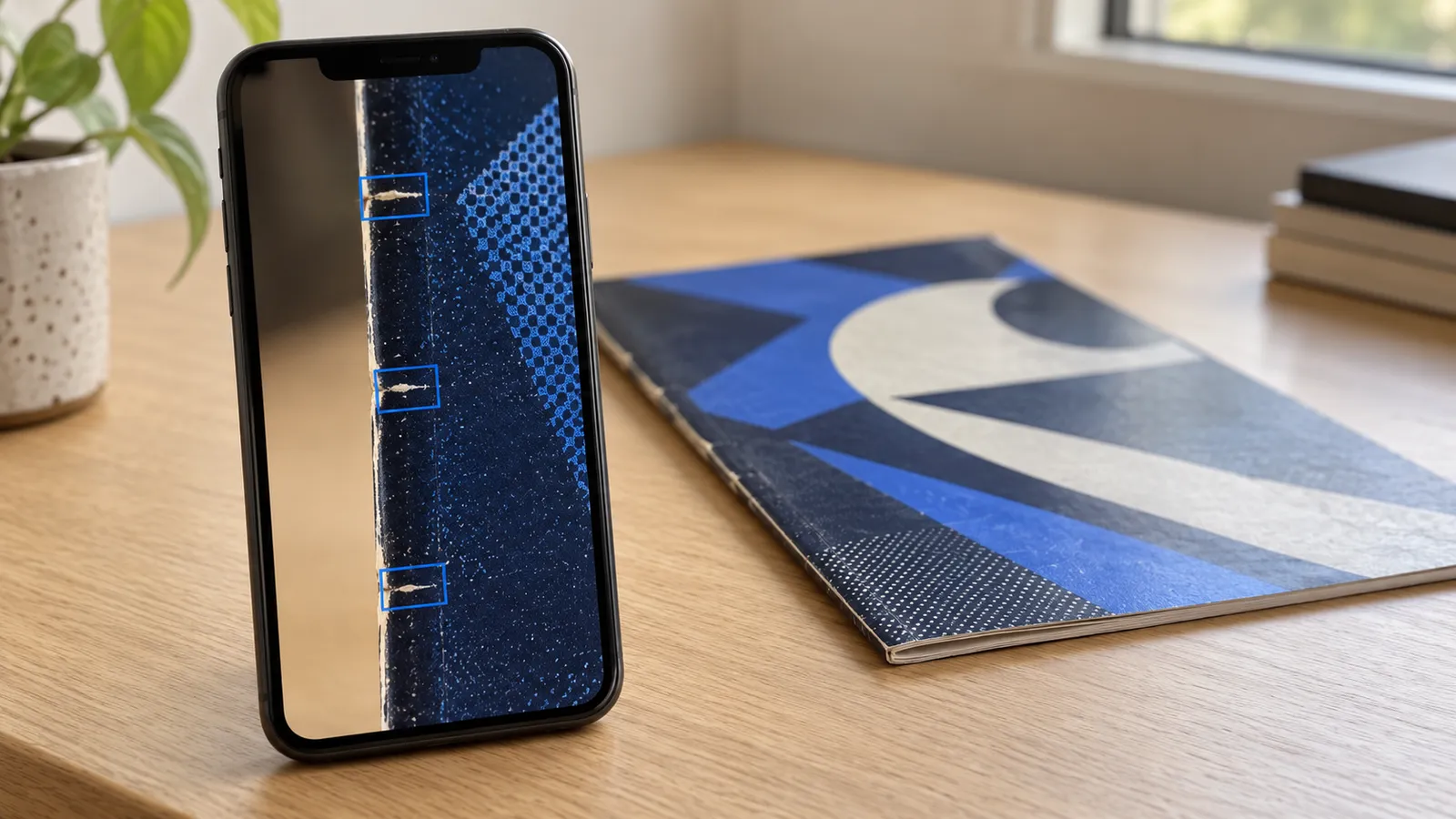
A miswrap is a factory centering defect: the cover was folded around the pages off its intended line, so a strip of back cover or bare paper shows at the front spine edge, or front art wraps onto the back. Grading treats it as a manufacturing defect weighed by size and visibility, with no fixed grade cap. Judge it from full front, back and spine views, not one crop.
A tight close-up of the spine edge can make a harmless factory strip look like wear, color break or a split. A public sample report from NuGrade, an AI-assisted grading app for raw comics, shows what a slight miswrap does to a grade.
The E-Man #1 report: a slight miswrap on a 9.2 NM- book
The E-Man #1 sample report records a slight miswrap on a book that still graded 9.2 NM-, with a plausible range of 8.5 VF+ to 9.4 NM. NuGrade graded this Charlton comic, cover-dated October 1973, on September 30, 2026 from seven phone photos and two short videos.
Its only two findings are filed under Production, not wear:
- "Slight miswrap: a narrow unprinted strip runs along the front spine edge"
- "Small dark mark at the left edge of the back cover, likely a bindery or printing artifact"
Cover, corners, spine, staples, edges, page color, page structure and interior all read clean. The pages are Cream to Off-White, and all 36 are accounted for in the page-flip count.
What the report knows, and what it does not
The strip is a plain finding. The mark is only "likely" a factory artifact, and that hedge is honest: a photo cannot always tell ink printed into the paper from something that landed on it later. For marks that may be stains, see what a stain or water ripple looks like.
Both findings sit under the report's "why not higher" heading. The grade is one opinion from photos, not proof of an in-hand grade: the range reaches two steps below 9.2 and one above, and the disclosure says defects smaller than the photos resolve may exist and would lower the grade if found in hand. Restoration reads None detected, with the note that photos can miss skilled work.
Charlton printed and bound its own comics in Derby, Connecticut, and its books have a reputation for cheap paper and color that did not always line up. That is context, not a diagnosis of this copy.
Miswraps, centering and other factory defects
A manufacturing defect is a flaw made at the printer or bindery before the book was sold; handling damage is everything after. Most factory flaws put something in the wrong place, such as the fold, the cut, the color or the staples, while handling marks, wears, bends or breaks what was already there.
Centering is how squarely the cover, the cut and the staples sit on the book. The published grade descriptions give no centering percentage, and the only part they ask to be centered, at the top grades, is the staples.
| Factory defect | What it looks like | What it can pass for |
|---|---|---|
| Miswrap | Back-cover art or bare paper along the front spine edge, or front art wrapping onto the back; even in width, or tapering steadily | Spine wear, color break, a split |
| Off-center cut | Extra margin along one cut edge, art cut short along the opposite one | Trimming |
| Misregistration | Color printed out of line with the black outlines, shifted the same way everywhere | Color flecks, smudges, touch-up |
| Bindery tear | A short, clean tear at a cut edge or the spine, with no crease or wear around it | A handling tear |
| Overhang or short cover | The cover standing past the pages, or the pages past the cover | Trimming, if the cover is flush with or shorter than the pages |
| Off-center staples | A staple at an angle, or off the fold | A replaced staple |
A bindery tear is the exception to the wrong-place rule: a small tear made at the bindery, which a photo may not separate from a handling tear, so write "possible bindery tear" unless the evidence is clear. A short cover can come from the factory, but it is also a sign of trimming.
The Green Lantern #59 sample report records one factory flaw: the cover edge "sits slightly proud of the page block at the top-right, consistent with a mild bindery overhang." Color-breaking spine ticks, not the overhang, set its 5.5 FN-.
Why one tight crop misleads
A tight crop removes the context that separates a factory flaw from damage. In a close-up of the spine edge, a strip of bare paper reads as white, and white against dark ink is what color break, spine wear and a split look like.
Three facts decide the call, and all three sit outside the crop: whether the strip runs the full height, whether its inner edge is a straight printed line, and whether the back cover shows the other half of the shift.
The error runs both ways: a split or a row of color-breaking ticks can hide inside a miswrap strip, where a quick look writes it off as part of the wrap. If a listing shows white along the spine edge, ask for the full front and back covers before you price the flaw.
How to check a suspected miswrap
Lay the book flat on a dark, non-glossy surface under one lamp, with no flash, and work through five checks.
- Shoot the full front cover, square on and edge to edge. Look along the spine edge for a strip of different color or bare paper.
- Follow the strip from top to bottom. A miswrap strip runs the full height at an even width, or tapers steadily if the cover went on crooked. Wear and color break come and go, gathering at the staples and the ends of the spine.
- Look at the strip's inner edge. A miswrap boundary is a crisp printed line or the fold itself, with the paper intact. Color break shows as cracked ink with ragged edges, and a split separates the paper.
- Shoot the full back cover. A miswrap moves the whole cover, so the back often shows the other half of the shift at its spine edge, or an uneven margin at its open edge. Wear does not move art.
- Film or study the spine fold. Look for ticks, stress lines and splits inside the strip as well as beside it, because a book can have both.
When the checks agree, record a miswrap with its size and place; when they do not, record what you saw and what stayed unclear. For framing and the spine video, see how to photograph a comic for grading; the full inspection order is in how to grade a comic book at home.
Does a miswrap cap the grade?
No. Neither the standard 10-point scale nor the published grade descriptions give a miswrap its own grade or a fixed deduction. Both weigh manufacturing defects by size and number, the same way they weigh wear.
Some collectors say a miswrapped book can never reach 9.8, or that every miswrap costs at least half a grade. Those are rules of thumb. Here is what the standard scale says near the top, paraphrased:
| Grade | What the standard scale allows |
|---|---|
| 10.0 GM | No manufacturing or handling defects |
| 9.9 MT | A single, very minor manufacturing defect; no handling defects |
| 9.8 NM/MT | Negligible defects of either kind |
| 9.6 NM+ | Several minor defects of either kind |
| 9.4 NM | Small defects of either kind, plus minor wear |
| 9.2 NM- | Small defects of either kind, plus some wear |
| 9.0 VF/NM | A number of minor defects of either kind |
| 8.5 VF+ and below | Moderate or major defects, or an accumulation of small ones, of any origin |
In that scale, manufacturing defects get extra room only at 9.9, where one is allowed and handling damage is not; from 9.8 down they count beside wear. The longer published descriptions agree: subtle bindery and printing defects near the top, a limited number at 9.2 and 9.0, and a growing accumulation from 8.0 VF down to 5.0 VG/FN. They also allow for era: a bindery tear under 1/16 inch fits 9.4 NM on Silver Age and later books, and tears up to 1/4 inch are noted on Golden Age books.
So the size of the miswrap sets its cost. A slight one, like the narrow strip on E-Man #1, is the kind of small manufacturing defect the 9.4 and 9.2 descriptions leave room for; one that drags a wide band of back-cover art onto the front, or cuts the front art short, costs eye appeal and fits lower descriptions. The exact cost is a judgment, which is one reason an honest grade comes with a range. For the tier names, see what VF, FN and NM actually mean.
Original edges: when a fix becomes restoration
A miswrap or an off-center cut is a factory flaw, not restoration. Trying to fix one is what can turn it into restoration.
Every comic is cut on three sides at the factory. Trimming is cutting those edges again later, to square up a miscut, remove a strip or sharpen worn edges, and it counts as restoration. Adding color counts too, so do not fill a bare miswrap strip with a marker or pencil: that is color touch. Professional grading gives a restored book a restored label, and the market usually values it below an unrestored copy of the same apparent grade.
Signs that edges may not be original include edges too sharp and square for the wear on the rest of the book, a cover flush with or smaller than the pages, one edge cut straighter than the opposite one, and a book smaller than untouched copies of the same issue. None proves trimming on its own, so record it as a question, not a verdict.
Photos can miss a light trim. That is why NuGrade's survey asks the owner about trimming and color touch, and why its reports mark restoration Unverified when the photos cannot establish it. For the rest of what a photo grade can miss, see can AI grade a comic from photos.
How to describe a miswrap when you sell
Name the flaw, give its size and place, and say what you could not settle. A buyer who sees "slight miswrap" beside full front and back covers can judge it; one who finds an unexplained white strip in a crop may read it as damage.
PRODUCTION FLAWS (factory, not handling)
Miswrap:     none / slight / clear
  Strip:     back-cover art / bare paper / front art on back
  Where:     front spine edge / back spine edge
  Width:     about ___ inch, even / tapering
  Back:      matching shift seen: yes / no / unsure
Spine fold:  intact / ticks (where) / split (length)
Cut:         centered / off-center (which edge)
Color:       in register / off register (where)
Staples:     on the fold / off the fold / crooked
Other marks: describe; factory origin likely or confirmed
Evidence:    full front, full back, spine video
Not known:   restoration (photos cannot settle it)
The E-Man #1 finding is a good model of the wording: "a narrow unprinted strip runs along the front spine edge" gives the flaw, its size and its place in one line.
If you attach a NuGrade report, a buyer can open it at the report lookup by its report ID or QR code, with no app and no account, and see each finding next to the photo or frame it came from. The grade is an opinion limited to the photos and video. It does not replace professional grading, which is still the right choice for a high-value book.
Frequently asked questions
Does a miswrap lower a comic's grade?
Yes, as a manufacturing defect, but by no fixed amount. The standard 10-point scale weighs manufacturing defects by size and number, so a slight miswrap costs less than a severe one.
Can a miswrapped comic still grade Near Mint?
It can, when the miswrap is slight and the rest of the book is clean. The E-Man #1 sample report graded 9.2 NM- from photos with a slight miswrap among its two findings, though that is one photo-based opinion, not a promise for other books.
How can you tell a miswrap from spine damage in a photo?
Use the full front cover, the full back cover and the spine, not a crop. A miswrap strip runs the full height at an even width with a crisp printed edge, while damage comes and goes, gathers at the staples and spine ends, and cracks ink or breaks paper.
Is a miswrap considered restoration?
No. A miswrap is a factory defect, so it does not make a book restored. Trimming the book to hide the miswrap, or coloring in a bare strip, would be restoration.
What is the difference between a miswrap and an off-center cut?
A miswrap is a cover folded around the pages off its intended line, so the shift shows at the spine. An off-center cut is a factory cut that landed off the artwork, leaving extra margin along one cut edge and art cut short along the other.