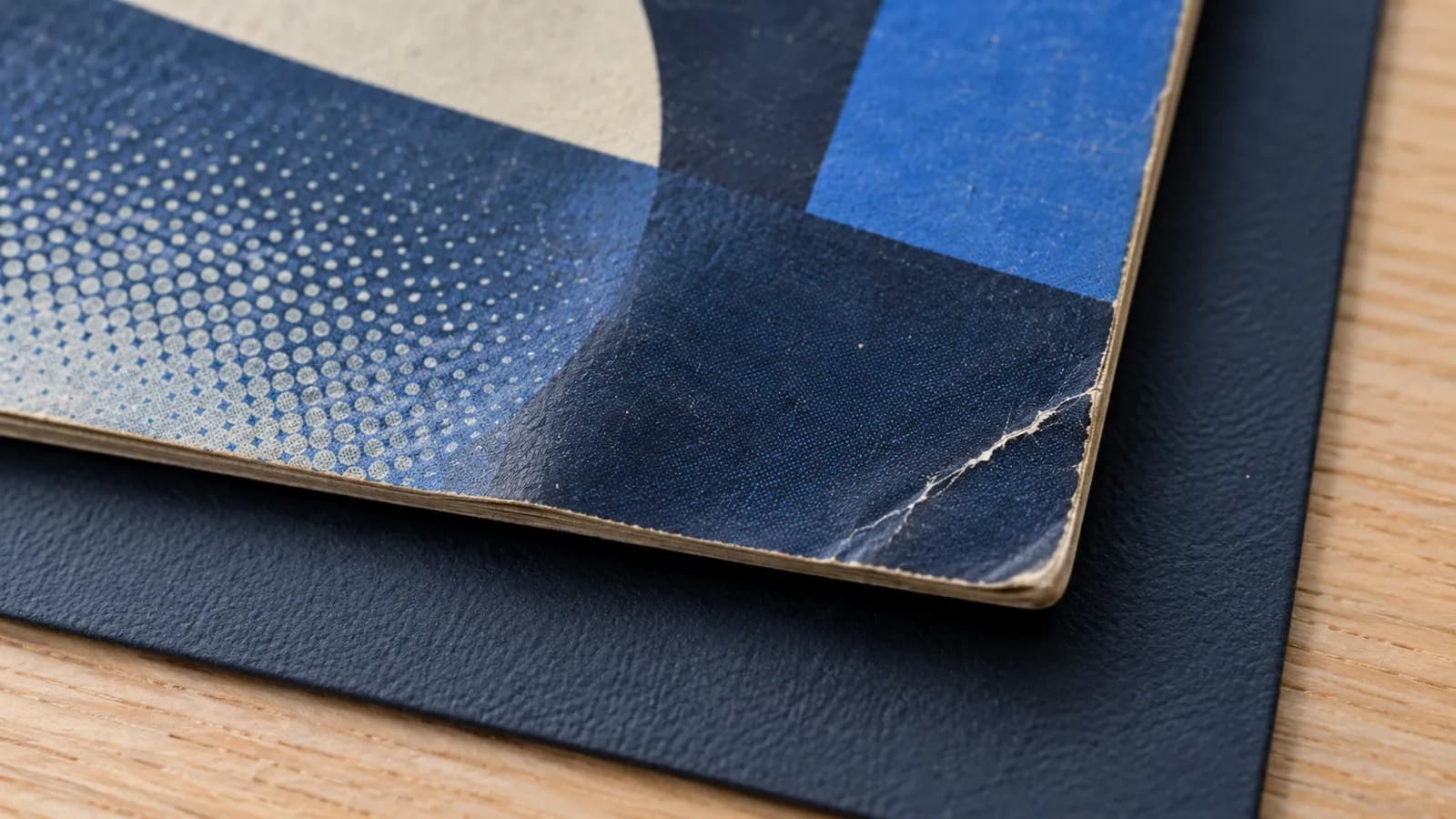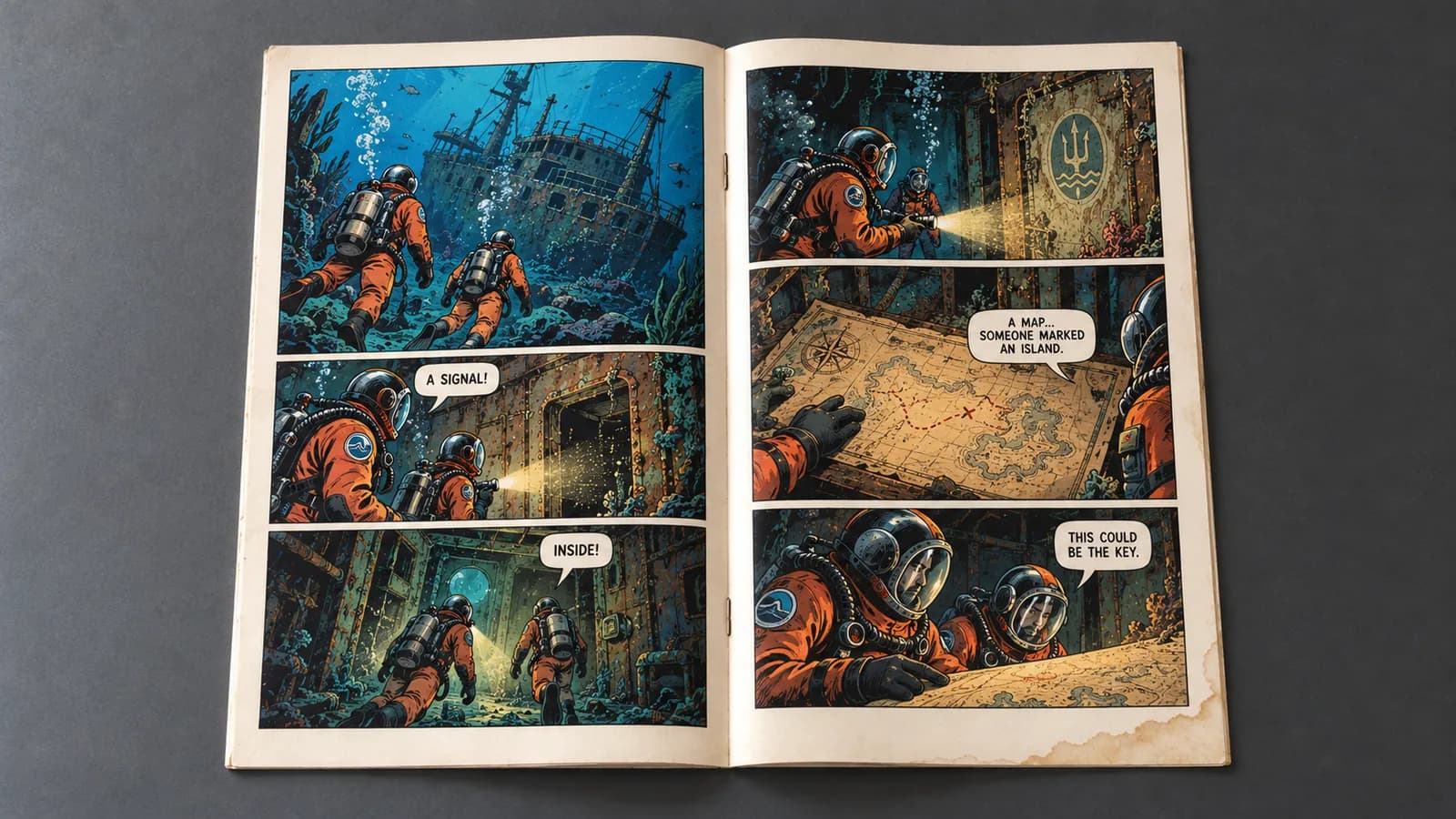
Water damage on a comic shows as rippled paper, a brownish tide line where a wet patch dried, color that ran, rust stains at the staples, or mold and foxing spots, often with a musty smell. The published descriptions for the 10-point grading scale allow slight foxing near the top, first mention minor staining at 6.0 FN, and reserve heavy water damage for 0.5 PR.
A photo cannot record a smell, show whether the paper is still damp, or reveal a faint stain under glare. Light can also fake damage: a lamp shadow, a glare patch or a wrinkled bag can pass for a stain, and a slight wave from humid air can pass for a water ripple.
What water damage looks like on a comic
Water damage is any lasting change that liquid or damp storage leaves in a comic: a change of shape, a stain, rust or mold. One spill or one damp season can cause several at once, so when you find one sign, look for the others.
- Ripples and cockling. Cockling is the puckered, wavy shape paper takes when parts of a sheet swell and shrink unevenly with moisture. On a comic it shows as waves across the cover or along the page edges.
- Tide lines. A tide line is the darker line that forms at the edge of a wet patch as it dries, where the water leaves the dirt and paper breakdown products it carried. A Library of Congress preservation talk describes tidelines as stains that both mar paper and weaken it.
- Stains. A water stain is a patch of discoloration, often with warping, where liquid soaked into the paper, usually bordered by a tide line. Glossy pages that dry while touching can also stick together.
- Color that ran. Color bleed is ink or dye that moved while the paper was wet, leaving a blurred edge, a streak or a tinted halo. Stamped arrival dates and some pen inks can run too.
- Rust at the staples. Rust migration is rust from a staple that has stained the paper around it. Moisture rusts steel staples, so a brown halo at the staple slits is a common trace of a damp past.
- Mold. Active mold shows as fuzzy or powdery growth in clusters, and mold that has dried out can leave dark stains.
- Foxing. Foxing is a scatter of small orange-brown spots in the paper. Comic grading glossaries usually blame mold, and Library of Congress preservation research names traces of copper and iron in the paper as another cause. Damp storage favors both.
- Smell. A musty smell comes from compounds that some molds release, according to the EPA, so it can point to mold even when no spots show. A sharp, acidic smell often goes with aging paper instead.
Other stains: drinks, oil, soiling and tape
Not every stain comes from water. Graders count marks from drinks, oil and fingers as staining or soiling, and tape as an amateur repair.
- Drinks and food. A spilled drink dries like water, with its own tide line, and often leaves a tint from whatever was in it.
- Oil and grease. Oil darkens paper and can make it partly translucent, so print from the other side may show through.
- Fingerprints and dirt. Smudges, finger oils and grime count as soiling, which the published descriptions first mention at 6.0 FN.
- Tape and tape residue. Old tape yellows and can leave a stained or sticky band where it used to be. The published descriptions first allow tape at 4.0 VG, and only minor, unobtrusive tape.
Do not rub a stain, lift tape or try a cleaner yourself: an eraser or a solvent can take ink and paper with the mark.
Look-alikes that are not water damage
Several things look like stains or ripples in a photo without being either. Most come from the light, the camera or the bag, and a few come from the factory.
| What you see in a photo | Probably a look-alike if | Probably real damage if |
|---|---|---|
| A dark band or soft gradient | It shifts or fades when you move the lamp | It stays put under every light, with a defined edge |
| A pale or white patch | It slides when you tilt the book: that is glare | It stays put and looks faded at every angle |
| Wavy lines or bright streaks | They vanish once the book is out of its bag | The paper still ripples out of the bag |
| A gentle wave along the page edges | The paper tone is even, with no tide line, stain or smell | The wave surrounds a tide line, a stain or rust |
| A page that looks tan all over | A sheet of white paper in the same shot looks tinted too | The white sheet stays white and the page stays darker |
| Color on the page-block edges | It is an even distributor stripe across the closed edges | It fades into the margins and ends in a darker line |
A wave from humid air is not a stain, but the top grades describe a flat cover, so it still counts. The Library of Congress newspaper preservation guide warns that relative humidity above 60 percent risks warping and mold in books, so a comic can ripple without ever getting wet. Pressing can often flatten a wave that carries no stain; see what pressing can and cannot fix.
In grading, "shadow" means something else: fading in the shape of an object that shielded part of the cover from light, such as another book in a stack. It is real light damage, not water, and it stays put when your lamp moves.
Factory marks can pass for stains as well. In a sample report from NuGrade, an AI-assisted grading app for raw comics, a small dark mark at the left edge of the back cover of E-Man #1 (Charlton, 1973) is filed under production as likely a bindery or printing artifact. "Likely" is the honest word: from photos, the cause of a small mark is a judgment. For the same question about cover position, see how to tell a miswrap from damage.
How to tell a stain from a shadow or glare
Change the light and watch what moves. A stain belongs to the paper and stays put under every light, while shadows, glare and reflections belong to the light and move with it.
- Take the book out of its bag and lay it flat on a dark, non-glossy surface, with one lamp and no flash.
- Look straight down, then move the lamp low to one side, then the other. A mark that keeps its place and its edge is on the paper; a dark area that shifts is a shadow, and a bright patch that slides is glare.
- Give the book a quarter turn and look again. Never bend or flex it to make a mark show.
- Check the back of the same leaf. Liquid soaks through comic paper, so a water stain often shows on the back in the same place. A lighting effect never does.
- For color, lay a sheet of white printer paper beside the page. If the sheet looks tinted too, the camera's color is off, not the page.
- Smell the book and note what you find. A musty smell belongs in your disclosure even when every photo looks clean.
- Photograph each real mark straight on, with a ruler beside the book for scale.
For the full inspection order, use the at-home grading checklist. For lamp placement, see how to photograph a comic so the flaws show.
How stains and water damage affect the grade
The worst defect sets the ceiling, and a stain counts by how much it takes from the book's look. The published descriptions use words such as slight, minor and moderate rather than sizes, so a grader weighs a stain's size, darkness and place.
| Sign | What the published grade descriptions allow |
|---|---|
| Foxing | Slight at 9.4 NM and 9.2 NM-, very minor at 9.0 VF/NM, minor at 8.0 VF and 7.0 FN/VF |
| Staining | Minor at 6.0 FN, minor to moderate at 5.0 VG/FN, moderate at 2.0 GD |
| Heavy water damage, mildew | Named only at 0.5 PR, beside extremely severe stains |
| Flatness | A flat cover at 9.2 NM- and above, almost flat at 9.0 VF/NM, relatively flat from 8.0 VF to 6.0 FN |
| Staple rust | No rust at 9.8 NM/MT and above, slight rust migration at 7.0 FN/VF, minor at 6.0 FN |
| Tape | Minor, unobtrusive tape first appears at 4.0 VG |
| Odor | Acidic odor first appears at 1.5 FR/GD |
Read the table as the grades where the descriptions name each sign, not as a fixed deduction. A faint tide line in an inside margin weighs less than a dark stain across the cover art. One water event can add several findings, such as a stain, a ripple and staple rust, and the published descriptions count an accumulation of defects as well as the worst one.
A musty smell has no grade of its own in the descriptions. It matters as a clue to mold or damp storage, and as a fact no buyer can get from photos.
Pressing changes shape, not color, so a pressed book keeps its stains, foxing and rust. A conservator or restorer can sometimes lighten a stain by cleaning, which the published restoration scale lists among conservation repairs, so a cleaned book has a history to disclose.
What a photo grade can and cannot show about water damage
Photos and video show the shape and color changes that water leaves, but not smell, dampness or past treatment.
| Shown in photos and video | Comes only from the owner | Can stay unknown |
|---|---|---|
| Ripples, tide lines, stains, color that ran, staple rust, foxing | A musty or acidic smell, past cleaning, tape removal, pressing | Damp paper, a faint stain under glare, marks smaller than the photos resolve, skilled cleaning |
NuGrade works from seven stills (front and back covers, the centerfold staple seam and four corner close-ups) and two short videos, a slow spine pass and a page flip-through. A stain that shows becomes a finding in its area, such as the cover or the interior, with the photo or video frame it came from. The survey asks what the camera cannot see, including odor and cleaning, and you must pick an answer, even "Nothing that I know of". Restoration, which includes cleaning, shows as "Unverified" when the photos cannot establish it.
A NuGrade grade is an opinion limited to that evidence. It does not replace professional grading, which is still the right choice for a valuable water-damaged book. Buyers can check any report at the report lookup without an app or an account. For what any photo grade can miss, see what AI can and cannot see in comic photos.
What to do if your comic is wet or smells musty
Keep a wet comic flat, do not heat it, and ask a professional conservator. Act soon: the Library of Congress emergency response guide says mold can grow within 48 to 96 hours of collections getting wet.
- Use no heat: no hair dryer, iron, oven or radiator.
- Leave stuck pages alone. They can tear if you pull them apart.
- If you see fuzzy growth or smell mold, keep the book away from your other books and handle it as little as you can. The Library of Congress isolates moldy items to stop spores from spreading, and notes that mold can trigger allergies and asthma.
- Find a conservator. As of October 2026, the National Archives' guide to repairing family papers advises contacting one when storage and handling cannot solve a problem, and points to the American Institute for Conservation's directory.
- Wait to photograph the book for a grade until it is dry and stable, because paper can cockle as it dries.
Frequently asked questions
Does water damage ruin a comic's grade?
Not always. The published grade descriptions allow slight foxing even at 9.4 NM, first mention minor staining at 6.0 FN, and name heavy water damage only at 0.5 PR. The stain's size and darkness, plus any rippling or rust, decide where the ceiling falls.
Is a wavy comic always water damaged?
No. Humid air alone can warp paper into a gentle, even wave with no tide line, while a ripple around a stain or rust points to liquid. Either one can keep a book out of the top grades, which describe a flat cover.
Can pressing fix water damage on a comic?
Pressing can often flatten waves and warping when no stain is present. It does not remove tide lines, stains, foxing or rust.
What is the difference between foxing and mold on a comic?
Foxing is a scatter of small orange-brown spots that lie flat in the paper. Active mold looks fuzzy or powdery, grows in clusters and often smells musty. If you cannot tell, treat it as mold and ask a conservator.
Can photos show water damage on a comic?
Sharp photos and video show ripples, tide lines, stains, staple rust and foxing. They cannot show a smell or dampness, and glare can hide a faint stain, so NuGrade asks the owner about odor in its survey.