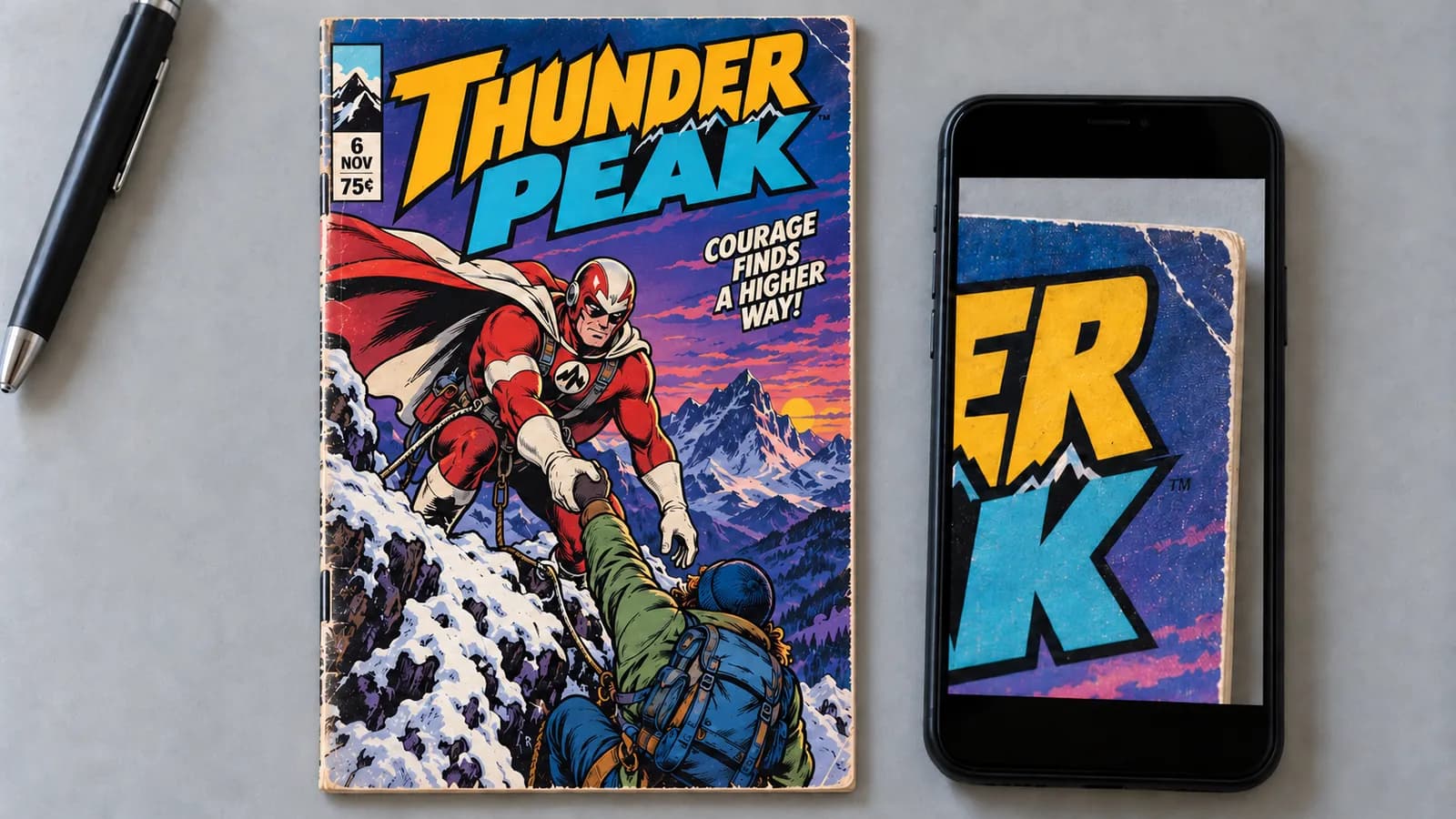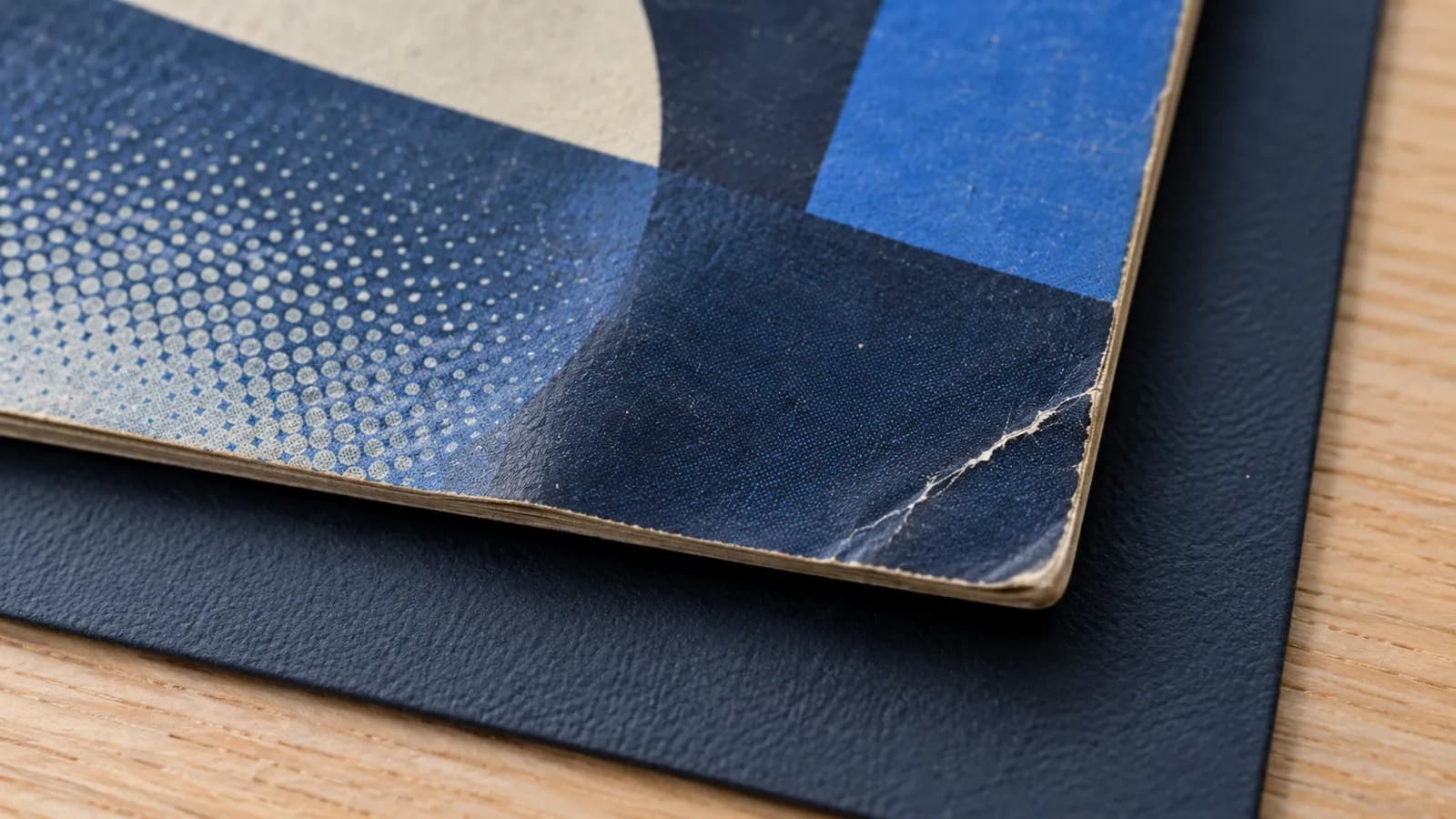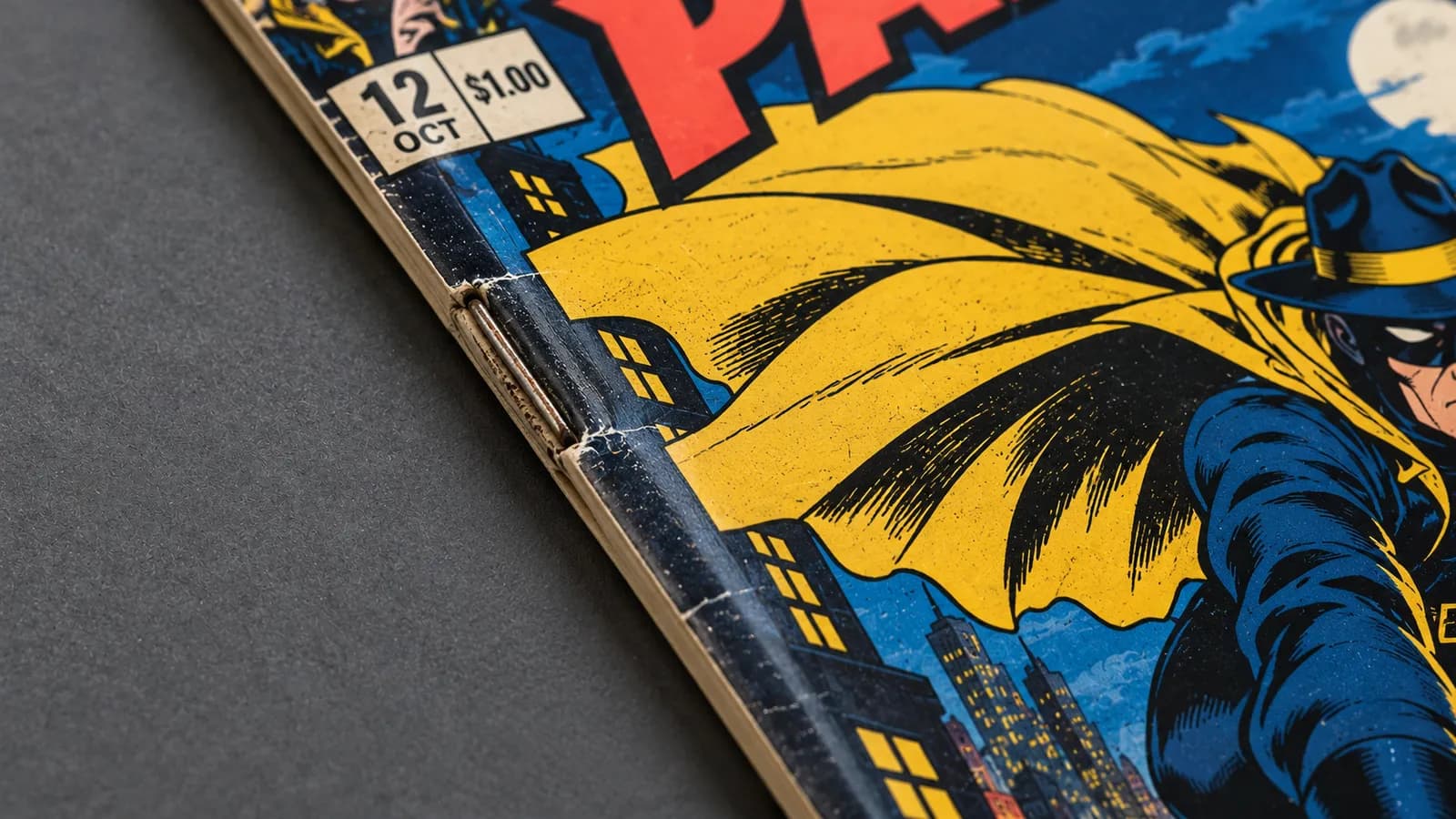
A spine tick is a short crease across a comic's spine fold. A color-breaking tick has cracked the ink to bare paper, so it shows as a thin white line on a dark spine; a non-color-breaking tick is a dent with the ink intact. To tell them apart, check the same spot under a low lamp, then in soft light. Only a color break stays white in both.
Color-breaking ticks usually lower the grade more than unbroken ones, but no published rule takes a fixed amount off per tick: size, count, broken ink and position decide the cost together. On books from the 1970s and 1980s, color-breaking spine ticks are often the defect that sets the grade.
What a spine tick is, and what gets mistaken for one
Creases, spine roll and spine splits all get mistaken for ticks, and a tick itself comes in two kinds. They differ in direction, in length, and in what broke: the ink, the paper or only the shape.
- A spine tick is a short crease across the spine fold, at a right angle to it, where the cover was flexed. In the published grade descriptions for the 10-point grading scale they are stress lines; sellers also say spine stress.
- A color-breaking tick is a tick where the printed ink cracked or flaked off along the crease and left bare paper showing. On black, blue or red ink it reads as a white line; on a white or yellow spine it can be nearly invisible.
- A non-color-breaking tick is a dent across the fold with the ink still whole. It shows as a small ridge or shadow when light skims the spine, and fades in flat light.
- A crease is a longer fold line that runs off the spine fold onto a cover, or along the spine as a reading crease from folding the cover back. No published length turns a tick into a crease; once a line leaves the fold, measure it.
- Spine roll is a bow that pulls the spine toward the front or back cover, so the page edges no longer line up.
- A spine split is a tear along the spine fold itself, where the paper has separated. It runs along the spine, not across it.
Usage varies: some sellers say "tick" only for a mark that broke color. If a listing says "small spine tick", ask whether it breaks color.
How to check one spot in two lights
Look at each mark twice from the same phone position: under a low lamp that skims along the spine, then in soft, even light. Low light shows shape and soft light shows color, so the pair separates a dent from broken ink.
- Take the book out of its bag and lay it flat on a dark cloth, front cover up, handling it by the edges.
- Set a lamp near table height at the top edge of the book, shining down the length of the spine. Ticks run across the spine, so this light catches one side of each tick and shadows the other. Museum conservators call it raking light; one museum glossary puts it at 5 to 20 degrees to the surface.
- Find each mark, then move the lamp slowly from side to side. A tick stays at the same place on the spine, while a reflection slides with the lamp.
- Photograph each mark, flash off, with a ruler beside the book (not on it) to show where the mark sits. Brace your elbows so the phone stays put.
- Switch off the lamp and light the book softly and evenly, with daylight from a window (out of direct sun) or the lamp bounced off a white wall. Take the second photo from the same position; if glare covers the mark, adjust the light, not the phone.
- Compare the two photos at full zoom. Then turn the book over and check the back of the fold the same way.
Never flex the spine to make a mark show, because bending is what makes ticks in the first place. For the rest of the capture set, see how to photograph comics so the flaws actually show.
What each spine defect looks like in the two lights
A color break stays visible in both lights, an unbroken tick shows mostly in the low light, and a reflection moves when the lamp does. The table sorts the common cases.
| What you see | Low light along the spine | Soft, even light | When the lamp moves | Call it |
|---|---|---|---|---|
| Short line across the fold | Ridge or shadow, often a bright edge | White line stays | Stays put | Color-breaking tick |
| Short line across the fold | Ridge or shadow | Fades; ink looks whole | Stays put | Non-color-breaking tick |
| Bright streak or spot | Bright | Gone or elsewhere | Slides | Reflection |
| Line that leaves the fold | Ridge along its length | White line if the ink broke | Stays put | Crease: measure it |
| Pale line that follows the artwork | No ridge | Unchanged | Stays put | Printing, not a defect |
| Ridge in a flat or off-color patch | Ridge | Smooth patch, sheen slightly off | Sheen does not shift with the gloss around it | Possible color touch: ask |
A reflection is an image of the lamp on the gloss, so it appears only where lamp, cover and eye line up. A tick is part of the paper, so it stays the same distance from the staples whatever the light does.
NuGrade, an AI-assisted grading app for raw comics, uses the same idea in its spine pass video, with the camera moving instead of the lamp: reflections shift from frame to frame, while a real tick holds its place. A finding can say that a tick persisted across adjacent frames, as both sample reports below do.
Two cases stay hard. On a white or yellow spine, a break may show only as a faint line or a break in the gloss; if unsure, write "possible color break". And a break filled with ink can pass for an unbroken tick, because competent color touch can be invisible in ordinary light.
How much do spine ticks lower a comic's grade?
There is no fixed deduction per tick. The grade descriptions judge the spine as a whole, and four things decide what ticks cost:
- Size. A tick on the fold is a small defect; a line that runs onto the cover is graded as a crease, by length.
- Count. The descriptions step from almost no stress lines near the top of the scale to an accumulation lower down.
- Broken ink. Unbroken ticks are tolerated higher on the scale than broken ones.
- Position and visibility. Ticks bunched at a staple, ticks along the whole spine and a white break on a black band all read differently, and the minus grades turn on whether a defect visibly detracts from the book.
| Grade | What the published descriptions allow at the spine (paraphrased) |
|---|---|
| 9.6 NM+ and up | A tight, flat spine; at 9.6, no creases, bends or color break anywhere |
| 9.4 NM, 9.2 NM- | A tight, flat spine with almost no stress lines |
| 9.0 VF/NM | A very small accumulation of stress lines, only if nearly invisible |
| 8.0 VF | An almost flat spine, a few nearly insignificant stress lines, and possibly a minor color break |
| 7.0 FN/VF | A small accumulation of light stress lines, the slightest spine roll, and possibly a moderate color break |
| 6.0 FN | A minor spine roll, plus a severe color break or a 1/4 inch spine split |
| 5.0 VG/FN | Minor to moderate spine roll, and a spine split up to 1/2 inch |
| 4.0 VG | Moderate spine roll, a 1 inch spine split, or both |
The grades in between, such as 8.5, 7.5 and 5.5, describe a main grade with a virtue or a defect added. A tick is also only one part of the book: the lowest ceiling across all areas sets the grade, as how to grade a raw comic at home explains.
Two sample reports limited by color-breaking ticks
Two public NuGrade sample reports are both limited by color-breaking spine ticks, yet they sit two points apart. The finding text points to the differences: how far the ticks run, how many broke color and where they bunch.
| Guardians of the Galaxy #4 | Green Lantern #59 | |
|---|---|---|
| Published | Marvel, April 1976 | DC, March 1968 |
| Grade and range | 7.5 VF-, range 7.0 FN/VF to 8.0 VF | 5.5 FN-, range 5.0 VG/FN to 6.5 FN+ |
| Limiting finding | An accumulation of small stress ticks through the upper and middle spine, several showing white color break against the black cover | A row of short color-breaking ticks along most of the spine, concentrated at both staples |
On Marvel Presents: Guardians of the Galaxy #4, the standard scale's wording for 7.5 VF- fits the finding: a moderate defect or an accumulation of small defects. The copy also has a short color-breaking crease at its top-right corner tip, yet the report names the spine as the limit.
On Green Lantern #59, the ticks run most of the spine's length and bunch at both staples. The report names them as the limit at 5.5 FN-, a grade the scale describes as several moderate defects.
Neither report counts its ticks; both describe extent and place, and both say the ticks persisted across adjacent video frames. These reports are examples of what photo evidence shows, not proof of accuracy, and each notes that defects smaller than its media can resolve may exist.
Can pressing fix a spine tick?
Pressing can relax a tick that did not break color, but it cannot put back ink that is gone. A professional press flattens the paper under controlled pressure, so the ridge of an unbroken tick can ease until it is hard to find, and a spine roll can square up.
A color-breaking tick keeps its white line after any press, although the ridge around it may relax so the line shows less. Filling that line with ink or marker is color touch, and the published restoration scale counts even light color touch over spine stress as restoration. What pressing can and cannot fix covers the process, its risks and how graders treat a pressed book.
NuGrade's intake survey asks about pressing and about color touch, because a photo cannot reliably show either one.
How to record and disclose spine ticks
Write each mark down with its place, its size and what each light showed, and keep the matched photo pair with the note. A buyer can then check every claim instead of trusting a word like "minor".
SPINE TICK LOG
Book:                     Spine color:
Light A: lamp low at the top edge, shining along the spine
Light B: soft, even light, same phone position
Zones:   top edge / top staple / between / bottom staple / bottom edge

#  Zone           Side   Length   Light A  Light B  Moves?  Call
1  top staple     front  1/8 in   ridge    white    no      color-breaking tick
2  between        front  1/16 in  ridge    gone     no      unbroken tick
3  bottom staple  back   -        streak   gone     yes     reflection
The three rows are made-up examples. For a listing, turn the log into plain sentences, for example: "Spine: one color-breaking tick at the top staple, about 1/8 inch, front side. One unbroken tick between the staples. No roll or split." If you circle the ticks on a photo, mark a copy and post the unmarked pair as well, so buyers can see nothing was edited.
Positions also help a buyer confirm that the copy in a listing is the copy in a report. How to read a comic condition report before buying walks through the other checks, and anyone can open a NuGrade report by its ID at the report lookup, with no app or account.
Frequently asked questions
What is a color-breaking spine tick?
A color-breaking spine tick is a short crease across a comic's spine fold where the ink has cracked away and exposed the paper. On a dark spine it shows as a thin white line that stays visible in soft, even light.
Do spine ticks that do not break color lower the grade?
Yes, though usually less than color-breaking ones. The published grade descriptions allow almost no stress lines at 9.4 NM and 9.2 NM-, and only a nearly invisible accumulation at 9.0 VF/NM.
How many spine ticks lower a comic's grade?
No fixed number. Graders weigh the size, count, position and broken ink of all the ticks together, plus how much they detract from the book's appearance, so two books with the same count can grade differently.
Can pressing remove spine ticks?
Pressing can relax a tick that did not break color until it is hard to see. It cannot put back lost ink, so a color-breaking tick keeps its white line, and filling that line with ink is color touch, which counts as restoration.
Is a spine split the same as a spine tick?
No. A tick is a short crease across the fold, while a split is a tear along the fold where the paper itself has separated. The published descriptions place a 1/4 inch split at 6.0 FN, a split up to 1/2 inch at 5.0 VG/FN and a 1 inch split at 4.0 VG.