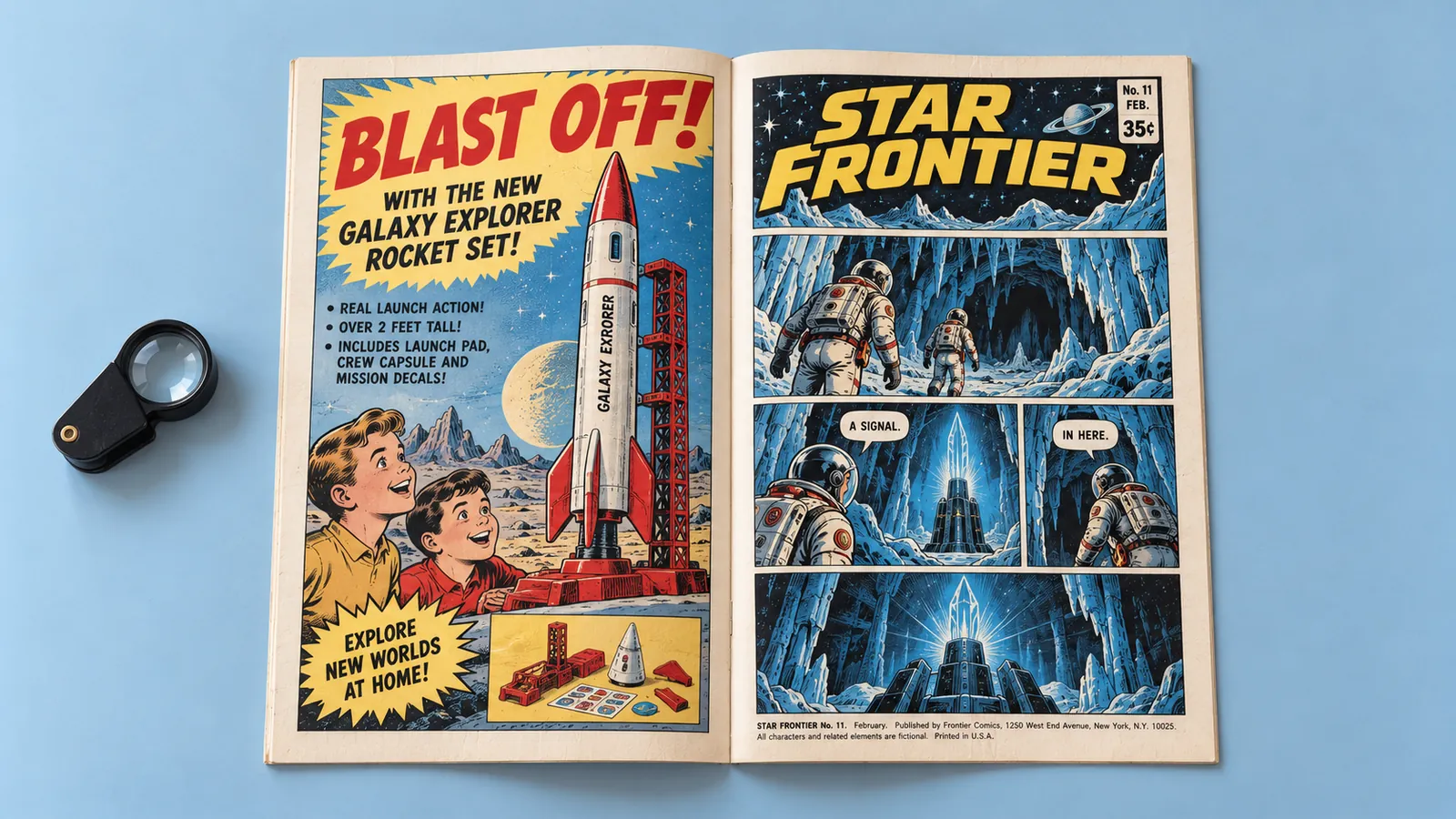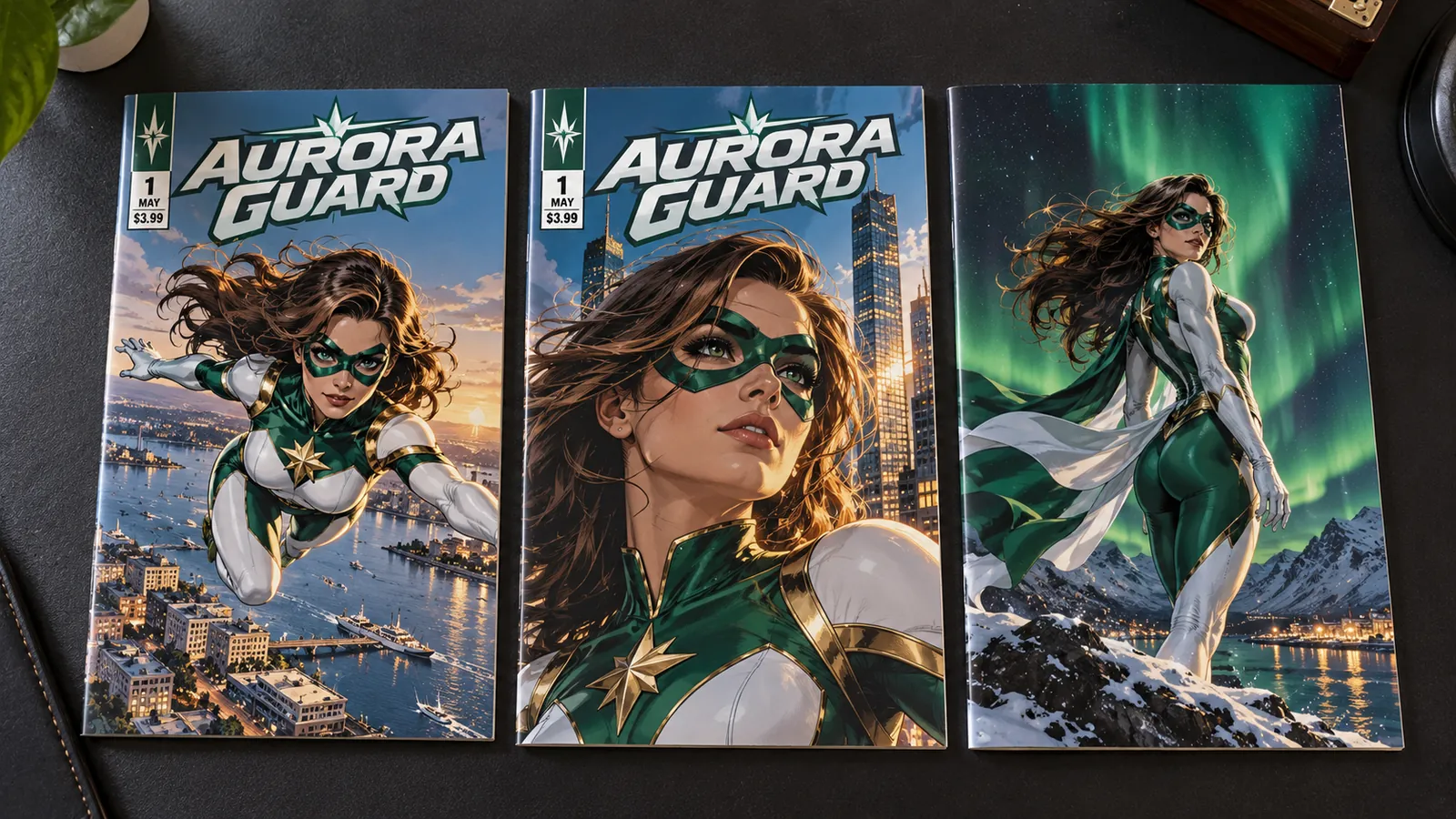
A comic book variant cover is an alternate cover for the same issue, wrapped around the same interior pages as the standard (A) cover. Variants include open-order, incentive (ratio), store-exclusive, convention, virgin, blank sketch and foil covers. Newsstand editions, price variants and later printings answer a different question: which edition or printing you hold. Confirm both from the cover, the indicia, the barcode and the publisher's solicitation.
The name matters when you buy, sell or submit: the version decides which past sales are fair comparisons when you work out whether a book is worth grading.
What counts as a variant cover
A cover is a variant when the publisher offered more than one cover for the same issue and your copy wears one of the others. The standard cover, also called cover A, is the regular cover, usually listed first in the publisher's solicitation. An edition is a version of the same issue made for a different sales channel or price, with the same art. A printing is one press run, so a second printing is the issue printed again later.
| Difference | What changes | What stays the same | Check first |
|---|---|---|---|
| Variant cover | Art, trade dress or finish | Interior, issue, printing | The solicitation |
| Edition | Barcode box or price | Art and interior | Barcode box and price |
| Later printing | Printing, often the cover | Story and issue number | Indicia and cover text |
The main types of variant covers, and how to spot each
The table lists the standard cover and seven types of variant, defined by how the cover was offered or how it looks. One copy can be both, such as a virgin cover offered on a ratio.
| Type | How it was offered | What to look for |
|---|---|---|
| Standard (A) cover | Any quantity | Cover A in the solicitation |
| Open-order variant | Any quantity | Other art, no ratio listed |
| Incentive (ratio) variant | One per set number ordered, such as 1:25 | A ratio in the solicitation |
| Store exclusive | A run ordered by one retailer | Store name or logo, or the store's announcement |
| Convention exclusive | Sold at one show | The show announcement |
| Virgin cover | Varies; check the solicitation | Art with no logo, title or trade dress |
| Blank sketch cover | Sold to be drawn on | A white cover with no art |
| Special finish | Varies; check the solicitation | Foil, chrome, hologram, embossing or a die cut |
Incentive variants: what a ratio means
An incentive variant is a cover a shop can order only in proportion to its order of the issue: at 1:25, one copy for every 25 qualifying copies, usually of the standard cover. The ratio comes from the publisher's solicitation, and it is why far fewer incentive copies reach shops.
DC's own announcement for DC Pride 2022, a special released in June 2022, shows how close two versions can be. It lists a 1:25 retail incentive foil cover and adds an open-to-order card stock cover with the same art and minimal trade dress. The finish and the trade dress tell them apart, not the picture. DC added that card stock cover about a month before release, so check later announcements too.
Store and convention exclusives
A store exclusive is a cover that one retailer orders in a set minimum run and sells through its own shop. Archie Comics' retailer variant page, for example, lists a 300-copy minimum as of October 2026. Some print the store's name or logo on the cover; for the rest, save the store's announcement as the record.
A convention exclusive is a cover sold at one show, often from a publisher's or retailer's booth, and its announcement confirms it.
Virgin, blank sketch and special-finish covers
A virgin cover is the cover art with the trade dress removed; the Archie page describes its virgin editions as having no title card or logos.
A blank sketch cover is left white, often with only the logo and barcode, so an artist can draw on it. Some publishers also say "sketch variant" for a cover printed with black-and-white line art, so read the solicitation's wording.
A special-finish cover uses foil, chromium, a hologram, embossing, glow-in-the-dark ink or a die cut. These were common in the 1990s and still appear today, but the finish alone does not show how a cover was offered.
Edition differences that look like variants
These copies differ in the barcode box, the price or the printing rather than the cover design, though a later printing can bring new art.
Newsstand and direct editions
A direct edition is a copy printed for comic shops, which could not return unsold copies; newsstands could, so newsstand copies kept a scannable barcode. Marvel began marking direct copies in 1979 and DC in 1980, at first with a blank box, a line through the barcode, or a logo or character head in its place. Later direct copies often carry a barcode too, sometimes with "Direct Edition" printed beside it.
Price variants
A price variant is a copy printed with a different cover price for a test market or another country, with the same art and interior. Marvel tested 30 cents against its regular 25 cents in some U.S. markets on books cover-dated April to August 1976, then 35 cents against 30 cents on books cover-dated June to October 1977. From late 1982 into the later 1980s, some Marvel and DC newsstand copies sold in Canada carried a higher price, such as 75 cents against a U.S. 60 cents.
Later printings with new covers
A later printing is the same issue printed again after the first run. Publishers often give it a new cover or printing text on the cover, so it is easy to mistake for a first-print variant. Many modern indicia name the printing or carry a number line; the guide to telling a first printing from a reprint covers those checks.
How to identify your copy, step by step
Read the copy from the outside in: cover, barcode, indicia, then the publisher's solicitation. The same identity check opens a full home inspection.
- Front cover. Note the art, the trade dress (logo, title, price, barcode box), any printing text, any store or show name, and the finish.
- Barcode box. A logo, art or "Direct Edition" points to a direct edition; a plain barcode, in years when both editions existed, to a newsstand copy.
- Barcode add-on. Many modern books carry a five-digit add-on to the right of the main barcode. The main code usually identifies the series, and the add-on identifies the issue, the cover and the printing.
- Indicia. The indicia is the small publication text, usually on the first page or inside the front cover: title, issue number, cover date, publisher and, in many modern books, the printing. It usually cannot name your cover, because every cover of one printing wraps the same interior.
- Solicitation. Find the issue's solicitation or announcement on the publisher's website, match your art to its cover list, and note whether that cover was open order or on a ratio.
EXAMPLE ADD-ON (illustrative digits, not a real book)

  0 0 3   2   1
  -----   -   -
    |     |   +-- 5th digit: printing, often 1 = first printing
    |     +------ 4th digit: cover, often 1 = standard cover
    +------------ 1st to 3rd digits: issue number (#3)
Treat the add-on as a lead, not proof. The publisher sets the digits, and variants and later printings often ship without new ones.
A decision tree for naming your copy
Work through the questions in order; each answer adds one part to the name, and the tree stops at "not confirmed" when the evidence runs out.
1. PRINTING: does the cover or indicia name a later printing?
   yes -> "2nd printing" (or the number given), even with new
          cover art. Go to 2.
   no  -> "1st printing" if the indicia or add-on supports it,
          else "printing not stated". Go to 2.

2. ART: does it match the standard cover of that printing
   (cover A in the solicitation, or a catalog listing)?
   yes -> standard cover. Go to 3.
   no  -> variant cover. Go to 4.

3. EDITION (mainly 1970s to 1990s books): barcode box, price.
   logo, art or "Direct Edition"      -> direct edition
   plain barcode, direct copies exist -> newsstand edition
   price unlike the regular price     -> possible price variant
   Done: printing + edition + "cover A".

4. LOOK: what kind of variant is it?
   white, made for drawing            -> blank sketch cover
   art without logo or title          -> virgin cover
   store or show name on the cover    -> store or show exclusive
   foil, chrome, hologram, die cut    -> special-finish cover
   other art                          -> lettered variant (B, C)
   Go to 5.

5. OFFER: what does the solicitation or announcement say?
   open order, no ratio               -> "open-order variant"
   a ratio                            -> "incentive variant 1:__"
   a store's or show's notice         -> "exclusive", name it
   nothing found                      -> "ratio not confirmed"
A finished name reads like this example: "1st printing, cover B open-order variant, per the publisher's solicitation." A name with a gap says so: "cover C virgin variant, ratio not confirmed."
Easy ways to get it wrong
Most naming mistakes come from trusting a single clue:
- Matching the picture only. The same art can sit on a ratio cover and an open-order cover, as DC Pride 2022 shows. Compare the finish and the trade dress.
- Calling every non-A cover rare. Shops could order open-order variants in any quantity; only the solicitation shows a ratio.
- Taking a ratio from a listing title. That is the seller's claim; the solicitation is the source.
- Reading the add-on as proof. A "1" in the fourth or fifth place can sit on a variant or a later printing whose digits were never updated.
- Calling a later printing a first-print variant. Check the indicia and the cover text for the printing first.
- Calling a newsstand copy or a price variant a variant cover. The art is the same, so name the edition.
Does a variant cover change the grade?
No. Condition grading uses the same 10-point scale and the same defect rules for every cover and edition, so a 1:100 cover with a color-breaking spine tick grades like the standard cover with the same tick. The version changes what the book is; the condition sets the grade.
Reflective finishes do change the photos. On foil or chrome, a spine tick can show only when the light crosses it, and a reflection can look like a scratch that is not there, so use a low lamp and a slow spine video (how to photograph comics for grading).
A sample report from NuGrade, an AI-assisted grading app for raw comics, shows the split. Its report for Marvel Presents: Guardians of the Galaxy #4 (Marvel, April 1976) notes that the cover date and publisher were read from the front cover and from the indicia in a page-flip frame, and its 7.5 VF- grade is set by condition: color-breaking stress ticks along the spine of a black cover. It states no cover price, and April 1976 falls inside Marvel's 30-cent test window, so the printed price, checked against a catalog listing, answers the edition question; the grade cannot.
How to list a copy you cannot fully confirm
State what you confirmed, where, and what stays open. A buyer can check a sourced claim, and an honest "not confirmed" is safer than an unsourced ratio.
VERSION RECORD (one per copy)
Book:      title, issue, publisher, cover date
Printing:  1st / 2nd / later / not stated
Edition:   direct / newsstand / price variant (price: ___)
Cover:     A / B / C / virgin / blank sketch / store or
           show exclusive (name: ___)
Finish:    plain / card stock / foil / other: ___
Offer:     open order / ratio 1:___ / not confirmed
Source:    solicitation (month, year) / announcement / none
Condition: grade, range and report link
A NuGrade report gives the grade, the range and each finding with the photo or frame it came from, and a buyer can open it by its QR code or at the report lookup with no app or account. The report covers condition, so the version lines stay yours to confirm. If you plan to submit the book, keep this record next to a pre-grade of its condition.
Frequently asked questions
What is a variant cover on a comic book?
A variant cover is an alternate cover printed for the same issue as the standard (A) cover, with the same interior pages. It can differ in art, trade dress or finish, and the publisher may offer it in any quantity or only on a ratio.
What does 1:25 mean on a variant cover?
It is the incentive ratio: a shop could order one copy of that cover for every 25 qualifying copies of the issue it ordered. Check the ratio in the publisher's solicitation, not in a listing title.
Is a second printing a variant?
Not a first-printing variant. A second printing is a later press run of the issue, even when it has a new cover, so name the printing first and the cover second.
Is a newsstand edition a variant cover?
No. A newsstand copy has the same art as the direct edition, so it is an edition difference; only the barcode box and the sales channel differ.