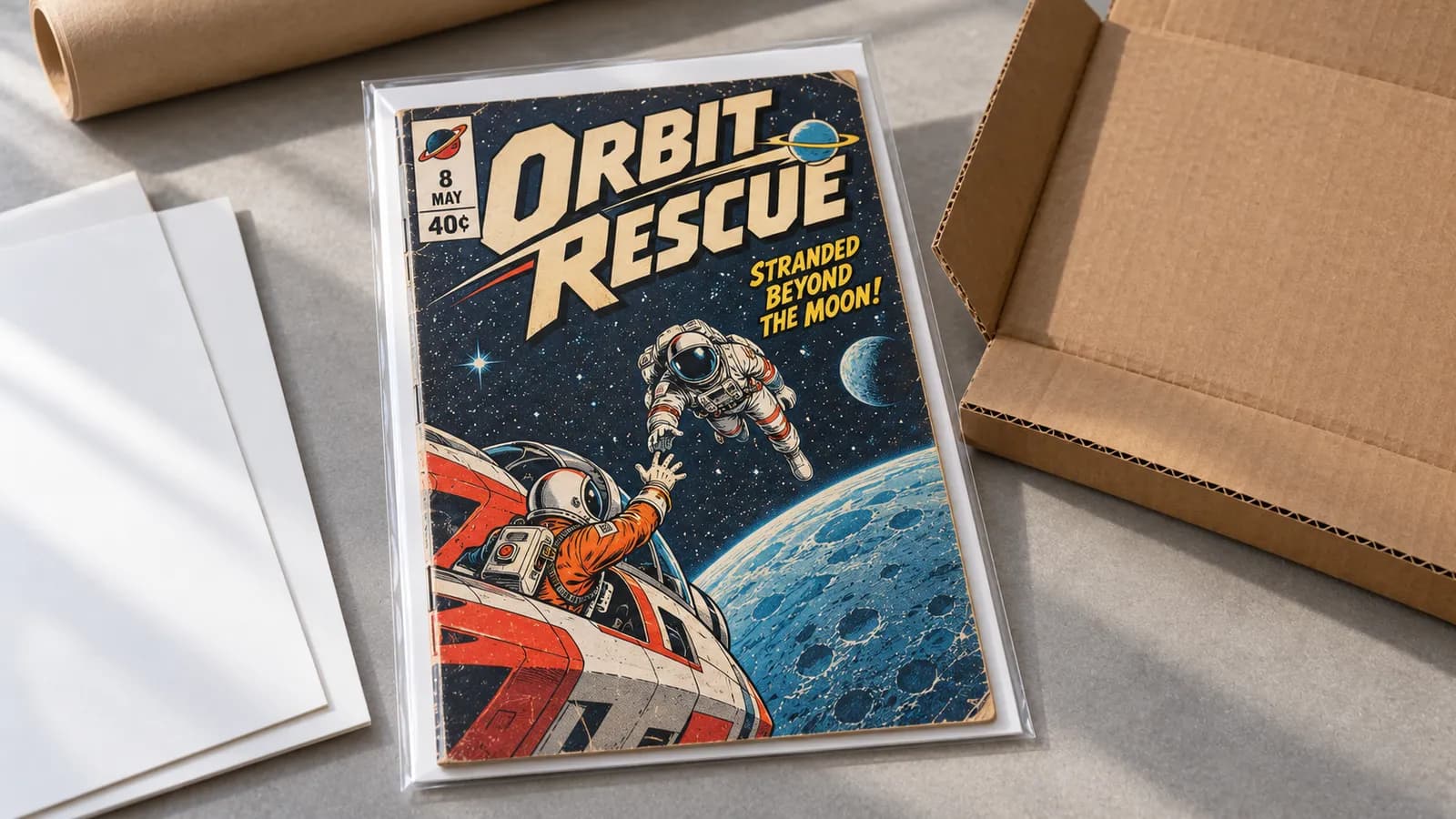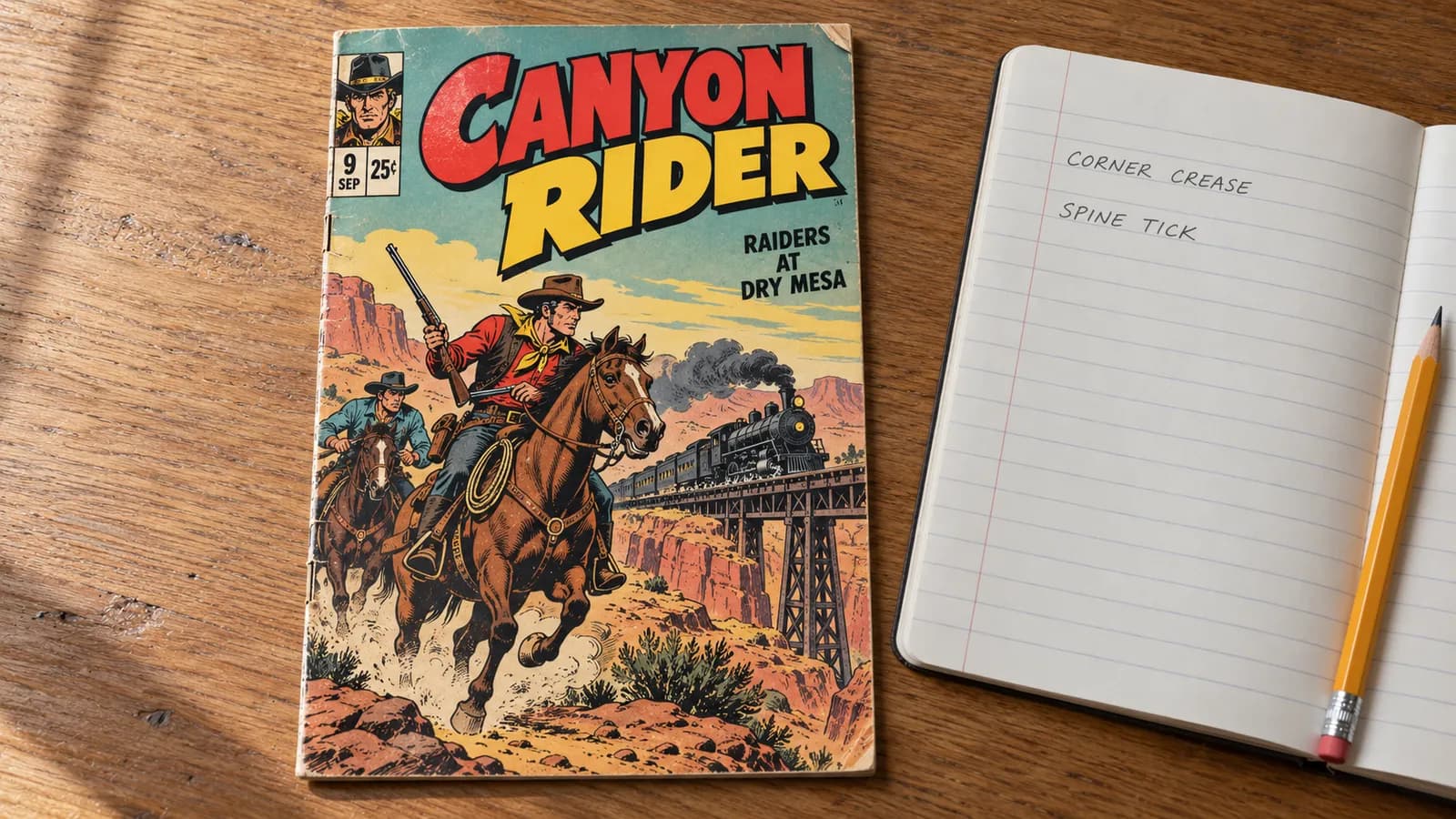
To describe comic book condition for sale, give each defect its own line: what it is, how big it is, where it sits, and which photo shows it. Then give a grade with a range, name the one flaw that limits it, and say what you could not check, such as restoration or odor. A buyer should be able to check every line against your photos.
Why near mint is not a condition description
"Near mint" is a grade claim, a conclusion about the whole book, and a buyer needs the evidence behind it. A condition description is a list of the defects on one copy, each with its size, location and photo, followed by the grade those defects support.
The claim does not say which grade you mean, either. On the 10-point grading scale, NM is one grade, 9.4, and also a band from 9.2 NM- to 9.6 NM+, as what VF, FN and NM actually mean explains.
Near mint also leaves little room. The published grade descriptions allow a 1/16 inch bend at 9.4 and up to 1/8 inch at 9.2, only when the color is not broken, and almost no stress lines. A color break is a spot where the ink has cracked or worn away to expose the paper, often a white line or fleck on a dark cover. A few color-breaking spine ticks in your photos contradict an NM claim and cast doubt on the rest of the listing.
A raw book has no label to vouch for it, so the description and the photos are all a buyer has. How to sell a raw comic book covers pricing, packing and the rest of the sale.
What to include in a comic condition description
A checkable condition description has a header and a list. The header gives the grade, the range and the limiting flaw. The list gives one line per defect, with five parts: the defect, its size, its location, the photo that shows it, and its effect on the grade.
| Part | What to write | Example (illustrative) |
|---|---|---|
| Defect | The standard term, and whether the ink broke | Stress ticks, two breaking the color |
| Size | A measurement, or a count | Three ticks, each under 1/8 inch |
| Location | The cover, then the nearest landmark | Front cover, within 1 inch of the top staple |
| Photo | The listing photo that shows it | photo 8 |
| Effect | Limiting, or not limiting | Not limiting; a corner crease is worse |
Size and location
Measure with a ruler beside the book, never on it, and write fractions of an inch, because the grade descriptions are written in sizes. When you cannot measure, count: "three ticks" says more than "some spine stress". For location, name the cover, then the nearest fixed point, such as a corner, an edge, a staple or the logo. "Back cover, bottom edge, 1 inch from the spine" leaves nothing to guess.
Photo numbers
Number the photos in the same order on every listing, and end each condition line with its number, because the photo settles any doubt your words leave:
- Front cover
- Back cover
- Top-left corner of the front cover
- Top-right corner
- Bottom-left corner
- Bottom-right corner
- Centerfold staples
- Spine
- Close-ups, one per defect, from 9 on
For light and framing, see how to photograph comics so the flaws actually show.
Effect and the limiting flaw
A limiting flaw is the one defect that sets the ceiling on the grade: the book grades no higher than that defect allows, however clean the rest is. Name it in the header, mark its line "limiting" and the others "not limiting", and name both if two tie. The photo-first grading checklist shows how to find it.
Write the grade as a number with its tier, a range and who made the call, for example "6.0 FN in my opinion, range 5.5 to 6.5, raw and not professionally graded".
Weak phrases and better rewrites
A weak phrase gives a verdict or a mood; a better line gives the evidence. The rewrites are example wording for an imaginary copy.
| Weak phrase | What it hides | Better line (example wording) |
|---|---|---|
| NM, tight copy | Which of three NM grades, and what keeps it from higher | 9.2 NM- in my opinion, range 9.0 to 9.4. Limiting flaw: a 1/8 inch bend at the top-right corner, no color break (photo 4). |
| Minor wear | What kind, where and how much | Light abrasion along the bottom edge of the back cover, about 2 inches long; no chips or tears (photo 2). |
| Light spine stress | Whether the ticks break the color | Three stress ticks within 1 inch of the top staple, each under 1/8 inch; two break the color (photo 8). |
| Sharp corners | Whether all four are sharp | Three corners sharp; bottom-left slightly blunted, with one white fleck at the tip (photo 5). |
| Unrestored | Who checked, and how | No signs of restoration seen in normal light; not examined in hand by a professional. |
| Smoke-free home | How the book itself smells | Odor: none that I notice. |
| See photos | Every defect, now for the buyer to find | Every defect I found is listed below, worst first, with its photo number. |
How to separate what you saw from what you infer
Write what you saw first, then what you think it means, marked with a hedge word. An observation is what a buyer can check in your photo: a mark, its size and its place. An inference is your explanation of the mark: its cause, its history, or what it means for the grade.
| What you saw | Possible inference | How to write it |
|---|---|---|
| Cover edge slightly proud of the page block at the top-right | Made at the bindery, not by handling | "...consistent with a mild bindery overhang" (Green Lantern #59 report) |
| Small dark mark at the left edge of the back cover | A printing or bindery flaw, not a stain | "...likely a bindery or printing artifact" (E-Man #1 report) |
| Faint marks at the top margin of an ad page | Pencil, or print showing through | "Faint marks at the top margin; could be pencil or show-through" |
| A flat cover with no bends | Never pressed | Photos cannot prove it: "pressing history not known" |
| Bright color and strong gloss | Unrestored | Photos cannot prove it: "no restoration signs seen" |
Pick the hedge word that matches your confidence. "Consistent with" means the evidence fits but does not prove it, "likely" means you would bet on it, and "could be X or Y" means you cannot tell. An inference without its observation, such as "bindery overhang" alone, asks a buyer to trust what they cannot see.
Settle cheap inferences: for possible show-through, add a close photo of the other side of the page.
How to state what you do not know
List the unknowns in their own section instead of leaving them out. A buyer can price a stated unknown as a risk; one found after the sale looks like something you hid.
- Restoration. Photos in ordinary light can show obvious repairs, but competent color touch or piece fill can be invisible. Write "no signs of restoration seen", never "unrestored".
- Pressing and cleaning. Say what you know and where it stops: "not pressed by me; earlier history not known." What pressing can and cannot fix covers what to disclose.
- Odor. No photo shows it. Write "none that I notice", describe it, or say you did not check.
- Brittleness. Report what you saw while turning the pages, such as flaking corners. Never fold a corner to test it.
- Small defects. Defects smaller than your photos show may exist in any listing; saying so costs nothing.
NuGrade, an AI-assisted grading app for raw comics, handles unknowns the same way. Its survey asks only what the camera cannot see, and "Nothing that I know of" is an answer the owner has to choose. Each report keeps a "What the owner told us" section for the survey answers, and it marks restoration Unverified when the photos cannot establish it.
A filled example from a real report: Green Lantern #59
Here is the template filled from a public NuGrade sample report, Green Lantern #59 (DC, March 1968), graded 5.5 FN- on September 30, 2026 from phone photos and two short videos. The findings are quoted from the report; the labels and photo numbers are the template's, each pointing to the image the report cites.
CONDITION: Green Lantern #59 (DC, March 1968)
Raw book, not professionally graded.
Grade:     5.5 FN-, range 5.0 VG/FN to 6.5 FN+,
           from NuGrade report NG-MMDT9A2T-AVTF
Limiting:  a row of color-breaking stress ticks
           along most of the spine, concentrated
           at both staples (photo 8)
Photos:    1 front, 2 back, 3-6 corners (TL, TR,
           BL, BR), 7 centerfold, 8 spine (video
           still), 9 back cover (page-flip still)

FINDINGS, WORST FIRST
Spine      Multiple short color-breaking stress
           ticks along the spine edge,
           concentrated at both staple positions
           and persistent across adjacent frames
           (photo 8). LIMITING (5.5 FN-).
Spine      Stress ticks and light spine wear at
           the lower staple and toward the bottom
           of the spine (photo 8). Not limiting.
Corners    Bottom-left corner tip blunted, with
           small color flecks exposing paper
           along the bottom edge (photo 5).
           Not limiting.
Corners    Top-left corner slightly blunted, with
           light edge wear along the top edge
           (photo 3). Not limiting.
Corners    Faint white wear flecks at the bottom
           edge near the bottom-right corner
           (photo 6). Not limiting.
Edges      Small nicks and edge wear along the
           spine-side edge of the back cover
           (photo 9). Not limiting.
Edges      A small nick on the right edge of the
           back cover (photo 2). Not limiting.
Cover      Light surface abrasion and faint shelf
           wear in the green field near the
           bottom-left, with no crease through
           the image area (photo 5). Not limiting.
Production The cover edge sits slightly proud of
           the page block at the top-right
           (photo 4). Inference: consistent with
           a mild bindery overhang. Possible
           defect; not limiting.

ALSO SEEN
Strong color and good gloss; the cover sits flat.
Pages Cream to Off-White; all 36 pages accounted
for. Staples: no findings (photo 7).

NOT KNOWN
Restoration: Unverified; the photos cannot
  establish it.
Pressing, cleaning, odor, brittleness: nothing
  disclosed in the owner survey. A statement,
  not an inspection.
Defects smaller than the photos show may exist.
Each line carries the five parts. The bottom-left corner line names the defect, sizes it in words, places it, cites photo 5 and states its effect. With the book in hand, replace words such as small with measurements.
The limiting line explains the number: the spine ticks hold the book at 5.5 FN-, so cleaner corners would not raise it. The production line shows an inference done right: the observation comes first, and the report files it as a possible defect, not a confirmed one.
Anyone can open the report by its ID at the report lookup, with no app or account. The report is an evidence-bounded opinion, not professional grading. The sample shows what photos can support; it is not proof of accuracy.
A blank condition template you can copy
Copy this into your notes and fill one line per defect, worst first. Delete the lines that do not apply, but keep NOT KNOWN even when it is short.
CONDITION: [title] #[issue] ([publisher], [date])
Raw book, not professionally graded.
Grade:     [number and tier], range [low] to
           [high]; graded by [me / report ID]
Limiting:  [defect, size, location] (photo #)
Photos:    1 front, 2 back, 3-6 corners (TL, TR,
           BL, BR), 7 centerfold, 8 spine,
           9+ close-ups

FINDINGS, WORST FIRST
[Area]     [Defect], [size], [location]
           (photo #). LIMITING / Not limiting.
[Area]     [What you saw] (photo #). Inference:
           consistent with / likely / could be
           [explanation]. Not limiting.

ALSO SEEN
[Gloss, color, flatness, page color, page count,
staples, centerfold] (photo #)

NOT KNOWN
Restoration: no signs seen in normal light; not
  examined in hand by a professional.
Pressing, cleaning: [none by me / what you
  know]; earlier history: [known / not known]
Odor: [none that I notice / describe / not
  checked]
Brittleness: [what you saw turning the pages]
Defects smaller than the photos show may exist.
Frequently asked questions
What should a comic book condition description include?
It should list each defect with its size, location, photo and effect on the grade. Add a grade with a range, the one flaw that limits it, and what you could not check, such as restoration and odor.
Is it enough to write near mint in a listing?
No. NM names one grade, 9.4, or a band from 9.2 to 9.6, and a buyer cannot check it against your photos. List the defects behind it and name the flaw that keeps the book from going higher.
How do you describe a comic defect you are not sure about?
Write what you see first, then your reading with a hedge word, such as "consistent with" or "could be pencil or show-through". Never write the guess on its own.
Do you need a grading app to describe a comic's condition?
No. A ruler, a lamp, careful photos and the published 10-point grade descriptions are enough. An app report such as NuGrade's adds an outside opinion, with each finding tied to a photo and an ID a buyer can check at nugrade.app/lookup.