To share a comic book collection online without losing the condition details, give every book its exact identity, a grade with its date and source, recent photos, and a report link where one exists. Share a view-only copy with the people who need it, and keep your address, storage location, receipts and total value out of anything public.
A line such as "Green Lantern #59, FN" drops most of what a reader needs. DC has printed a Green Lantern #59 in at least three different series, in 1968, 1995 and 2010, and "FN" does not say who called it, when, or from what evidence. Five fields per book fix that.
What each book needs in a shared list
Each book needs five fields: exact identity, the grade with its date and source, recent photos, a report link if one exists, and the questions still open. With all five, a reader can check your claim instead of taking it on trust.
A shareable condition record is one entry per book that ties one exact copy to a dated grade, the source of that grade, and evidence the reader can open.
| Field | What to write | Why it matters |
|---|---|---|
| Identity | Title, issue, publisher, cover date, printing, variant, edition | Copies with the same title and number can be different books |
| Grade, date and source | Number and tier, the range if there is one, who gave it and when | A grade describes the book on one day |
| Recent photos | Front, back and the worst defect, with the date taken | They show the book as it is now |
| Report link | The URL or the short report ID | The reader can see the evidence behind the grade |
| Open questions | What nobody has checked yet | "Not seen" stops reading as "not there" |
Exact identity
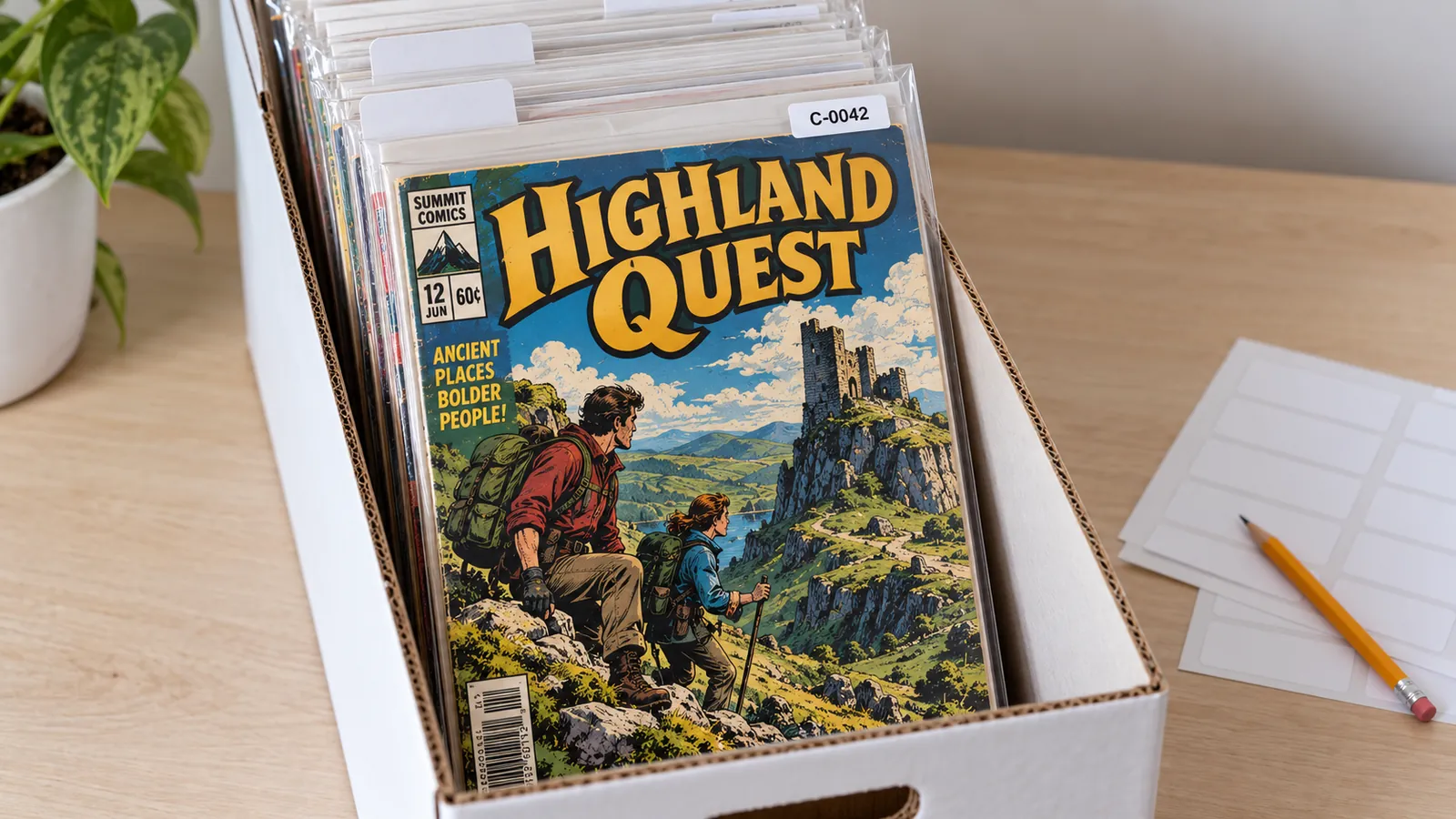
Copy the identity from the book, not from memory. The cover date appears in the indicia (the small publication notice inside the book) and on many covers, and it is the quickest way to tell the 1968 Green Lantern #59 from the later ones. Add the printing, any variant cover, and newsstand or direct edition where the issue was sold both ways.
The grade, its date and its source
Write the number with its tier, such as 7.5 VF-, and copy the range if the grade came with one. A bare "VF" covers 7.5, 8.0 and 8.5 (see what the tier names mean). Then say who gave the grade and when:
- A self-grade: write "self-grade" and the date. A reader weighs it as your opinion, and how to grade a comic at home gives a method you can cite.
- A grade in a sealed holder from a grading service: write the label grade and the certification number, so the reader can check it with the service that issued it.
- A NuGrade report: write the grade, the range, the report ID and the graded date, as on the E-Man #1 sample: 9.2 NM-, range 8.5 VF+ to 9.4 NM, graded September 30, 2026.
The date matters because books change. A crease from a drop, or a pressing, after that date is not in the grade.
Recent photos
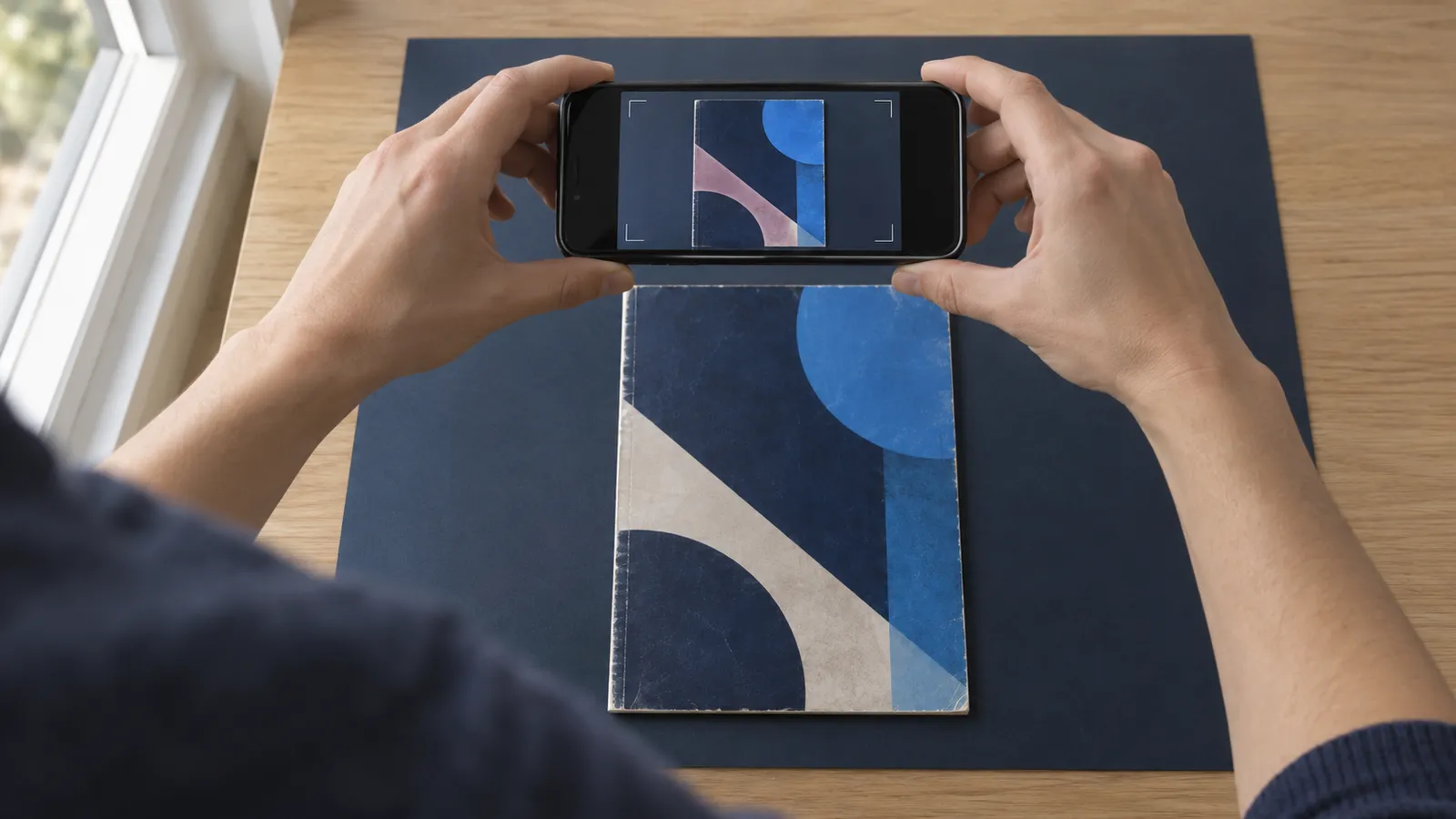
Photos show the book now; the grade shows it on the graded date. Shoot the front, the back and the defect that limits the grade, note the date, and use the light and angles in how to photograph a comic so the flaws show.
Which format to share: list, album, document or report links
The best format depends on the reader, and most collections need two: a list for scope and a link per book for proof.
| Format | Good for | Weak spot | Privacy check |
|---|---|---|---|
| View-only spreadsheet | Long lists, sorting by title or grade | Says only what you typed | Delete private columns from the copy you share |
| Shared photo album | The current look of each book | Photos get separated from identity and grade | Turn off photo location; check the backgrounds |
| Document or PDF | A fixed record for an appraiser, insurer or family | Goes out of date after you send it | Date the first line; send it privately |
| Report links, one per book | Proof of one book's condition on one date | Covers only books that have a report | Anyone with the link can open the report |
View-only stops edits, not copies: anyone who can see a list can screenshot it or forward the link. Hiding a column does not delete it, because anyone with a copy of the file can unhide it.
A public collection list vs a single-book report
A public collection list answers "what do you own?" A single-book report answers "what condition is this copy in, on what date, and on what evidence?" Use the list for scope and a report for proof.
| Public collection list | Single-book report (NuGrade) | |
|---|---|---|
| Source of the grade | You | An AI-assisted grade from your photos and video, stamped with the method version |
| Date | Only if you write it | Printed on the report |
| Evidence | Whatever you attach | The photos and videos the grade came from, with each finding tied to a photo or frame |
| Changes | You can edit it at any time | Fixed; a regrade makes a new report with a new ID |
| Privacy exposure | Anything you typed, totals and locations included | The photos, the videos and your survey answers, to anyone with the link |
A NuGrade report is an opinion limited to what the photos and video show, not a professional grade, so each line should say which kind of grade it carries. NuGrade makes single-book reports only; it does not build collection lists.
How a reader checks a report link
- Open the report from your link or its QR code, or type the short ID at the report lookup page. No app or account is needed.
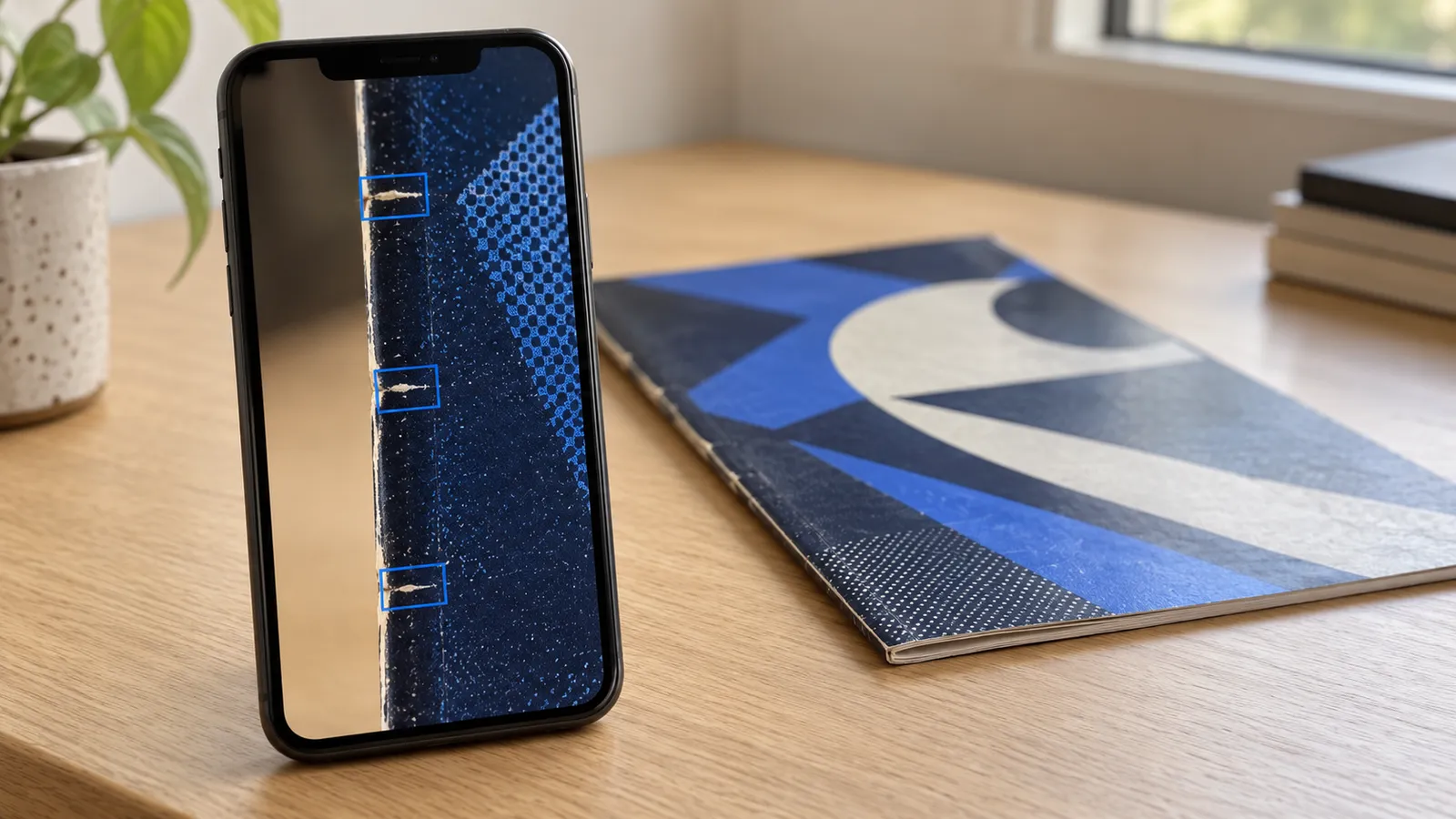
- Compare the report's photos with your recent ones, looking for the same marks in the same places, such as the narrow unprinted strip along the front spine edge of the E-Man #1 sample.
- Read the graded date, the range and what the report could not establish. All three samples say no restoration was detected and add that photos can miss skilled work, because good restoration can be invisible in normal light (see what a photo grade can miss).
Who needs which details: trade, sale, appraisal, family, insurance
Each reader needs a different slice of the record, so make one share copy per reader. Values go only to the people who need them.
| Reader | Give them | Leave out |
|---|---|---|
| Trade partner | Identity, grade with date and source, recent photos, report links | What you paid, total value, storage location |
| Buyer | The same, plus an asking price per book | What you paid, total value, storage location |
| Appraiser | Everything that affects value, including pressing or repairs you know about | Nothing they ask for, but send it privately |
| Family | What exists, where the books and records are, who could help value or sell them | Nothing, but keep that copy private |
| Insurer or agent | The full list with values, receipts or appraisals, and photos | Nothing they ask for, and never as a public link |
Insurance is where values and receipts matter most. A consumer page from the Texas Department of Insurance (last updated November 2024, checked October 2026) warns that a standard home or renters policy may pay much less than a collectible is worth, and tells owners to keep appraisals, receipts and photos somewhere safe for a claim. Ask your own insurer what it wants.
For readers who want files, each NuGrade report downloads as a PDF. On a printed list, each report's QR code beside its line opens the report from a phone camera.
What to keep out of anything public
Keep five things off any list, album or post that strangers can open: your home address, where the books are stored, receipts, what you paid, and the total value. Together they tell a stranger what you own, what it is worth and where it is.
- Your address. It hides in photos (an envelope, a shipping label), in file names and in folder titles.
- The storage location. "Longbox 4, back bedroom closet" belongs in your private master list, and a box label in a photo gives it away too.
- Receipts. They can show your name, address and payment details. An insurer may need them; a trade partner does not.
- What you paid, and the total value. Price each book for the person buying it. A grand total on a public list helps no trade partner, and every stranger reads it.
- Photo location data. Phone photos can store where they were taken. Turn location off in your phone's share options before you send original files, or check that your photo service leaves it out of shared links.
A NuGrade report is public to anyone with its link, QR code or short ID. The page shows the photos, the videos and your survey answers under "What the owner told us", so keep anything personal out of the frame.
How to share a collection list, step by step
Build every share copy from one private master list, in this order.
- Keep one private master list. It holds everything, including prices paid, box locations and receipts. For its columns and box tags, see how to set up the inventory itself.
- Copy it for one reader. Delete every column that the reader table above leaves out.
- Check each identity line against the book, including the cover date in the indicia.
- Put each grade, its source and its date in one cell, for example: 7.5 VF-, NuGrade report NG-HM9D44HX-7VVS, graded 2026-09-30.
- Add recent, dated photos with the location data left out.
- Add a report link or ID for each book that has one, and check that it is the latest report for that book.
- Share view-only, with named people where your tool allows it. A link that anyone can open can travel further than you planned. If your tool can end access on a date, set one.
- Head the copy with four lines: the date made, who made it (a first name or handle), who it is for, and what it leaves out.
- Update after every change. After a sale, new damage, a pressing or a regrade, change the line and its date. A NuGrade regrade creates a new report with a new ID and does not overwrite the old report. Replace the link so readers see the latest report. The owner can delete either report.
A share-copy template you can copy
The template gives each book one short block: identity, grade, source, photos and open questions. The first two entries are examples built from NuGrade's public sample reports, and the photo dates are example dates.
SHARED LIST (view only)
Made:      2026-11-10 by [first name or handle]
For:       [reader, for example a trade partner]
Left out:  address, storage location, receipts,
           prices paid, total value

1. E-Man #1, Charlton, Oct 1973
   Grade:   9.2 NM-, range 8.5 VF+ to 9.4 NM
   Source:  NuGrade report NG-Y1ZW2NQN-RMEV,
            graded 2026-09-30
   Photos:  report set; new front and back 2026-11-08
   Open:    restoration (photos can miss skilled work)

2. Green Lantern #59, DC, Mar 1968
   Grade:   5.5 FN-, range 5.0 VG/FN to 6.5 FN+
   Source:  NuGrade report NG-MMDT9A2T-AVTF,
            graded 2026-09-30
   Photos:  report set; new front and back 2026-11-08
   Open:    restoration (photos can miss skilled work)

3. [Title #issue], [publisher], [cover date]
   [printing, variant, edition]
   Grade:   [number and tier, range]
   Source:  [self-grade, label grade and cert number,
            or report ID], graded [date]
   Photos:  [which views, date taken]
   Open:    [what nobody has checked]
Open E-Man #1, Green Lantern #59 and the Marvel Presents: Guardians of the Galaxy #4 report from step 4 to see what your reader would see. They are examples of what photo evidence can support, not proof that a photo grade is right. The Guardians grade, for example, is limited by color-breaking spine ticks on a black cover, and a reader can open the photo or frame behind that finding. In a spreadsheet, each label becomes a column.
Frequently asked questions
What is the safest way to share a comic collection online?
Share a view-only copy with named people instead of a public link, and delete the columns that reader does not need. Leave out your address, storage location, receipts, what you paid and the total value.
Should a shared collection list include values?
Only for readers who need them: an insurer, an appraiser, a buyer who needs an asking price, or the person who will handle the collection later. A public list should carry no values and no total.
Can NuGrade share a whole collection?
No. NuGrade makes one report per book, with a public URL, a short ID and a QR code, and anyone can open a report at nugrade.app/lookup without an account. You add each report's link or ID to your own list.
How do I show that a grade is still current?
Write the date the grade was given next to it and add photos taken recently. If the book has changed since, say what changed or have it graded again; a NuGrade regrade creates a new dated report with a new ID.