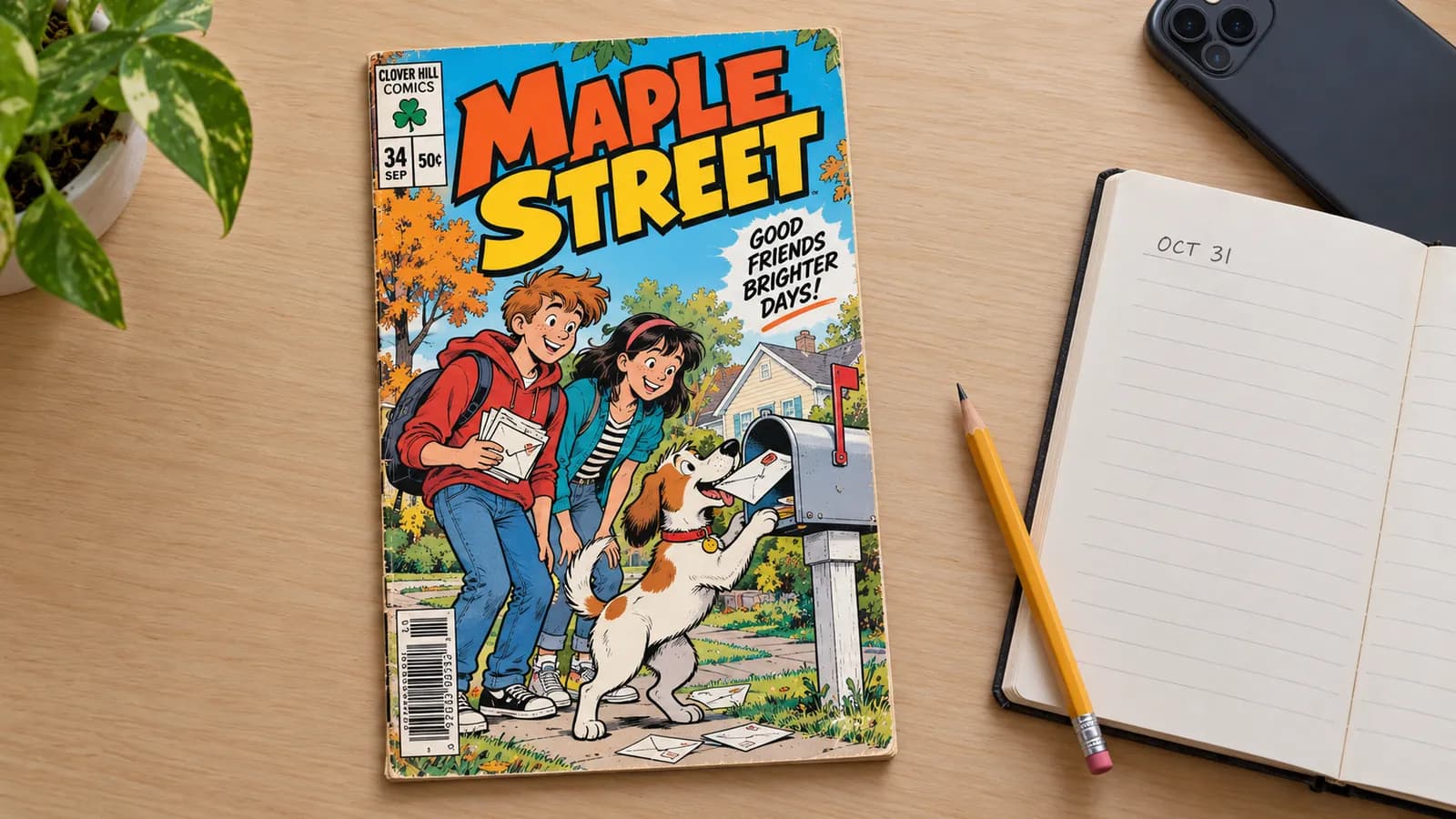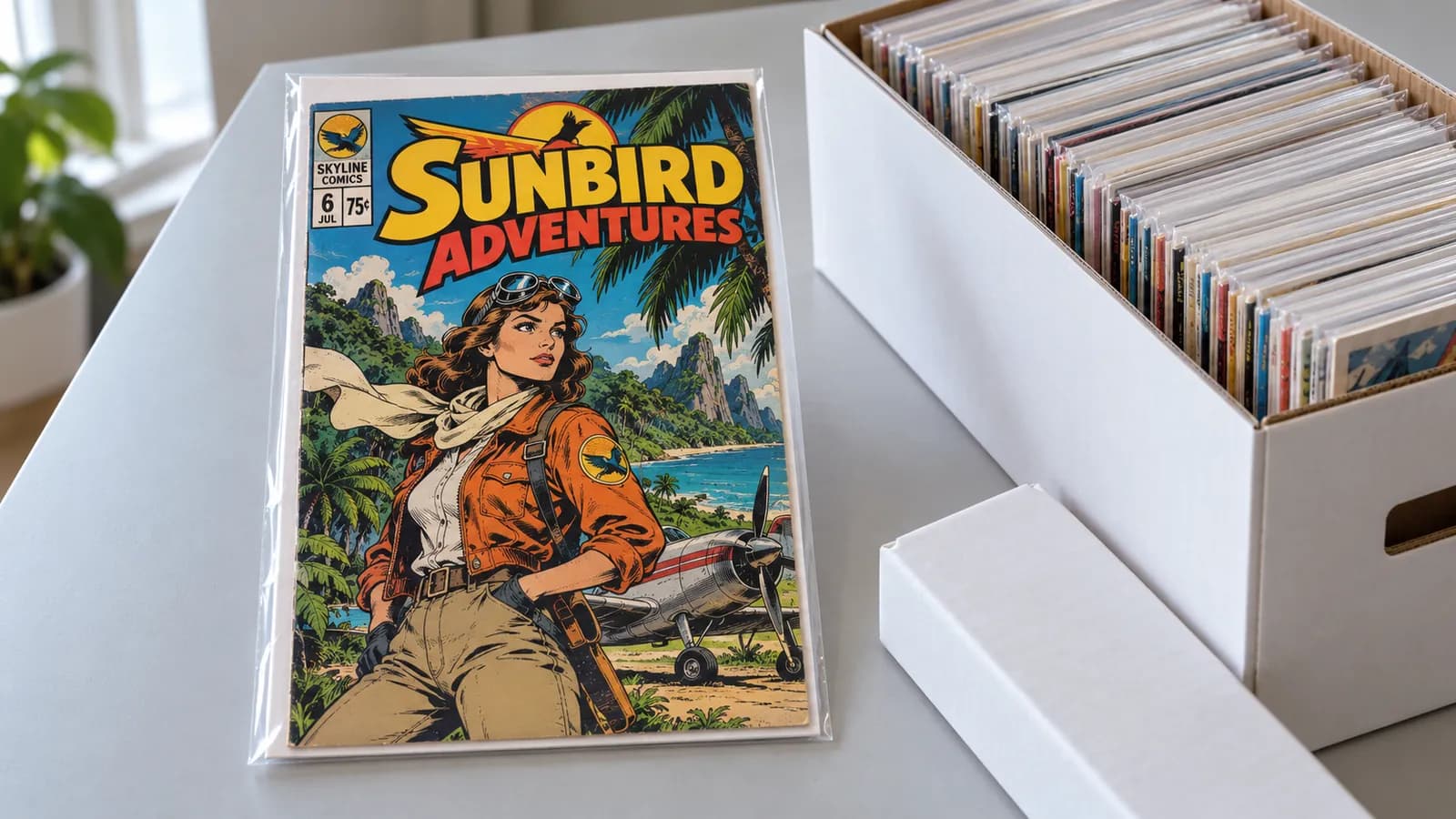
To store comic books, put each one on an acid-free, lignin-free backing board inside a sleeve of polypropylene or polyester film that fits its width. Stand the sleeved books upright and snug in a closed box, and keep the box off the floor in a cool room with low, steady humidity, away from attics, basements, outside walls and sunlight.
Storage cannot raise a grade. Its job is to slow the changes that would put the condition you just recorded out of date. The advice below follows published guidance from the Library of Congress, the US National Archives and the National Park Service.
What bad storage does to a comic's grade
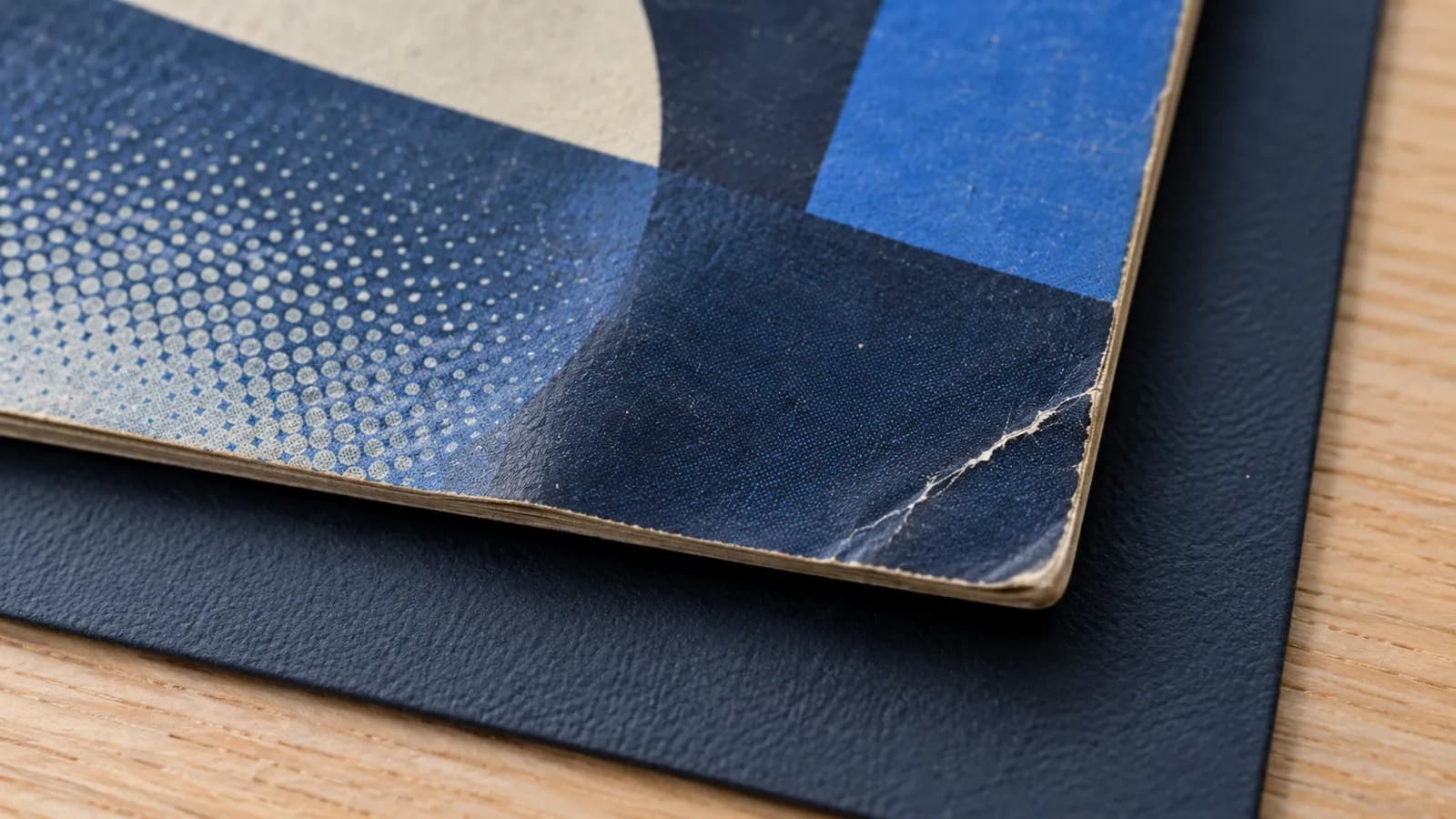
Bad storage fades covers, ages pages, rusts staples and bends books, and the published 10-point grade descriptions give each defect a set place.
| Cause | Defect it leaves | Where the grade descriptions place it |
|---|---|---|
| Light, above all direct sun | Faded cover inks, or a shadow: fading in the shape of whatever covered part of the cover | The top grades allow only minimal fading |
| Heat and temperature swings | Faster aging of acidic paper: tanning and brittleness | Light Tan to Off-White pages cap a book at 8.5 VF+, Tan to Off-White at 7.5 VF-, slightly brittle pages at 6.5 FN+ and brittle pages at 3.5 VG- |
| Damp | Foxing, rust migration, warping | 10.0 GM through 9.8 NM/MT require staples with no rust; rust migration first appears at 7.0 FN/VF |
| Poor fit and pressure | Bends, dents, corner wear, spine stress | 9.4 NM allows a 1/16-inch bend, and only without color break |
| Rubber bands and tape | Edge dents, stains, residue | Tape first appears at 4.0 VG, and only as minor, unobtrusive tape on an otherwise high-grade copy |
Foxing is a scatter of small brown or orange spots, often linked to mold and damp storage. Rust migration is staple rust that has stained the paper around the staples. A box slows aging, but it cannot return faded ink or lift a stain.
The E-Man #1 sample report from NuGrade, an AI-assisted grading app for raw comics, shows a recorded state: 9.2 NM- on September 30, 2026, Cream to Off-White pages, and no findings at the staples, corners or spine. Good storage helps keep rust, fade lines and bent corners off a book like that; it cannot make the pages whiter.
How to choose sleeves: polypropylene or polyester film
Use a sleeve made of a stable plastic: polypropylene for everyday storage, or polyester film for a book you would sell, grade or keep for decades. The US National Archives lists polyester, polypropylene and polyethylene as stable plastics, and it says to avoid PVC (vinyl) and any plastic you cannot identify.
Polyester film is a stiff, clear plastic that the National Park Service describes as inert, and it is the only sleeve material the Library of Congress names for comic books. Polypropylene is the soft, thin plastic of the standard comic bag.
| Polypropylene bag | Polyester film sleeve | |
|---|---|---|
| Support | Little on its own; the board does the work | Adds support; the Library of Congress asks for a sleeve stiff enough to support the book |
| Cost | Lower | Higher per sleeve |
| Watch for | Clouding, yellowing, stickiness or a split seam | Static that can lift crumbs from brittle pages; stiff edges that can catch a corner |
| Best use | Reading copies and bulk storage | Books you would sell, grade or keep long term |
Neither plastic neutralizes acid. A buffered board can neutralize some acids.
How to choose backing boards: acid-free, lignin-free, buffered
Choose boards labeled acid-free and lignin-free, and preferably buffered. A backing board is a stiff sheet of paperboard that sits behind the book inside the sleeve so the book cannot flex. The words on the package mean:
- Lignin-free. Lignin is a natural substance in wood that darkens and breaks down into acids as it ages. It is a large part of why the pulp paper in comics printed before about 1990 yellows and turns brittle.
- Acid-free. The board had a pH of 7 or higher when it was made. Without a buffer, that drifts down over time.
- Buffered. The board carries an alkaline reserve that neutralizes acids as they form. The reserve gets used up, so no board lasts forever.
Acid travels, too. The National Park Service's guidance for acidic wood pulp paper warns that such paper can stain what sits beside it, and houses it much like a bag and board: in a polyester folder with lignin-free paper behind it to absorb acid.
The Library of Congress lists both buffered and neutral-pH enclosures for comics, and notes that some inks can be sensitive to alkaline pH. For unusual inks or hand coloring, ask a paper conservator first.
The board goes behind the book. Replace any board that bows, stains or shows a water tide line, or whose pack did not say what it is made of.
How to get the sleeve and board size right
Measure your book's width, then buy by the inside dimensions printed on the package, not by the era name alone. Sleeves and boards come in era-named sizes (Golden, Silver or Regular, Current or Modern), about 10 1/2 inches tall and different mainly in width.
The names are not a standard: the same era name can mean a different width from one maker to the next, and a stiff polyester sleeve often runs wider than a soft bag with the same name. Thick and giant-size issues need wider sizes again.
Use a board at least as wide as the book and a little narrower than the sleeve. The National Archives sets the same test for any enclosure: nothing sticks out, and nothing shifts.
| Fit problem | What it does to the book | Fix |
|---|---|---|
| Sleeve too tight | Rubs corners and edges going in and out; can bow the cover | The next size up |
| Sleeve too loose | The book slides, and its corners take the knocks | A smaller size |
| Board too wide for the sleeve | Bows the sleeve, which presses on the cover | The matching board |
| Board narrower than the book | The book's edge overhangs and can bend | A wider board |
How to bag and board a comic without damaging it
Work on a clean table with clean, dry hands and no food or drink nearby, and move the book and the board together as one piece.
- Wash and dry your hands, take off rings and a watch, and clear the table.
- Write any label on a box divider, not on a filled sleeve. A pen pressed on a filled sleeve can dent the cover.
- To remove an old sleeve, hold it open and slide the book out on its old board, never by its cover.
- Set the book face up on the new board, back cover down, edges even at the bottom and the spine.
- Hold the sleeve open and slide the book and board in together, bottom edge first. Push on the board, not the cover.
- Fold the flap over the back, and never tape the book. Keep any adhesive strip on the flap away from the cover.
- Check that the book lies flat, no corner is turned and the sleeve does not bow.
When you read a book, follow the Library of Congress handling rule: open it no further than flat, and never fold it back on itself. That fold is how reading creases start.
How to store comic boxes: upright, snug and off the floor
Stand sleeved books upright in a closed comic box, snug enough that they do not lean and loose enough that any one comes out without force. The National Park Service warns about both mistakes: a box packed too tight damages items on the way out, and a box too empty lets them slump and distort.
- Fill the space in a part-full box with a spacer board, as the National Archives advises.
- Keep the lid on to block light and dust.
- Keep boxes on a shelf at least four inches off the floor, the National Park Service minimum.
- Keep stacks of boxes low, and never set a full box on a crushed one.
- Skip rubber bands around groups of books, and do not pile loose books flat, where the bottom ones carry the weight.
Where to keep comic boxes: a cool room with steady humidity
Keep the boxes in the lived-in part of the home, at room temperature or a little cooler, with humidity well under 65 percent and as steady as you can manage. The sources agree on that shape, though their numbers differ.
| Source (as of October 2026) | Temperature | Relative humidity | Also says |
|---|---|---|---|
| Library of Congress, comic book care | Room temperature or below | About 35 percent | Stable; no direct light; away from radiators and vents |
| Library of Congress, storing books | 70°F or below | 30 to 55 percent | Avoid frequent extreme swings |
| US National Archives, family papers | Below 75°F | Below 65 percent to prevent mold; not below 15 percent (brittleness) | Not in damp basements, garages or hot attics |
| National Park Service, mold prevention (2007) | 64 to 68°F target | 45 to 55 percent target; always below 65 percent | Four inches off the floor; not against outside walls |
Avoid attics (heat), basements and garages (damp), outside walls (condensation and swings), radiators and vents, and windows and pipes (sun and leaks). In most homes, a closet on an inside wall of a lived-in floor avoids all of them.
A digital thermometer-hygrometer beside the boxes shows whether the room meets these targets in the hottest and dampest months. Above 65 percent, the National Park Service calls a dehumidifier necessary. To display a cover, frame a print and keep the original boxed: even low light can darken pulp paper.
How to re-check stored comics and record changes
Re-check the room and a few books every few months and after any heat wave, storm, leak or move, and make a new dated record when anything changes. The National Park Service asks for regular checks for mold and its musty smell.
STORAGE RE-CHECK
Date:
Room: temperature ____ F   humidity ____ %
Open-box smell: none / musty (find the damp first)
Boxes: dry, square, lid on, off the floor, out of sun
Fit: upright, not leaning or slumping, none jammed
Sleeves: clear / cloudy, yellowed, sticky, split -> replace
Boards: flat / bowed, stained, tide line -> replace
Spot check three books per box (front, middle, back)
against your last record: page edges, staples,
cover color, corners
Anything changed?  no / yes -> make a new dated record
Make that new record after a move, a leak or humidity spike, new sleeves or boards, pressing or cleaning (see what pressing can and cannot fix), shipping or a sale, or anything new a re-check finds. Repeat the full photo set with the book out of its sleeve, because plastic adds glare, and add the date, the storage spot and what changed. See keeping a dated condition record for the format, grading a raw comic at home for the inspection and photographing comics so flaws show for the photos.
A NuGrade report works the same way: it is fixed when issued and stamped with its date and the methodology version that produced it. A regrade makes a new report with a new ID. The old one stays available at its URL unless the owner deletes it. When both reports are available, they show the book before and after a change. A buyer can open either at the report lookup without an app or an account. A report is an opinion limited to the photos and video: a musty smell or a brittle feel reaches it only through your survey answers, and it does not replace professional grading for a valuable book.
Frequently asked questions
Do comic books need to be bagged and boarded?
Any comic you want to keep in its current condition should be. The sleeve keeps off dust, oils and spills and the board stops bending, but the room still has to handle heat, damp and light.
Are polyester sleeves better than polypropylene bags?
Polyester film is stiffer and is the sleeve material the Library of Congress names for comics, so it suits books you would sell or grade. Polypropylene costs less and works for everyday storage if you replace any bag that clouds, yellows or splits.
What temperature and humidity are best for storing comic books?
The Library of Congress recommends room temperature or below and about 35 percent relative humidity for comic books, held steady. The US National Archives sets outer limits of 75°F and 65 percent humidity, and warns that air below 15 percent can cause brittleness.
Should comic books be stored flat or upright?
Upright, in a closed box that holds them snug without pressure, with a spacer board in any empty space. Tall flat piles put the weight of every book on the ones at the bottom.
How often should you check stored comic books?
Every few months, and after any heat wave, storm, leak or move. Read the hygrometer, smell the open box, look over the sleeves and boards, and compare a few books with your last dated record.