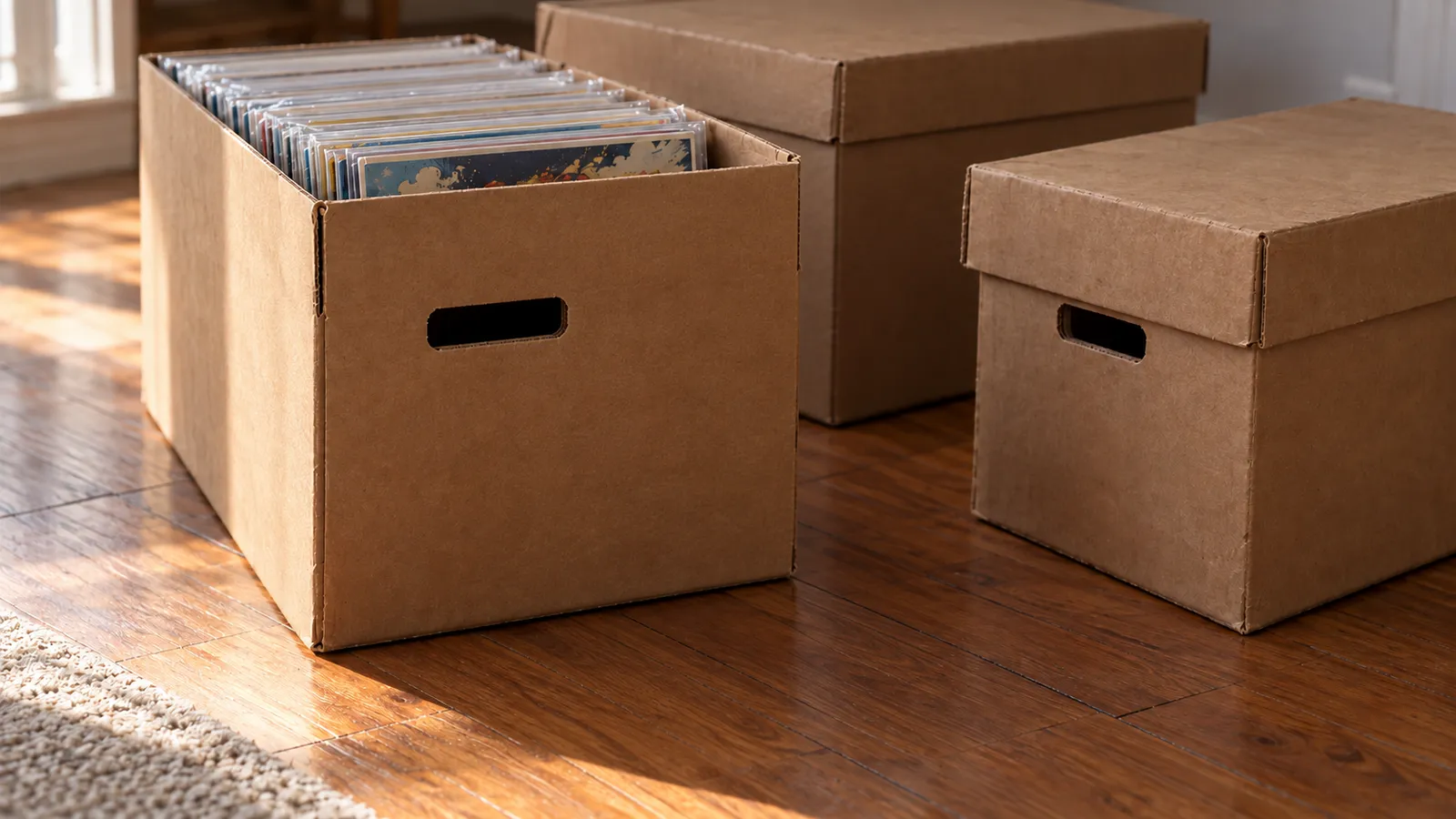
If you inherited a comic book collection, start by protecting it: leave the books in their bags and boxes, keep the boxes upright in a cool, dry room, and do not clean, press or tape anything. Then list each book's title, issue number, cover date and cover price, sort the list by era, and get condition evidence for the books that matter before you take any offer.
All this takes is patience, a notepad or a spreadsheet, and one rule: nothing leaves the house until the list is done.
First, do nothing that can harm the books
The Library of Congress care guidance for comic books notes that many comic collections contain acidic paper, which makes good storage especially important. Until you know what you have, change nothing.
- Do not clean, press or repair. Leave stains, tears and loose covers as they are. Buyers want to see a book as it is, and some cleaning counts as conservation work on the published restoration scale.
- Never use tape. The published grade descriptions treat tape as an amateur repair, and the Library of Congress warns against self-adhesive tape, rubber bands and glue on comics.
- Do not restack or repack. Leave the books in their boxes, in the order you found them. The order can show how the owner kept the collection, and a tall stack weighs on the books at the bottom.
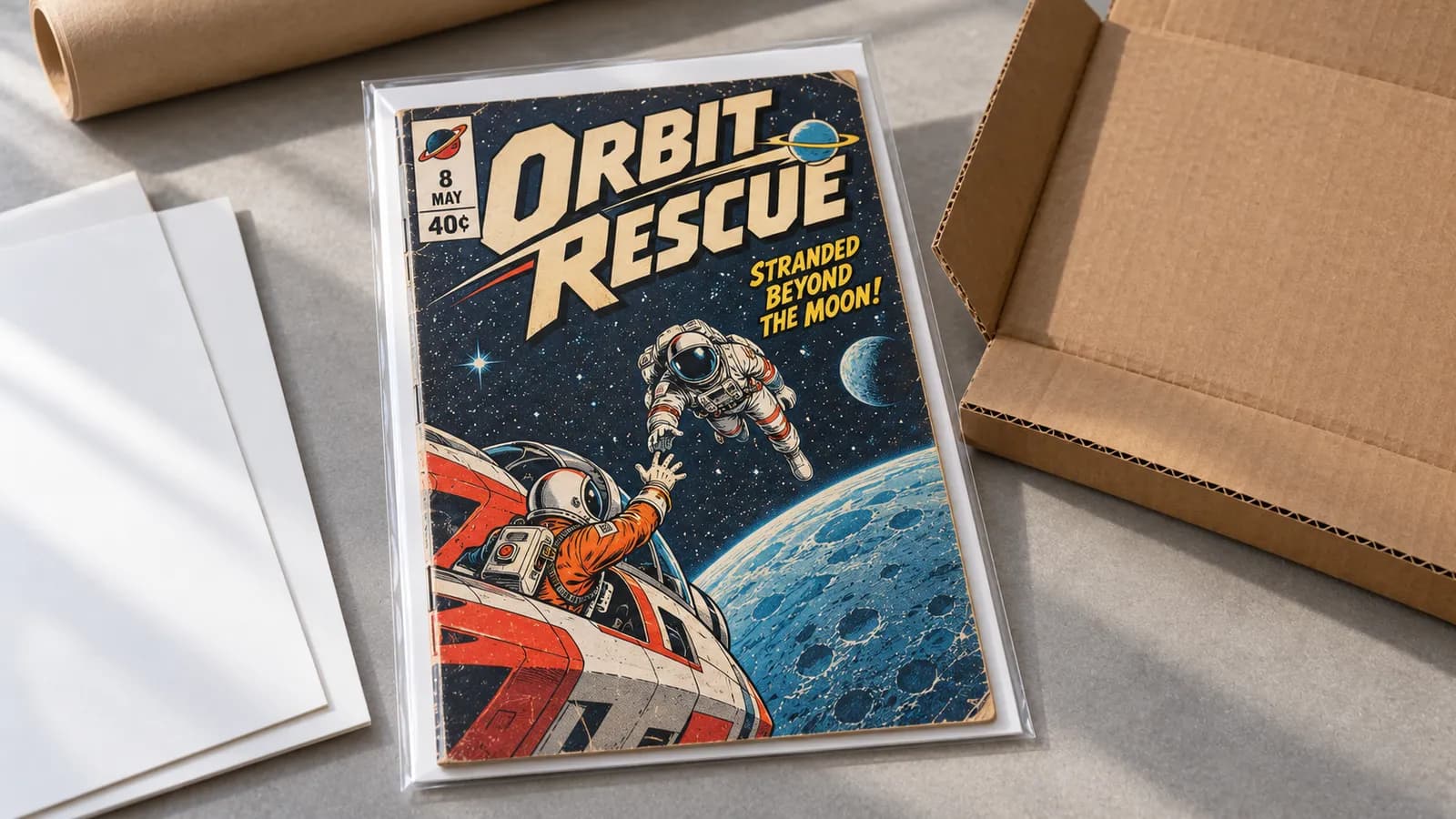
- Open old bags gently, or not at all. If a bag opens easily, slide the book out on its backing board, as how to take a comic out of its bag safely shows. If a book sits tight, tape on the flap touches it, or paper flakes lie in the bag, leave it in the bag.
- Keep the boxes upright, closed and cool. Store them as packed, in a room you live in. The Library of Congress advises a cool, relatively dry, stable place, away from attics, basements, radiators, vents and direct light.
- Handle books with clean, dry hands at a clean table, away from food and drink, and never open a book past flat.
If a box is wet, moldy or crumbling, do not dry, clean or pull apart the books yourself. For condition problems that good storage does not solve, the same Library of Congress page points to a book or paper conservator.
Make a quick inventory and sort it by era
A simple list shows you what you have, lets every buyer make an offer on the same facts, and gives the family or the estate a record. Number each box, photograph it with the lid open, then work through one box at a time and put each book back in its place.
What to record for each book
Write one line per book, plus anything unusual:
BOX 1
No.  Title           Issue  Cover date  Price  Notes
1    Green Lantern   59     Mar 1968    12c    bag and board
2    [title]         [#]    [mon year]  [  ]   [anything odd]
The title, issue number and price are on the front cover, and many covers show the month. The full date is in the indicia, the small print with the publisher and the date, usually on the first page or inside the front cover. If reading it means forcing a bag open, leave the year blank; the cover price gives a rough era until then. Look for the owner's own lists or receipts, too.
Sort the list by era
Sort the list from oldest to newest. Collectors group American comics into eras, and the era tells you where your first hours should go.
| Era | Usual cover dates | What to do first |
|---|---|---|
| Golden Age | 1938 to 1955 | Set every book aside for a closer look, and handle them little: paper this old can be brittle at the edges. |
| Silver Age | 1956 to about 1970 | Set every book aside for a closer look. |
| Bronze Age | About 1970 to 1984 | Check each issue for key status, and record the exact cover price: some issues exist at more than one price. |
| Copper Age | 1984 to 1991 | Check each issue for key status. |
| Modern Age | 1992 on | Check keys and variant covers, and set aside copies that look new. |
Collectors draw these lines a year or two apart. Age alone does not make a book valuable, but it tells you where to look first.
Spot the books that deserve a closer look
A closer look means identifying the book exactly, then checking its demand, its condition and what matching copies sold for. These signs mark the books that deserve one:
- Key issues. A key issue is one that collectors seek for what happens in it, such as a first appearance, an origin or a first issue. Confirm a key claim in a reference catalog for your exact series and issue, not in a seller's listing.
- Early cover prices. On most US comics, a price of 10 or 12 cents marks a book from the 1960s or earlier.
- First printings. A later printing, a reprint or a facsimile edition can copy the cover of a valuable first printing. Check the indicia for a later-printing line and the cover for a facsimile notice; how to identify the exact book and printing covers the checks.
- Copies that look almost new. Buyers pay by grade, so a near-new copy deserves a look even when the issue is common.
- Anything the owner kept apart. A book in its own case, a signed book, a labeled box, or a book with receipts or notes. Keep any paperwork with the book it describes.
Worn copies of keys still find buyers, often listed as reading copies; what reading copy means for a comic explains what buyers expect from one.
Get condition evidence before you take offers
Every buyer will judge condition, and condition sets much of the price. Have your own evidence first, so you can check what a buyer tells you. Comics are graded on a 10-point scale, from 10.0 Gem Mint down to 0.5 Poor.
| Books | Evidence | What it gives you |
|---|---|---|
| Books that deserve a closer look | Photos of both covers, the spine and the corners, in low side light without flash | A record of condition before anyone handles them |
| The few with real value as raw copies | A photo-based condition report | A grade, a range and findings a buyer can check |
| The few where graded copies sell for far more | Professional grading, after you run the numbers | An in-hand grade and a restoration check |
A raw comic is one that has not been graded and sealed in a holder. For the photos, follow what photos a raw-comic listing should include; for the last row, is my comic worth grading? runs the break-even math.
As an heir, you may not know whether a book was pressed, cleaned or restored. Say "not known"; it beats a guess.
NuGrade, an AI-assisted grading app for raw comics, is one way to fill the second row. You answer a short survey about what the camera cannot see, where "Nothing that I know of" is an answer you must choose, then take seven photos and two short videos with your phone. The report gives a grade on the 10-point scale with a plausible range, findings tied to the photo or video frame they came from, and a restoration read. Anyone can open it by its ID at the report lookup page, and the book stays with you.
New accounts start with complimentary credits (see pricing). A NuGrade grade is an opinion limited to what the photos and video show: it does not replace professional grading for a high-value book, and it is not an appraisal.
Sell the lot, consign, sell it yourself or keep it
The right choice depends on your time, how many books deserve a closer look, and whether anyone in the family wants them.
| Choice | What you get | What it costs you |
|---|---|---|
| Sell the whole lot to a dealer | One payment, quickly, with no listing work | Less than the books bring one at a time, because the dealer takes on the work and risk of reselling |
| Consign | A seller with buyers sells the books for you | A commission or fee, a wait, and the books out of your hands |
| Sell the books yourself | The most money per book, if you do the work | Your time, selling fees, packing, shipping and buyer questions |
| Keep them | The collection stays in the family | Storage space and care |
A lot is a group of books sold together for one price. In consignment, a dealer or an auction house sells your books and keeps a commission or fee; before you sign, read the fees, any minimum price, how long the books stay away and who insures them.
You can also split the collection: sell the common books as a lot, and sell, consign or keep the few that deserve a closer look. How to sell raw comic books covers pricing, listing and shipping single books. If you keep them, ask your insurer how it covers a collection.
How to avoid a lowball offer
A lowball offer is one far below what the books would bring, and it is easiest to make to a seller who does not know what they have. Your list and your evidence are the first defense. Then:
- Know the numbers for the books that matter. Find recent sold prices for matching copies: the same issue, printing and condition, raw against raw. Asking prices and price-guide figures are not sales. IRS Publication 561, the US guide to valuing donated property, lists comics among common collectibles and cautions that catalogs and dealers' price lists "are not always reliable indicators" of fair market value (revised December 2025, as of October 2026).
- Get more than one offer. Give every buyer the same list and photos, and ask for each offer in writing, with the books it covers.
- Ask which books carry the offer, and what the buyer would pay for those alone.
- Do not sell the best books at a lot price. If a buyer wants only the top books, price them on their own, and agree on the rest first.
- Do not decide on the spot. A buyer who presses for an answer today is a reason to slow down.
- Keep the books in your control. Let buyers look in your presence, and let no one take boxes away without a signed list of what they took.
A fair offer for a whole collection sits below the sum of single sales, because the gap pays for the buyer's work. Several offers on the same facts tell you whether the gap is fair.
Estates, donations and appraisals
A grade describes condition; an appraisal states a value for a purpose. You may need a written appraisal when an estate must report its value, when you donate books for a tax deduction, or when an insurer asks.
This guide gives no tax or legal advice. Ask the executor, the estate's attorney or a tax professional what is needed before anything is sold, divided or donated. If several heirs share the collection, agree on who decides before anyone sells or takes books.
For donations in the US, the official source is IRS Publication 561, Determining the Value of Donated Property. As of October 2026, it explains what the IRS means by a qualified appraisal and a qualified appraiser: among other conditions, a person with verifiable education and experience in valuing the type of property, who regularly prepares appraisals for pay.
Choose an appraiser with experience in comics who will not also bid on the books. A NuGrade report is a dated condition record, not an appraisal.
Frequently asked questions
What should I do first with an inherited comic book collection?
Protect it. Leave the books in their bags and boxes, keep the boxes upright in a cool, dry room, and do not clean, press, tape or restack anything until you have a list of what is there.
Are inherited comic books worth money?
Some are. Value depends on demand for the exact issue and edition, its condition and what matching copies sell for; age alone does not make a book valuable.
Should I sell an inherited comic collection as one lot?
A lot sale to a dealer is the fastest and least work, but it pays less than the books bring one at a time. You can also sell the common books as a lot and handle the valuable ones separately.
Do I need an appraisal for an inherited comic collection?
Only when someone needs a formal value, such as an estate, a donation for a tax deduction or an insurer. Ask the estate's attorney or a tax professional; for US donations, IRS Publication 561 explains what a qualified appraisal is.
Should I get inherited comics graded before I sell them?
Only the few where graded copies sell for enough more to cover the fees, shipping and wait. For the rest, honest photos or a photo-based condition report give buyers the evidence they need.