A comic grade estimate comes as a range because the evidence behind it cannot settle every finding. The point grade, such as 7.5 VF-, is the best estimate. The range, such as 7.0 FN/VF to 8.0 VF, shows how far that grade could move if an uncertain finding turned out better or worse with the book in hand.
NuGrade, an AI-assisted grading app for raw comics, gives both on its reports. The three public sample reports below show what a range means, why it can lean up or down, and what narrows it.
What a grade range means
A grade range, which NuGrade calls the plausible range, is the span of grades a book could fall in once its uncertain findings are settled in hand. The point grade inside it is the single grade the evidence supports best.
A point grade is set by the worst defect the photos and video show, because one bad flaw limits the whole book however clean the rest is. What VF, FN and NM actually mean explains the tier names used below.
Three points keep a range from being misread:
- It is not a confidence interval. No percentage stands behind a NuGrade range, and it makes no claim about how often an in-hand grade lands inside it. It is a judgment of how far the call could move.
- The grade is not its midpoint. The grade comes first, from the worst defect. The range surrounds it and never moves it, so it can reach further one way than the other.
- It is not a forecast of a professional grade. It describes what seven photos, two short videos and the owner's survey answers support. A grading service that examines the book in hand reaches its own grade.
Why a photo grade comes with a range
Photos and video show the common defects that set a grade, but they cannot measure every one of them. Some findings stay uncertain, and a range reports that doubt instead of hiding it behind one exact number.
The doubt comes from three places:
- Findings the photos show but cannot settle. An uncertain finding is a mark the evidence shows but cannot explain with confidence. The Guardians of the Galaxy #4 report records faint marks at the top margin of two ad pages "which could be pencil writing or show-through," and lists them as a possible defect instead of guessing.
- Areas that look clean but cannot be proven clean. A photo resolves detail only down to a limit. Below it, a hairline tick or a small dent leaves no trace.
- Facts outside the camera. Odor, a brittle feel and history such as past pressing or cleaning come from the owner's survey answers, not from the photos.
Our grading method handles that doubt in two fixed ways. First, 9.6 NM+ is the highest grade a review of photos and video supports, because the grades above it allow almost no defects and photos cannot confirm an absence that small. Second, an area where nothing was seen gets no ceiling of its own, so the camera's limits do not pull the grade down a second time. That leftover doubt goes into the range instead.
Why a range can lean up or down
A range does not have to be symmetric. It leans when the doubt runs more one way than the other: its top can rise no further than the next-worst finding allows, and its bottom reaches down for anything that could prove worse, or that the photos could not see.
- The top. If the limiting finding turns out milder in hand, the grade does not jump to the top of the scale. The next-worst finding becomes the limit, and no photo grade goes above 9.6 NM+.
- The bottom. The low end covers a finding that could prove worse in hand, such as a tick that runs deeper than it looks, plus the leftover doubt from areas that looked clean. An unseen flaw can only lower a grade, never raise it.
Three public NuGrade sample reports, all graded September 30, 2026, show three shapes. They are examples of what photo evidence shows, not a measure of accuracy.
| Sample report | Grade | Range | Steps below | Steps above | Grades in the range |
|---|---|---|---|---|---|
| E-Man #1 (Charlton, 1973) | 9.2 NM- | 8.5 VF+ to 9.4 NM | 2 | 1 | 4 |
| Marvel Presents: Guardians of the Galaxy #4 (Marvel, 1976) | 7.5 VF- | 7.0 FN/VF to 8.0 VF | 1 | 1 | 3 |
| Green Lantern #59 (DC, 1968) | 5.5 FN- | 5.0 VG/FN to 6.5 FN+ | 1 | 2 | 4 |
Count steps on the 25-step scale, not decimal points. E-Man's range spans only 0.9 of a point, yet it holds four grades, as many as Green Lantern's 1.5-point range, because the steps get smaller near the top of the scale. The notes below read each shape against the findings its report lists.
E-Man #1 leans down
The report's "why not higher" section lists two production findings: a slight miswrap that leaves a narrow unprinted strip along the front spine edge, and a small dark mark at the left edge of the back cover, likely a bindery or printing artifact. Every other condition area came back clean, and restoration reads Unverified. On a copy this clean, most of the remaining doubt is about what the photos could not resolve, and that doubt points down.
Guardians of the Galaxy #4 sits evenly
The spine sets this grade: an accumulation of small stress ticks, several showing white color break against the black cover, persistent across adjacent frames of the spine pass. Because the ticks persist from frame to frame, the open question is how much they weigh, not whether they exist. The published grade descriptions allow an accumulation of small defects at 7.0, 7.5 and 8.0 alike, so a step either way is a matter of degree. Dark covers make that kind of wear easy to miss, as why black covers hide edge wear until you look close explains.
Green Lantern #59 leans up
The spine sets this grade too: multiple short color-breaking stress ticks along the spine edge, concentrated at both staple positions and persistent across adjacent frames. By the method's own definition of a range, the grade could rise two steps if an uncertain finding resolved in the book's favor, and fall one step if it went the other way.
How to narrow a range with better evidence
You narrow a range by giving the grader evidence that settles findings instead of leaving them open. Four things matter most: sharp corner close-ups, a slow spine pass, a full page flip and honest survey answers.
| Evidence | What it answers | What leaves the question open |
|---|---|---|
| Corner close-ups, 3 to 4 inches from each tip, tip in focus | Whether each tip is sharp, slightly blunted or worn through to the paper | A soft or distant shot, so a corner cannot be cleared |
| A slow, steady spine pass, about 10 to 15 seconds from top to bottom | Whether a mark is a tick that persists across adjacent frames or a glint that shows in one | A fast pass, so each stretch of spine appears in too few frames |
| A full page flip, one page at a time, with a pause on each spread | Tears, writing, stains and page color across every spread | Skipped or blurred spreads, so part of the interior goes unseen |
| Honest survey answers | Odor, brittle feel, signatures, and past pressing, cleaning, tape removal, trimming or color touch | A guess, or an answer that leaves out known work |
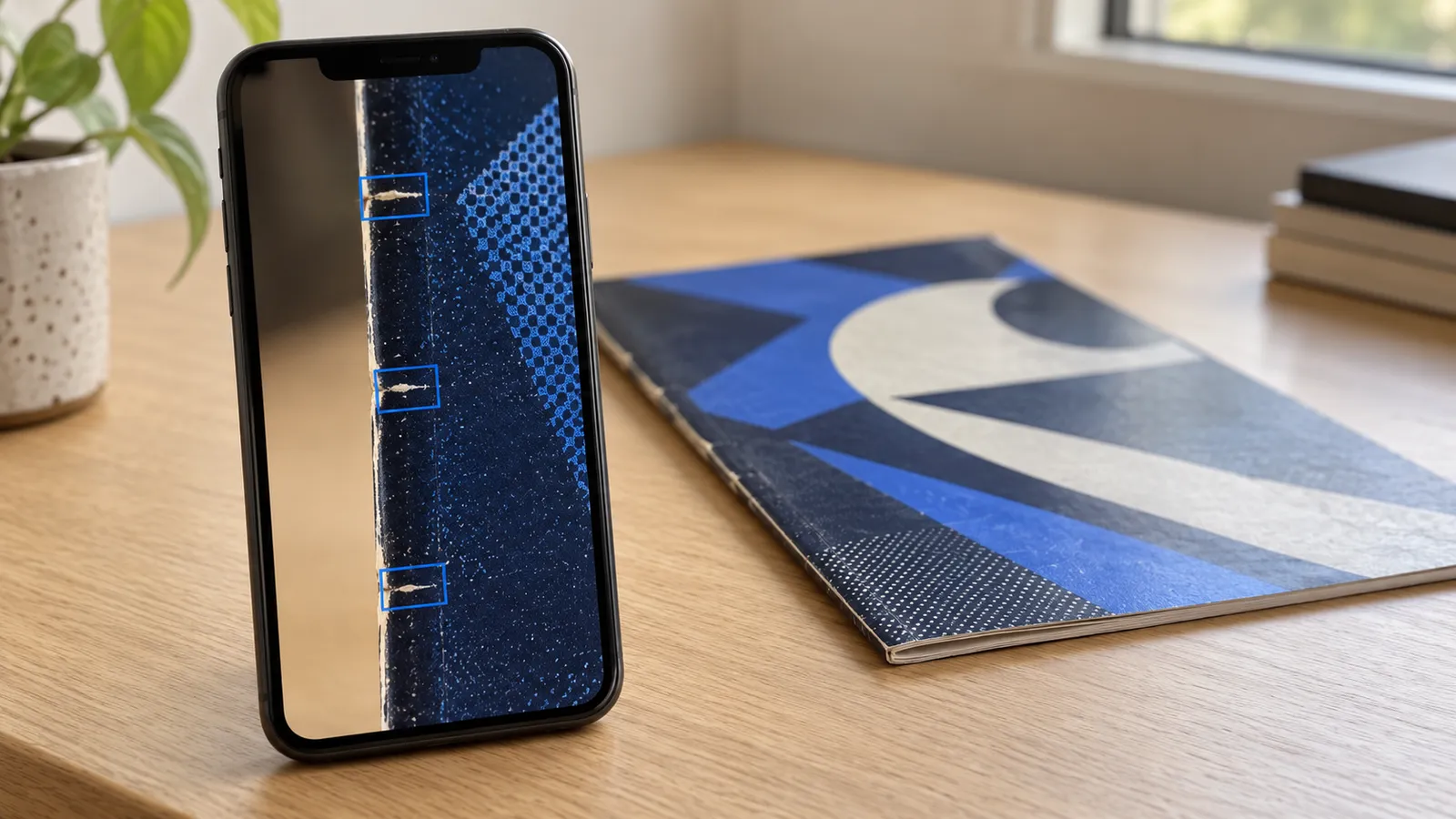
The spine pass carries extra weight. As the phone moves, light strikes the spine from a changing angle, so a tick can show in only a few frames. A real tick persists across adjacent frames, while a reflection shows in one. On two of the three sample reports, ticks that persisted this way set the grade.
A missing shot can cost grade, not just certainty. When a required photo or video is missing or unreadable, our method grades that area toward the low end of what is plausible and lists the gap in the report's evidence limits.
The app checks the capture for common problems before you submit, and each report includes one free re-shoot retry. For the full setup, see how to photograph comics so the flaws actually show.
What no photo can narrow
Four questions stay open however good the photos are: restoration in ordinary light, odor, brittleness and defects smaller than the photos resolve. A range cannot shrink them, and if one turns out badly in hand, the grade can fall below the range or the book's label can change.
- Restoration in ordinary light. Skilled color touch or piece fill is done to match the surrounding ink, so in ordinary light a photo may record nothing at all. NuGrade reports restoration as Unverified when the photos cannot establish it, as on all three sample reports. Restoration puts a book in a different category, so this question can change what the book is, not only its number.
- Odor. A camera records no smell. The survey asks about an acidic or musty odor, and the report rests on the owner's answer.
- Brittleness. Paper can look supple in a photo and still crack when a page turns, so the survey asks about a brittle feel. Brittleness caps a grade however clean the cover is: on the published page-quality scale, slightly brittle pages allow no grade above 6.5, and brittle pages none above 3.5.
- Defects smaller than the photos resolve. Each NuGrade report says so in its disclosure: such defects may exist and "would lower the grade if confirmed in hand."
The range also assumes the survey answers are true. The owner must choose "Nothing that I know of" on purpose, because the app never selects it in advance. A wrong answer does not widen the range; it makes the range wrong. For what photos show, what owners must disclose and what stays unknown, see what an AI grader can miss.
Why in-hand grading gives one number
Professional third-party grading states one number after an in-hand inspection. Holding the book can settle most of what a photo leaves open: a suspect tick under the grader's own light, the feel of the paper, the edges and the signs of restoration.
That number is still a judgment, and two careful graders can differ by a step. But an in-hand grader is not limited by what a camera resolved.
A photo-based range is not a forecast of that number. For a book with a high value, professional grading and encapsulation are still the right choice. A range helps you decide which books to send, and the cost math for grading a comic shows how to test a submission at the low end.
How to read a range before you buy or sell
Read a range from the limiting finding outward: what sets the grade, how sure the evidence is about it, and what the range leaves out. These five questions work for any grade estimate.
FIVE QUESTIONS FOR ANY GRADE RANGE
1. What is the point grade, with its tier?   (e.g. 7.5 VF-)
2. Which finding sets it? Is it seen clearly,
   or marked as possible?
3. How many steps does the range run below
   and above the grade? (Count grades, not decimals.)
4. What stays open? (Restoration, odor, brittleness,
   defects smaller than the photos resolve.)
5. Does my price or my plan still work at the
   low end of the range?
If you sell, list the grade, the range and the limiting finding together, and link the report. If you buy, plan around the low end and ask about anything marked possible or Unverified. Anyone can open a NuGrade report by its ID at the report lookup, with no app or account.
Frequently asked questions
What does a grade range mean on a comic?
A grade range shows how far a grade could move if an uncertain finding resolved the other way with the book in hand. The point grade inside it is the best estimate, set by the worst defect the evidence shows.
Is the grade always in the middle of the range?
No. The grade comes first, from the worst defect, and the range is drawn around it, so it can reach further down than up or the reverse. The E-Man #1 NuGrade sample report reads 9.2 NM- with a range of 8.5 VF+ to 9.4 NM.
Is a grade range a statistical confidence interval?
No. A NuGrade range carries no percentage or confidence level. It is a judgment of how far the grade could move as uncertain findings are settled.
How do you get a narrower grade range?
Give the grader evidence that settles findings: corner close-ups in sharp focus, a slow and steady spine pass, a full page flip with a pause on each spread, and honest survey answers. Some questions, such as skilled restoration, stay open in any photo.
Why does professional grading give one number instead of a range?
A professional grader inspects the book in hand, which can settle most of what photos leave open, and the label states one grade. A photo-based range is not a forecast of that grade.