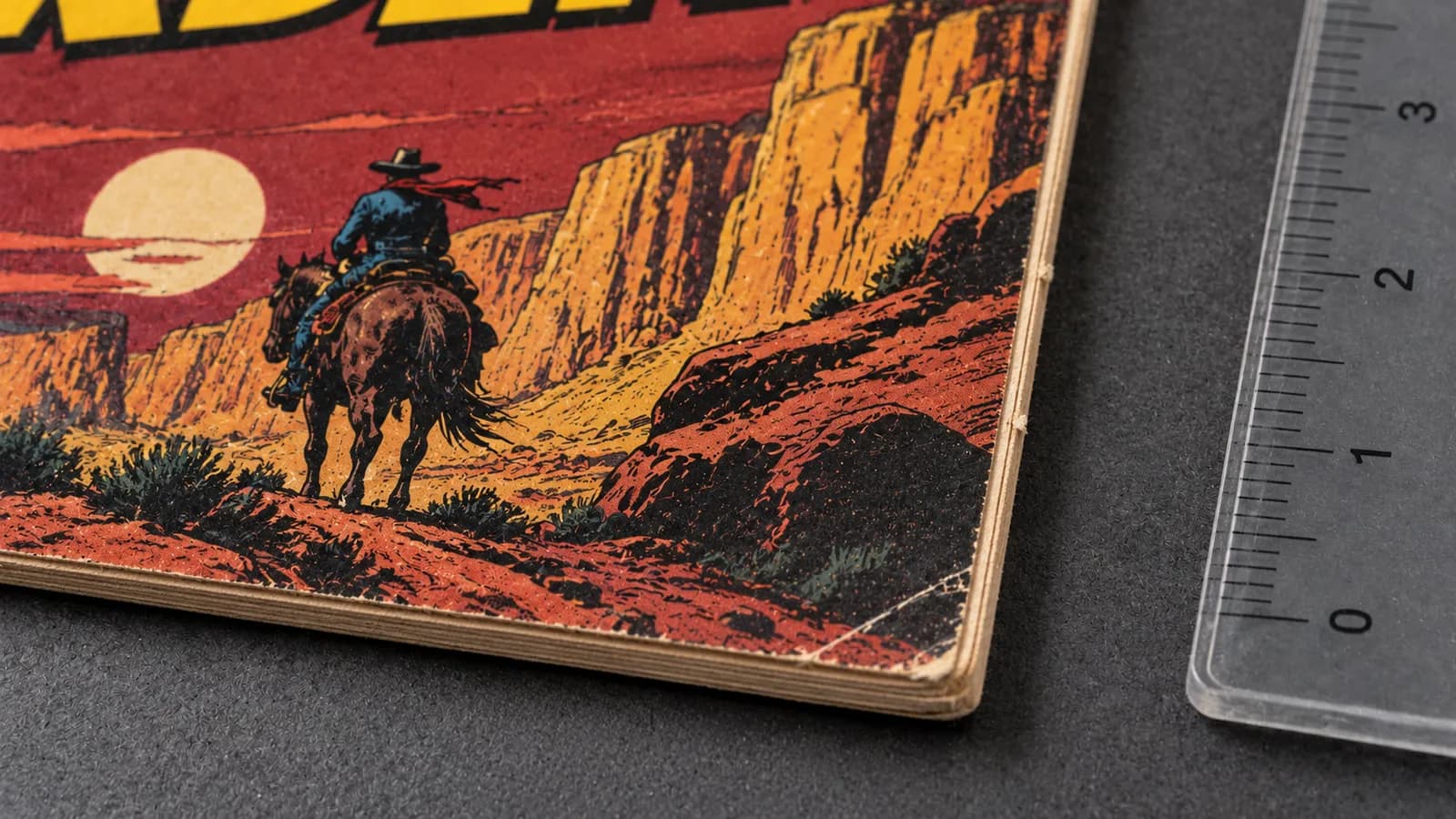
Graders judge comic corner and edge wear by its kind and its size. A corner tip with the slightest blunting still fits 9.4 NM on the standard 10-point grading scale, any corner crease keeps a book below 9.0 VF/NM, and the published 4.0 VG description allows a 1/4-inch triangle of missing paper. One worn corner sets the grade only when it is the book's worst flaw.
Up close, a soft tip, a white fleck, a cracked fold and a missing piece are different defects, and they land far apart on the scale.
What each corner condition means, from sharp to missing
Each corner condition names what happened to the paper at the tip: wear, a fold, a split or a loss.
- A sharp corner meets in a crisp, square point.
- Slight blunting is a tip gone a hair soft, visible only up close.
- A blunted corner has lost its point: the tip is pushed in or worn into a short flat.
- A rounded corner has worn into a visible curve.
- A bent or dinged corner was knocked out of line, with the ink still whole.
- A creased corner has a permanent fold line across it.
- A torn corner has a split running into the paper, with no paper gone.
- Missing paper leaves a gap in the corner's outline, measured as a triangle or a square.
Color break is ink that has cracked or worn away to show the paper beneath it. A wear fleck is a tiny spot where cover ink has rubbed off; on a dark cover it shows white.
Check the corners of both covers, then the page corners, where small chips can be a sign of brittle paper. For the inside of the book, see why a nice cover does not tell you what is inside.
How to tell a blunted corner from missing paper or a crease
Look at the outline first, then the ink. A blunted corner keeps its whole outline, missing paper leaves a gap in it, and a crease draws a line across it.
- Lay the book flat on a dark, non-glossy surface, with one lamp and no flash.
- Look straight down at the tip. Where the dark surface shows through a notch, paper is missing; on a blunted tip, paper runs to the soft point.
- Lower the lamp so its light skims the corner. A bend or a crease shows as a ridge or a line, and a white line in the ink is color break.
- Measure with a ruler beside the book, never on it, in fractions of an inch.
Never fold a corner back to see whether a crease opens. That can crack ink that was whole.
| What to check | Blunted | Missing paper | Creased, color broken |
|---|---|---|---|
| The outline | Whole, with a soft tip | Broken by a notch or a lost tip | Whole, with a line across it |
| On a dark surface | Paper to the end of the tip | The surface shows through | A white line in the ink |
| In low side light | Fuzzy fibers, little relief | A clean or ragged gap edge | A ridge that flashes |
| After pressing | The point stays lost | The gap stays; a fill is restoration | The fold can relax; the white line stays |
The pressing row is explained in what pressing can and cannot fix.
How much corner wear lowers the grade
How far corner wear lowers the grade depends on its kind: the slightest blunting fits 9.4 NM, blunted corners first appear at 7.0 FN/VF, and missing paper at 4.0 VG. The table paraphrases the published grade descriptions; the creases column covers the whole cover.
| Grade | Corners | Bends and creases |
|---|---|---|
| 9.8 NM/MT and up | Square and sharp | None |
| 9.6 NM+ | One corner almost imperceptibly blunted | None, and no color break |
| 9.4 NM and 9.2 NM- | The slightest blunting | A 1/16-inch (9.4) to 1/8-inch (9.2) bend, ink unbroken |
| 9.0 VF/NM | The slightest blunting, no corner creases | A 1/8-inch bend, ink unbroken |
| 8.0 VF | Minute wear at the corners | An unnoticeable 1/4-inch crease, ink unbroken |
| 7.0 FN/VF | Corners may be blunted | Minor creases |
| 6.0 FN to 5.0 VG/FN | Blunted corners more common | Minor to moderate creases |
| 4.0 VG | Up to a 1/4-inch triangle or 1/8-inch square missing | Moderate creases |
| 3.0 GD/VG | Blunted or rounded, up to a 1/2-inch triangle missing | A book-length crease |
Three rules turn the table into a grade.
Worn-through ink is color break. NuGrade, an AI-assisted grading app for raw comics, applies this rule: a corner with ink worn through to the paper cannot hold 9.2 NM- or above, and one small, isolated fleck sits at 9.0 VF/NM or 8.5 VF+, by its size and how much it shows. That fits the 9.4 and 9.2 descriptions, which call for no surface wear.
Small flaws add up. The standard scale describes 7.5 VF- as a book with a moderate defect or an accumulation of small ones, so several worn corners can count for more than one.
The worst flaw sets the grade. The book grades no higher than its lowest area ceiling. A blunted corner on a book with a split spine changes little; on an otherwise clean book, it is the reason the book is not near mint. See how findings become a grade band and what VF, FN and NM actually mean.
Edge wear: flecks, nicks, chips and tears
Edge flaws follow the corner logic: kind and size matter most, and missing paper costs the most. Check the top, bottom and outer edges of both covers.
- Edge wear is rubbing that thins the ink or flecks it away, often a row of white dots on a dark cover.
- A nick is a tiny cut or dent in the edge, with no paper gone.
- A chip is a small piece of the edge that is gone, so it counts as missing paper.
- A tear is a split that runs into the cover from the edge.
Edge flecks are color break, judged like corner flecks, and a longer tear costs more than a short one. The descriptions first size missing pieces at 4.0 VG, up to a 1/4-inch triangle out of a corner or edge. They do not say how high a book with a tiny chip can go, so graders weigh its size and how much it shows.
Factory edge flaws are graded differently
Some edge flaws come from the factory, not from handling. Graders count them as production defects, and each grade allows only so many.
- A bindery tear is a small factory tear. The descriptions allow none at 9.6 NM+, and only tears under 1/16 inch at 9.4 NM on Silver Age and later books, with more room on Golden Age books.
- A bindery chip is a chip left by the factory trimming. The published grading guide counts it as a printing defect.
- Overhang is a cover that extends past the pages. With nothing behind it, that edge can pick up nicks more easily.
- Marvel chipping is the collector name for a run of small chips and tears along the top, bottom and right edges from the trimming, seen most often on Marvel books of the late 1950s and early 1960s.
Damage after the book left the factory is handling wear. If you cannot tell which you have, log the flaw with the cause marked unknown.
Two real reports where the corners did not set the grade
On two NuGrade sample reports, the corners and edges show real wear, yet the spine set the grade both times. NuGrade grades from seven phone photos, four of them corner close-ups, plus two short videos. The reports are examples of what photos record, not proof that a photo grade matches an in-hand one.
Green Lantern #59: blunted corners, a 5.5 set by the spine
Green Lantern #59 (DC, March 1968) graded 5.5 FN-, with a range of 5.0 VG/FN to 6.5 FN+. Six of its nine findings sit on corners and edges, including, in the report's words:
- bottom-left corner tip blunted, with small color flecks exposing paper along the bottom edge
- top-left corner slightly blunted, with light edge wear along the top edge
- small nicks and edge wear along the spine-side edge of the back cover
- the cover edge sits slightly proud of the page block at the top-right, consistent with a mild bindery overhang
The report files the overhang under production, apart from the handling wear. Its "why not higher" names neither the corners nor the edges: a row of color-breaking stress ticks along the spine, concentrated at both staples, limits the book.
Guardians of the Galaxy #4: a creased corner, a 7.5 set by the spine
Marvel Presents: Guardians of the Galaxy #4 (Marvel, April 1976) graded 7.5 VF-, with a range of 7.0 FN/VF to 8.0 VF. In the report's words:
- short corner crease at the top-right tip with color break exposing paper, visible in the top-right corner close-up
- slight blunting with a small white wear fleck at the bottom-left corner tip, visible in the bottom-left corner close-up
- light edge wear with small white flecks along the top cover edge near the top-left, visible in the top-left corner close-up
By the published descriptions, that corner crease alone keeps the book below 9.0 VF/NM. Still, the report names the spine as the limit: an accumulation of small color-breaking stress ticks, white against the black cover.
For contrast, E-Man #1 (Charlton, 1973) has its corners and edges marked clean. Its only two findings are production flaws, and it graded 9.2 NM-.
How to photograph and record a corner or edge flaw
Shoot each corner close and sharp, then write each flaw as place, kind, size and evidence. "Front cover, top-right corner: 1/8-inch crease across the tip, ink broken" (an example, not a real book) tells a buyer far more than "light corner wear".
- Hold the phone 3 to 4 inches from the tip, with the tip centered, and tap the tip to focus.
- Lay a ruler beside the book, near the corner, so the size shows in the frame.
- Add a shot with the lamp low to one side, so creases catch the light.
For light and framing, see how to photograph comics so the flaws actually show. Then log each flaw:
CORNER AND EDGE LOG (example rows, not a real book)
Book:                     Checked on:

Where        Kind             Size      Ink     Paper
                                        broken  missing
Front TR     crease at tip    1/8 in    yes     no
Front BL     slight blunting  -         fleck   no
Back, top    nick             1/16 in   no      no

Photo and cause (factory or handling) for each row:
Worst corner or edge flaw:
Worst flaw on the whole book:
What corner and edge photos cannot show
Photos show a corner's shape and ink, but they cannot prove what someone did to it. Good repairs at corners and edges are made to blend in.
- Color touch can hide a fleck or a crease, and piece fill can rebuild a missing corner. Both are restoration even when tiny; the restoration grading scale lists light color touch on a corner crease at its smallest amount.
- Trimming can clean up a chipped edge, and it is restoration too. Edges too sharp and square for the wear on the rest of the book are a warning sign.
- Very small flaws, below what the photos resolve, can exist in any photo-based grade.
A NuGrade report marks restoration Unverified when the photos cannot establish it, and its survey asks about any color touch, piece fill or trimming you know of. Its grade is an opinion limited to that evidence; for a high-value book, professional grading is still the right choice. See what a photo grade can miss.
Do not touch up a corner yourself. Marker on a fleck, glue on a torn tip or a trim along a chipped edge makes the book restored.
Frequently asked questions
Does one blunted corner ruin a comic's grade?
No. The slightest blunting fits as high as 9.4 NM, and a clearly blunted corner sets the grade only when it is the book's worst flaw. Otherwise the worse flaw sets it.
What is the difference between a blunted corner and a missing corner?
A blunted corner still has all its paper, pushed in or worn into a soft tip. A missing corner has lost paper, so its outline has a gap, and the published grade descriptions size missing pieces only from 4.0 VG down.
Is a corner crease worse than slight corner blunting?
Yes. The 9.0 VF/NM description allows no corner creases, while the slightest blunting fits up to 9.4 NM. A crease that broke the ink also leaves a white line that pressing cannot remove.
Do bindery chips and bindery tears count against the grade?
Yes, but as production defects, not handling wear. Each grade allows only so many bindery defects, and the published descriptions accept bindery tears under 1/16 inch at 9.4 NM on Silver Age and later books.
Can pressing fix a worn or chipped corner?
No. Pressing can flatten a corner that is bent with its ink unbroken, but blunting, color break and missing paper stay, and filling a missing corner is restoration.