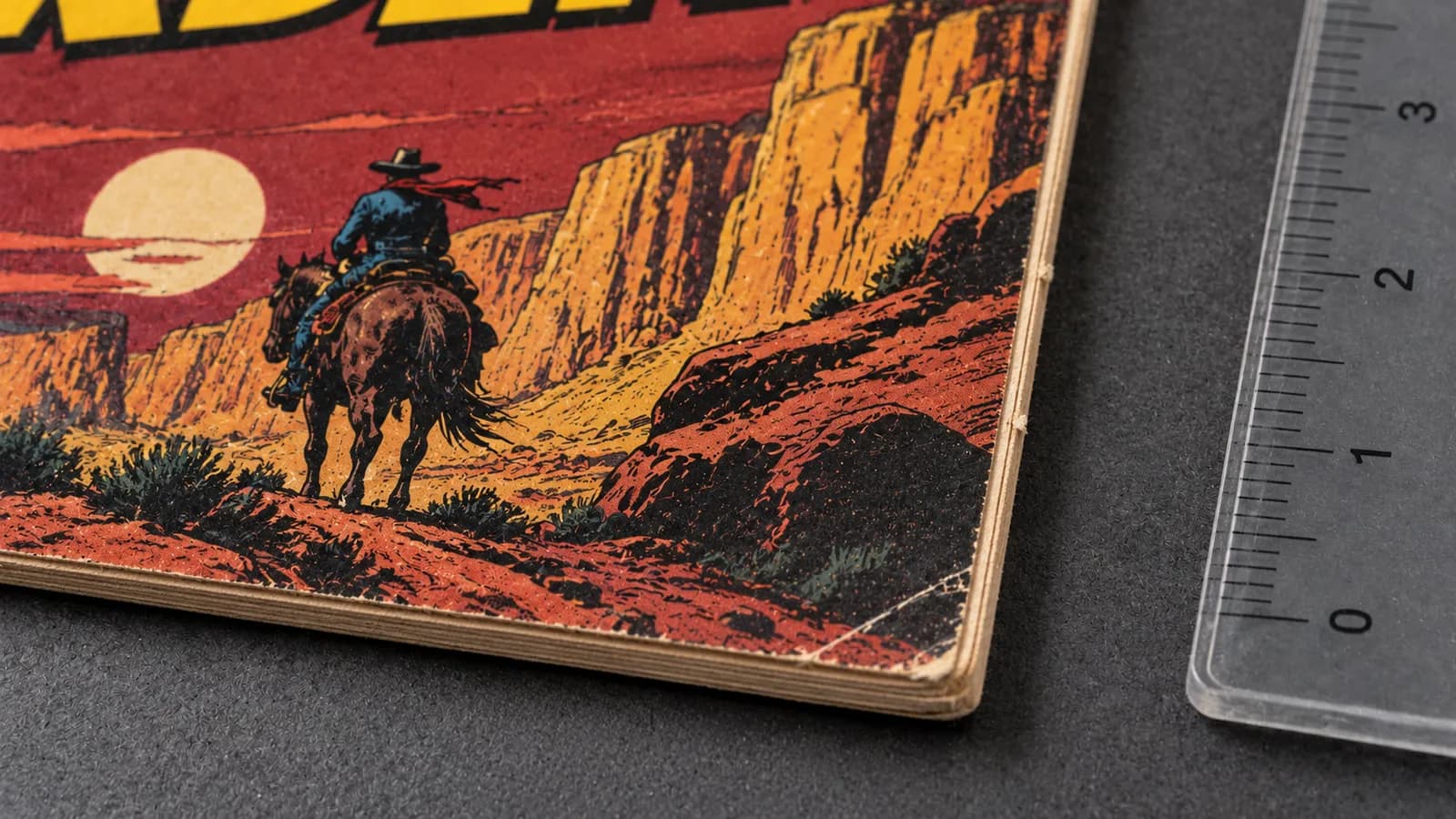
Interior defects count toward a comic's grade as much as cover defects, and the worst cost far more than cover wear. A missing page, a cut coupon or a panel clipped from a story page removes part of the book, and the published grade descriptions place those near the bottom of the standard 10-point grading scale. Tears, writing, stains, tape and a loose centerfold lower the grade too.
A bright, flat cover can hide a cut coupon, a clipped panel or a missing page, so check every page before you trust a clean cover.
Why missing paper costs more than cover wear
Cover wear damages paper that is still there, while a missing page, coupon or panel removes paper for good. The published grade descriptions tolerate a lot of wear before they tolerate missing interior paper:
- An unnoticeable 1/4-inch crease that does not break the color still fits 8.0 VF.
- A cut coupon, or a chunk missing from an interior page, first appears at 1.0 FR, and books at that grade generally still have all their pages.
- Several missing pages appear only at 0.5 PR. A copy with large parts gone can fall below the scale and be called incomplete.
Professional grading has a second route for a cut coupon: a qualified label, which grades the rest of the book and names the missing coupon. The number survives, and the label tells every buyer what is gone. The guide to pre-grading before you submit covers when a qualified label applies.
Nothing puts the original paper back. The standard restoration scale counts filling a missing piece or recreating a page as restoration, and puts a recreated page at its most extensive level. A married page is a page taken from another copy of the same issue to replace a missing or damaged one.
Same cover, different inside: one worked example
One interior finding can pull a strong book down by several grades, because the grade follows the single worst defect, the limiting flaw. In this example (example grades, not quotes for a real book), the cover, corners and spine support 8.0 VF, and the page flip finds one thing.
| What the page flip finds | Where the descriptions first allow it | Example result |
|---|---|---|
| A minor tear at a page margin | 8.0 VF | 8.0 VF |
| A loose centerfold | 6.0 FN | About 6.0 FN |
| A centerfold detached at one staple | 4.0 VG | About 4.0 VG |
| Minor tape on a torn page | 4.0 VG, only on a copy that would otherwise grade higher | About 4.0 VG |
| A coupon cut from an ad page | 1.0 FR | About 1.0 FR, or 8.0 on a qualified label that names the coupon |
| A missing page | Below 1.0 FR | 0.5 PR or incomplete |
The cover is the same in every row. What changes is how much of the original book is left and how well it holds together. The photo-first home grading checklist explains the limiting-flaw rule in full.
The interior defects to look for, and how each one grades
Each interior defect is graded by its size and position, so note where you found it ("top margin of the letters page") and how big it is.
Tears and missing pieces
A tear is a split in the paper with nothing lost; a missing piece means the paper is gone. The descriptions allow the slightest interior tears at 9.8 NM/MT, slight tears at 9.4 NM and minor margin tears at 8.0 VF, while missing chunks first appear at 1.0 FR. Look hardest along the outer edge, where fingers turn the pages, and at both ends of the gutter.
Chips along the trimmed edges of the book are edge defects, covered in the guide to corner and edge wear, from blunt to torn.
Cut coupons, clipped panels and cut-out pages
A cut coupon is a hole where an order form, a contest entry or a stamp was cut from a page. Marvel printed a value stamp on the letters pages of its comics from 1974 into 1976 for readers to cut out, so check that page on a Marvel book from those years.
A cut also takes whatever is printed on the back of the leaf. A clipped panel removes paper and story at once, and a page cut out near the spine can leave a narrow stub at the staples.
Writing, stamps and pencil marks
Writing is judged by its size, its place and how much it distracts. The descriptions accept small, light arrival dates in an unobtrusive spot up to 9.9 MT and several of them at 9.0 VF/NM, while a 10.0 GM allows no owner signatures inside. At 4.0 VG, store stamps, name stamps and initials have no effect on the grade.
Faint marks are hard to call, because print on the other side of thin paper can show through and look like pencil. Do not erase a mark; leave it and describe it.
Stains, foxing and tape
A stain is any discoloration from water, oil, food or dirt; foxing is small orange-brown spots. The descriptions allow slight foxing at 9.4 NM and minor staining from 6.0 FN down.
Tape is an amateur repair: even minor, unobtrusive tape first appears at 4.0 VG, and old tape can yellow and stain the paper under it. Leave tape in place, and disclose any tape you know was removed.
The centerfold, loose leaves and staple rust
The centerfold is the middle sheet of the book, where the staple legs fold over. The descriptions expect it mostly secure at 8.0 VF, allow it loose at 6.0 FN and detached at one staple at 4.0 VG, and allow it missing at 1.0 FR only if the story still reads. Other leaves can tear free at the staple slits, and only the slightest staple tears fit 9.0 VF/NM.
Light discoloration on the staple legs fits grades near the top of the scale. Rust migration is rust that spreads from a staple into the paper around it; slight rust migration first appears at 7.0 FN/VF, and rusted staples at 3.0 GD/VG. Never tug a centerfold to test it.
Page color and brittleness
Page color and brittleness set limits of their own: light tan to off-white pages cap a book at 8.5 VF+, tan to off-white at 7.5 VF-, slightly brittle pages at 6.5 FN+ and brittle pages at 3.5 VG-. Brittle paper can still look off-white, so look for chipped page corners, flakes in the bag and small splits at the top and bottom of the fold. Never fold a corner to test it.
What a page-flip video can show, and what it can miss
A page-flip video shows defects that change the shape or color of a page, and it can miss small ones, especially in the gutter.
| Interior item | A page-flip video can show | It can miss |
|---|---|---|
| Missing pages | Every page, when each spread pauses and the count matches the issue | A missing page, if a fast turn or short video leaves the count unconfirmed |
| Holes and missing pieces | The gap in the page, on that spread | A small cut close to the gutter |
| Tears | Clear tears at the outer edge | Tears below what the frames resolve, and tears in the gutter, where the page curves away |
| Writing, stamps and stains | Dark ink, stamps and water stains | Faint pencil, which can look like print from the other side |
| Brittleness | Signs such as chipped page corners and splits at the fold | How the paper feels, which only the owner can report |
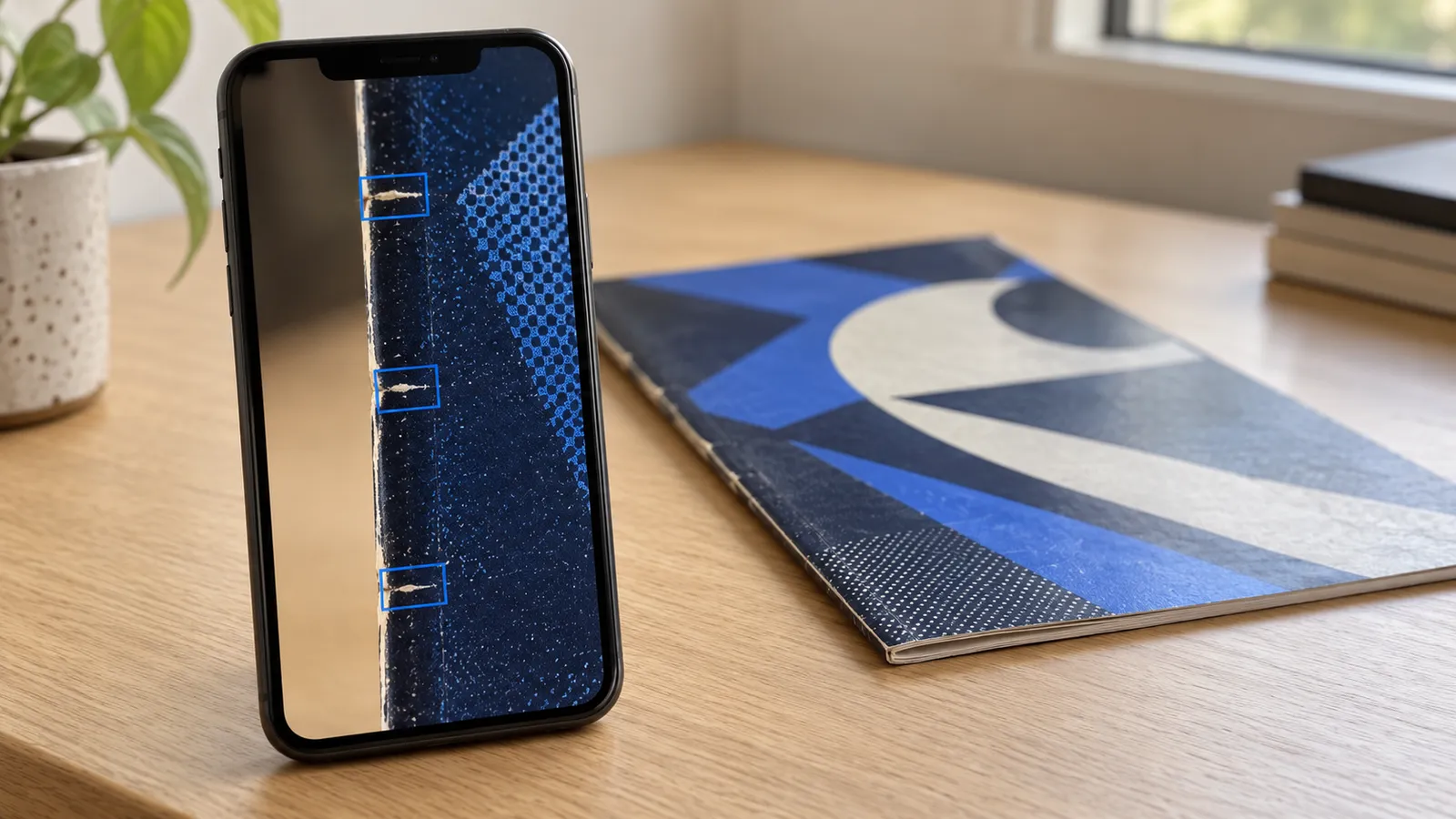
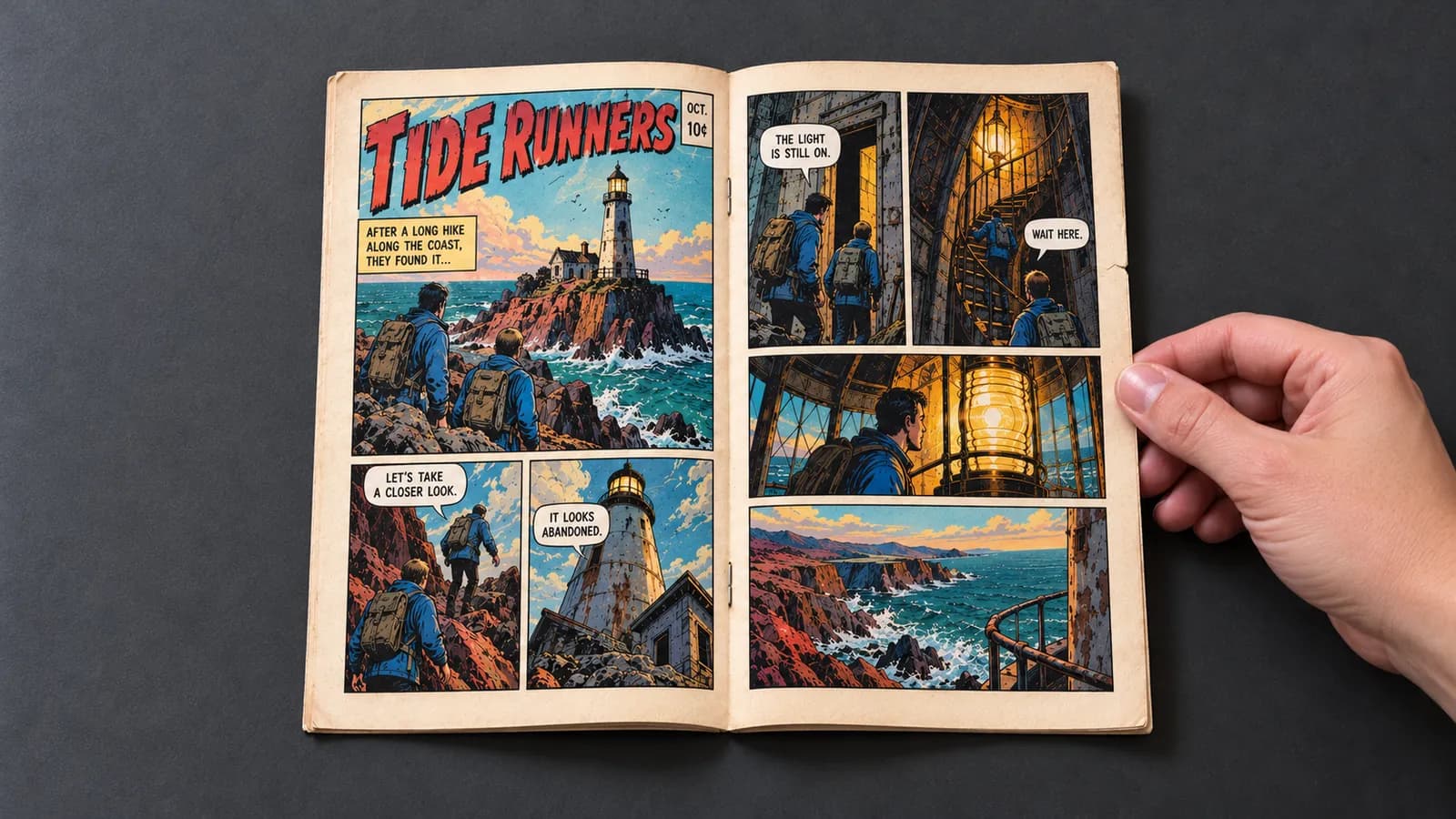
If a turn blurs, a defect on that spread can go unseen. For the flip-through video in NuGrade, an AI-assisted grading app for raw comics, start on the closed front cover, pause about two seconds after each turn with both pages flat in frame, and end on the closed back cover. A separate still of the centerfold staple seam shows how the centerfold sits at the staples.
How to photograph a comic for grading covers the whole capture, and what a photo grade can miss covers the limits of photo evidence in general.
Why a complete page count is not a clean interior
A page count answers one question, whether all the pages are there. It says nothing about whether each page is whole, original or free of small tears.
When the page-flip video lets NuGrade count every page and the total matches the number the issue was printed with, the report says so, for example "All 36 pages accounted for." A page with a coupon cut out, or a married page, still counts as a page, so the count and the condition of each page are separate findings.
When the count does not match or cannot be made, the report marks completeness as not established and states that this is not evidence of missing pages. A page turned too fast or a video that stops early leaves the same short count as a missing leaf. A gap you can see in a frame is different: that is a finding, cited to its frame.
To settle it yourself, count every page side in hand, covers included, against a catalog listing that also counts the covers. Buyers can open any NuGrade report by its ID at the report lookup page, with no app or account.
How one sample report handled an uncertain interior mark
The NuGrade sample report for Marvel Presents: Guardians of the Galaxy #4 (Marvel, April 1976), graded on September 30, 2026, recorded faint interior marks as a possible defect and named both explanations, and the marks did not set the grade. It is an example of what photo evidence shows, not proof of accuracy.
The finding reads: "faint marks at the top margin of the medallion ad page and the muscle-course ad page, which could be pencil writing or show-through, visible in page-flip frames."
The rest of the inside came back clean: all 36 pages accounted for, no staple findings, Cream to Off-White pages and no page-structure findings. The grade, 7.5 VF- with a range of 7.0 FN/VF to 8.0 VF, comes from color-breaking spine ticks, and restoration reads Unverified.
In hand, look at the same spot on the back of the leaf: if dark print sits right behind the mark, it is probably show-through. Then tilt the open book under a lamp, because pencil graphite often shows a faint gray sheen that show-through does not.
How to check every page without damaging the book
Work slowly, open the book no further than flat, and turn each page from the middle of its outer edge.
- Wash and dry your hands, and work on a clean, flat table with no food or drink nearby.
- Before you take the book out, check the bottom of the bag for paper flakes, a sign of brittle pages.
- Open the book slowly from the front cover, only as far as you need to see each spread. Never open it past flat, and never fold it back on itself.
- Lift each page at the middle of its outer edge, not by a corner.
- Scan each spread in the same order: top margin, outer margins, bottom margin, then the gutter at both staples.
- Count the page sides as you go, covers included.
- At the centerfold, confirm that it is held at both staples, and check the staple legs and slits for rust and small tears without tugging.
- Close the book, compare your count with a catalog listing, and write down each finding with its page and place.
The Library of Congress gives similar rules in its care guidance for comic books: clean hands and a clean surface, no opening past 180 degrees, no paper clips or folded corners as bookmarks, and no self-adhesive tape, glue or rubber bands.
If you find a tear or a loose leaf, do not tape, glue or flatten it yourself; record it and keep the book flat in a bag and board.
Frequently asked questions
Does a missing coupon lower a comic's grade?
Yes, sharply. The published grade descriptions first allow a cut coupon at 1.0 FR, so some grading services can instead grade the rest of the book and name the missing coupon on a separate qualified label.
Can a page-flip video prove a comic is complete?
A page-flip video can show that every page was there, when the pages counted in it match the number the issue was printed with. It cannot show that each page is whole or original, because a page with a coupon cut out, or a page taken from another copy, still counts as a page.
Does pencil writing inside a comic lower the grade?
Pencil writing inside a comic is judged by its size, its place and the grade level. Small, light arrival dates in an unobtrusive spot are accepted even near the top of the scale, and at 4.0 VG, store stamps, name stamps and initials have no effect on the grade.
What does "Not established" completeness mean on a NuGrade report?
On a NuGrade report, "Not established" completeness means the page-flip video did not let the app confirm the page count against the number the issue was printed with. It is not evidence of missing pages, and a count in hand settles it.