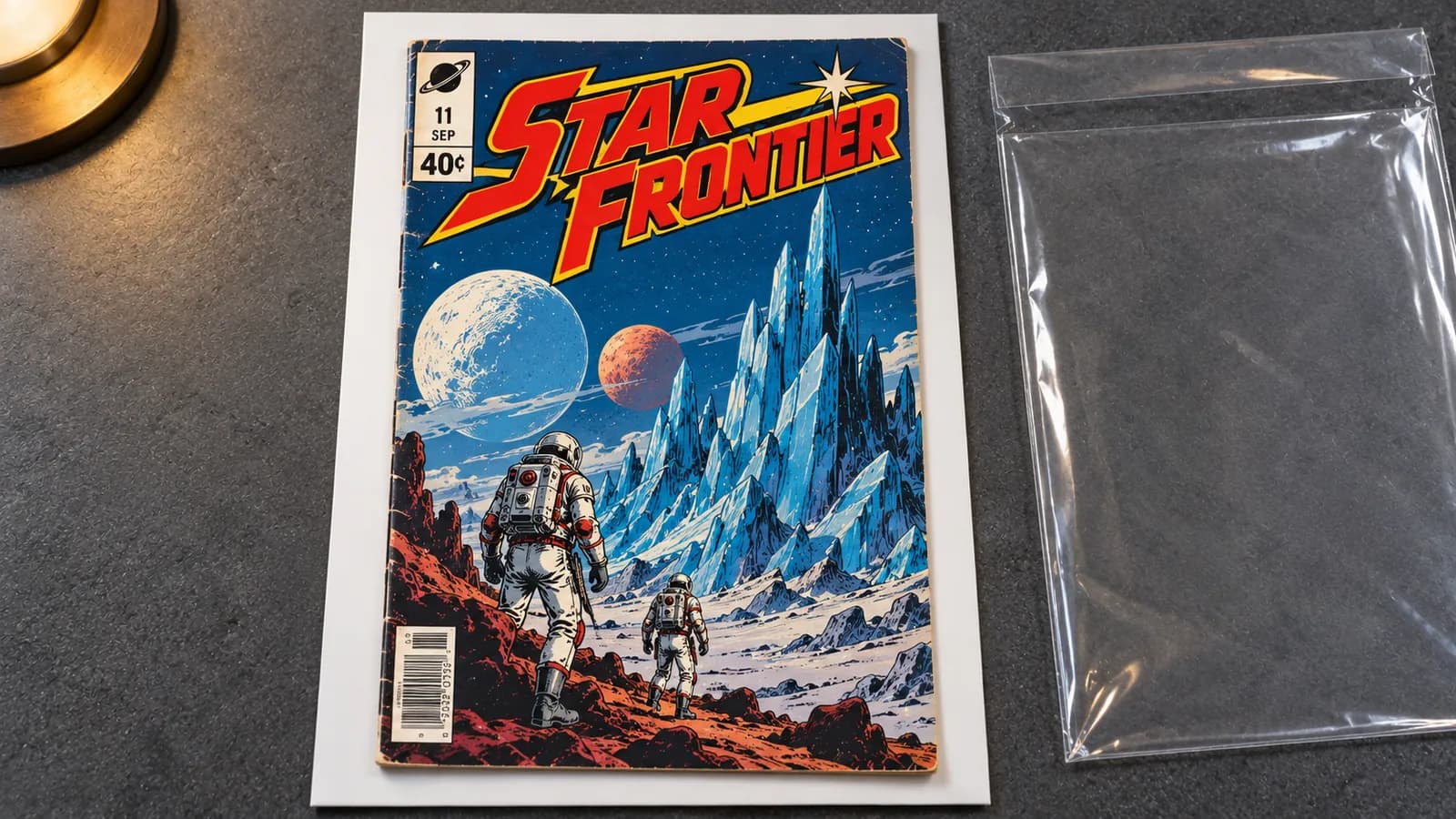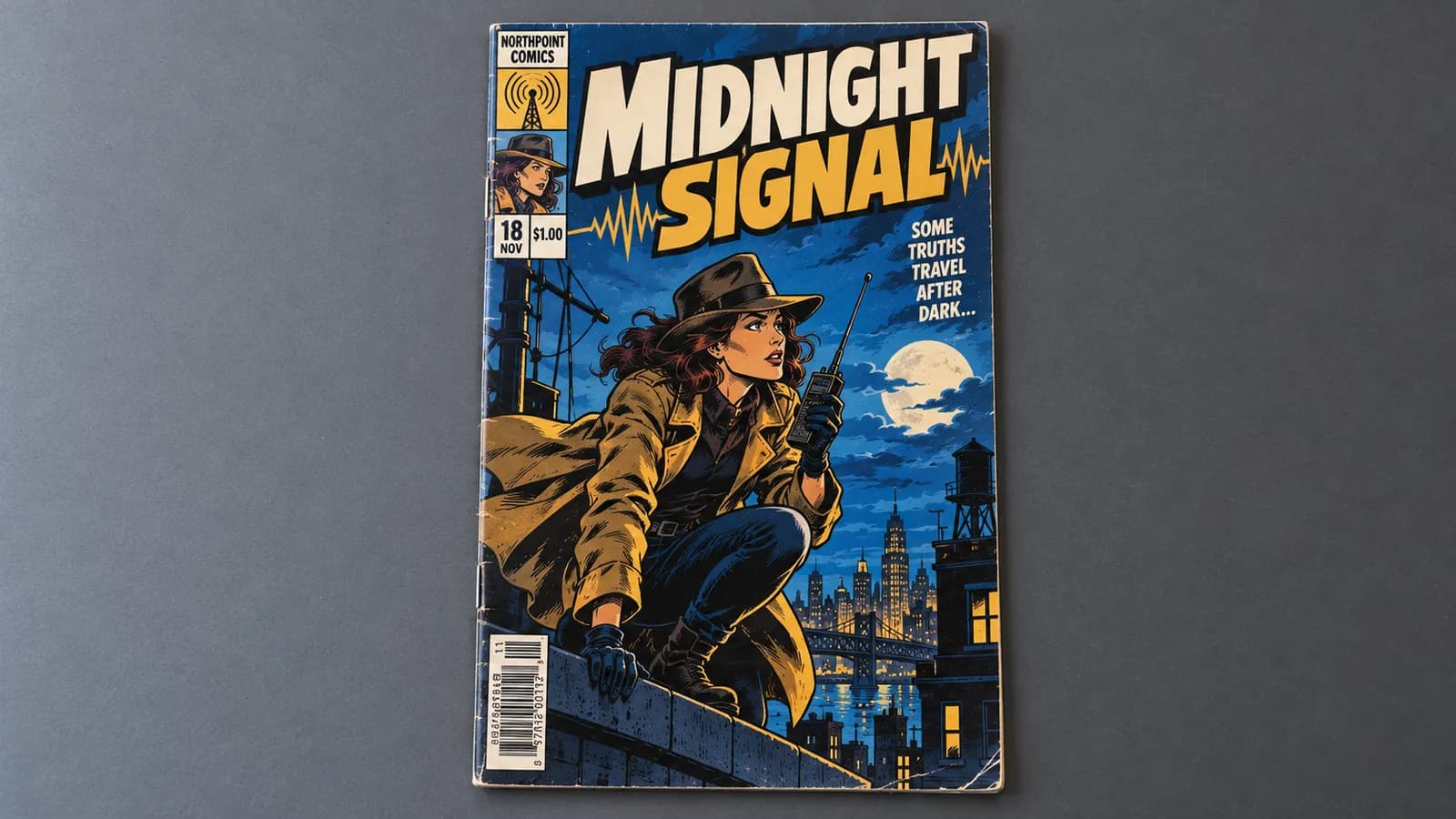
This comic book grading glossary defines more than 40 condition terms in plain English, grouped by where they show on a book. Each entry gives the meaning and the effect on the 10-point grade, and each section says how to photograph them. Two terms matter most: color break, ink cracked away to bare paper, and the limiting defect, the worst flaw, which caps the grade.
NuGrade, an AI-assisted grading app for raw comics, uses these terms in its reports. The definitions are our own, checked against the published grade descriptions.
Grade scale and label terms
These terms describe the grade and its label. For every step of the scale, see what VF, FN and NM actually mean.
10-point scale: the standard 25-step scale from 0.5 PR (Poor) to 10.0 GM (Gem Mint), written as a number plus letters, such as 9.2 NM- or the split grade 9.0 VF/NM. The number is exact; "VF" alone can mean 7.5, 8.0 or 8.5.
Raw: a comic not sealed in a grading service's plastic holder, which collectors call a slab. A raw book can have a seller's grade or a grade from an earlier certification. Judge its current condition from photos of every area below.
Limiting defect: the single worst flaw on a book, which caps the grade however clean the rest is; many small flaws can also add up to a lower grade. Photograph it closest, from two angles.
Label: the category printed with a professional grade: standard for most books, restored for restored ones, and at some services separate labels for conserved books, witnessed signatures or a qualified grade that sets one defect aside.
Cover terms
Cover terms describe damage to the outside of both covers. Shoot each cover straight down, flash off, with one lamp low to one side.
Color break: ink cracked or worn away along a bend, crease, tick or corner, exposing the paper beneath; it shows white on dark ink. The published descriptions first accept one at 8.0 VF, a minor break on the spine. Look straight down: a color break stays white, while an unbroken bend shows only as the light moves.
Crease: a sharp, permanent fold line, usually one that breaks the color; a fold or softer bend leaves the ink whole. The words overlap, so ask which. The descriptions allow a 1/16-inch bend at 9.4 NM and an unnoticeable 1/4-inch crease at 8.0 VF, both with unbroken color. A dent or dimple is a pressed-in spot instead of a line; dimples appear from 5.0 VG/FN down.
Subscription crease: a crease down the middle of the book, top to bottom, from folding copies in half to mail to subscribers. A subscription fold, with the ink unbroken, costs less, but either runs far past the 1/4-inch crease allowed at 8.0 VF.
Abrasion: scuffing that dulls or roughens the cover, from rubbing against other books or shelves, like the light abrasion in the green cover field of the Green Lantern #59 sample report (DC, 1968). It also lowers the gloss, which the descriptions call reflectivity: high at 9.4 NM, low at 4.0 VG. Fingerprints and dirt count separately as soiling.
Sun shadow: a darker stripe along one cover edge that sat exposed to light in a stack; a dust shadow is the same shape in dust. The top grades allow only a minimum of fading, and sleeve glare can hide both, so check a comic out of its bag.
Foxing: small orange-brown spots on the cover or pages, which grading references attribute to mold. Slight foxing fits even 9.4 NM. A larger patch with a darker tide line is a water stain; minor staining appears from 6.0 FN down.
Arrival date: a date a distributor or newsstand penciled, stamped or inked on the cover when the copy arrived. A small, light one in an unobtrusive spot is acceptable through 9.9 MT, and from 4.0 VG down, stamps, names and initials stop counting.
Corner and edge terms
These terms cover the four cover corners and the edges. Shoot each corner 3 to 4 inches from the tip, as how to photograph comics so the flaws actually show explains.
Blunted corner: a corner tip worn or pushed in so it is no longer sharp; a rounded corner has lost enough paper to curve. The slightest blunting fits 9.4 NM to 9.0 VF/NM, blunted corners appear from 7.0 FN/VF and rounded ones from 3.0 GD/VG. Any corner crease keeps a book below 9.0.
Wear fleck: a tiny spot where ink has rubbed off at a corner tip or edge, also called a color flake. The bare paper counts as color break, so even one fleck hurts at the top of the scale; on a dark cover it shows as a white dot.
Chip: a small piece missing from an edge or corner. Larger missing pieces are measured: a 1/4-inch triangle or 1/8-inch square fits 4.0 VG, and a 1/2-inch triangle or 1/4-inch square 2.0 GD. Measure with a ruler beside the book, not on it.
Spine terms
Spine terms cover the folded left edge, which flexes each time the book opens. Film a slow pass along it with the lamp low to one side.
Spine tick: a short crease running in from the spine fold that breaks the color, showing as a white dash on dark ink. A stress line is a similar bend, often by the staples, with or without broken ink. Stress lines must be almost absent at 9.4 NM, and a few faint ones fit 8.0 VF. Color-breaking ticks often set the grade on 1970s and 1980s books: an accumulation of them held the book in the Marvel Presents: Guardians of the Galaxy #4 sample report (Marvel, 1976) to 7.5 VF-. In video, a real tick stays put across frames while a reflection slides.
Spine roll: the spine bows toward the front or back cover, leaving the page edges uneven; reading with pages folded back and poor storage cause it. The slightest roll appears at 7.0 FN/VF, moderate roll at 4.0 VG. A straight-on photo of the right edge shows it.
Spine split: a separation along the spine fold. A 1/4-inch split fits 6.0 FN, 1 inch 4.0 VG and 2 inches 2.0 GD; a book-length split belongs to 0.5 PR.
Reading crease: a crease running top to bottom near the spine, from folding the cover back while reading. A short, light one costs far less than a full-height crease that breaks color.
Staple and centerfold terms
These terms cover the two staples and the centerfold, the middle sheet they hold. One photo of the open centerfold, both staples in frame, shows most of them.
Rust migration: rust from a staple that has stained the paper around it. Any rust rules out 9.8 NM/MT and above, where staples must be clean, and slight rust migration first appears at 7.0 FN/VF.
Staple tear: a small tear where the paper pulled against a staple; a staple pop is a staple pulled through. Only the slightest staple tears fit 9.0 VF/NM, and minor ones 6.0 FN.
Loose centerfold: a centerfold that has come free at one or both staples. It may be loose at 6.0 FN and detached at one staple at 4.0 VG. A detached cover follows a similar ladder, from loose at 4.0 VG to fully detached at 2.0 GD.
Page quality and interior terms
These terms cover the paper inside: its color, its strength and whether anything is missing. The page-flip video shows most of them.
Page quality: the color designation for the interior paper, on a ladder from White through Off-White, Cream and Tan to Brown. Some steps cap the grade: only White fits 10.0, Light Tan to Off-White tops out at 8.5 and Tan to Off-White at 7.5. Lay a white index card beside the page, because phone cameras shift color.
Brittleness: paper that cracks, chips or flakes when handled, judged apart from color: slightly brittle pages cap a book at 6.5 FN+, brittle ones at 3.5 VG-. The pulp paper of most pre-1990 comics is acidic from the start and turns brittle with age, as a National Park Service guide to acidic wood pulp paper explains. Never fold a corner to test it; NuGrade's survey asks about brittleness and acidic odor, which no photo shows.
Coupon cut: a coupon or order form cut out of a page or cover. The descriptions list cut coupons only at 1.0 FR and 0.5 PR; some services instead give a qualified grade that names the missing coupon.
Incomplete: a book missing so much that it falls below Poor; even 1.0 FR books generally keep all their pages. A NuGrade report states the page count only when the flip video lets the app confirm it. A report without that line has not confirmed the count, which is not evidence of missing pages.
Restoration and repair terms
Restoration terms describe work done to a book after printing. Competent work can be invisible in ordinary light, so NuGrade marks restoration Unverified when photos cannot settle it (what a photo-based grade can miss).
Restoration: a recognized aesthetic treatment that adds or removes material, such as color touch, piece fill, trimming or re-glossing. It earns a restored label, and a restored book usually sells below an unrestored copy that looks the same. If you find no signs, write "no signs seen," not "unrestored."
Color touch: ink or paint added to hide color breaks, wear or a fill, often right over a tick, crease or corner. It looks flat and smooth where printed ink has a fine grain. Even light color touch on spine stress counts as restoration.
Piece fill: new paper added where a piece is missing, usually color-touched to match. Look for a change in tone or texture and an edge that follows the damage rather than the art; the best fills need an in-hand check.
Trimming: cutting a book's edges to remove wear and make them look sharp; it counts as restoration. Clues are razor-sharp edges on a worn book, or a cover flush with or smaller than the pages. A careful trim can be invisible in photos.
Married cover: a cover or pages taken from another copy of the same issue. The published restoration scale counts it toward restoration when other work is also present. Clues are wear or tone that differ between cover and pages, and staple holes that miss the centerfold staples. A close match can be invisible; ask the seller.
Conservation: work that only preserves a book, such as sealing a tear or spine split or deacidifying, with archival materials. Services that separate it from restoration give a conserved label only to top-quality, slight work.
Pressing: flattening a book under controlled pressure, sometimes with humidity or heat, to relax bends, dents and spine stress without color break. It adds and removes nothing, so it is generally not counted as restoration, but it cannot fix a color break, tear or stain (what pressing can and cannot fix).
Tape: ordinary adhesive tape used to mend a tear or hold a cover on. The descriptions treat it as amateur repair and first allow minor, unobtrusive tape at 4.0 VG. Never add tape to a book; leave removal to a professional.
Production defect terms
Production defects happened at the printer or bindery, before sale. The descriptions allow subtle ones even at the top of the scale, so a factory flaw often costs less than handling damage of the same size.
Miswrap: a cover folded off-center around the pages, so an unprinted strip or part of the back cover shows along the front spine edge. On the E-Man #1 sample report (Charlton, 1973), a slight miswrap and a small dark mark on the back cover, likely a bindery or printing artifact, were the only two findings, and the book graded 9.2 NM-.
Bindery tear: a short tear at the edge made by the binding machinery, not a reader. None fits 9.6 NM+ on books after the Golden Age; one under 1/16 inch fits 9.4 NM on Silver Age and later books.
Bindery chip: a small piece knocked out of an edge when the stack was trimmed at the factory, common on Golden Age books and more accepted than handling damage. Marvel chipping is a run of tiny trimming chips, mostly on the right edge, named for the 1960s Marvel books where it shows up most.
Frequently asked questions
What does color break mean on a comic?
Color break means ink has cracked or worn away along a bend, crease, tick or corner, so bare paper shows as a white line. The published grade descriptions first accept one at 8.0 VF, a minor break on the spine.
What is the difference between a crease and a fold?
In grading, a crease usually means a fold line that broke the color, while a fold or bend changes the paper's shape without breaking the ink. The words overlap, so ask whether the color is broken.
What does raw mean in comic grading?
A raw comic is not sealed in a grading service's plastic holder, which collectors call a slab. It can have a seller's grade or a grade from an earlier certification. Check its current condition against photos.