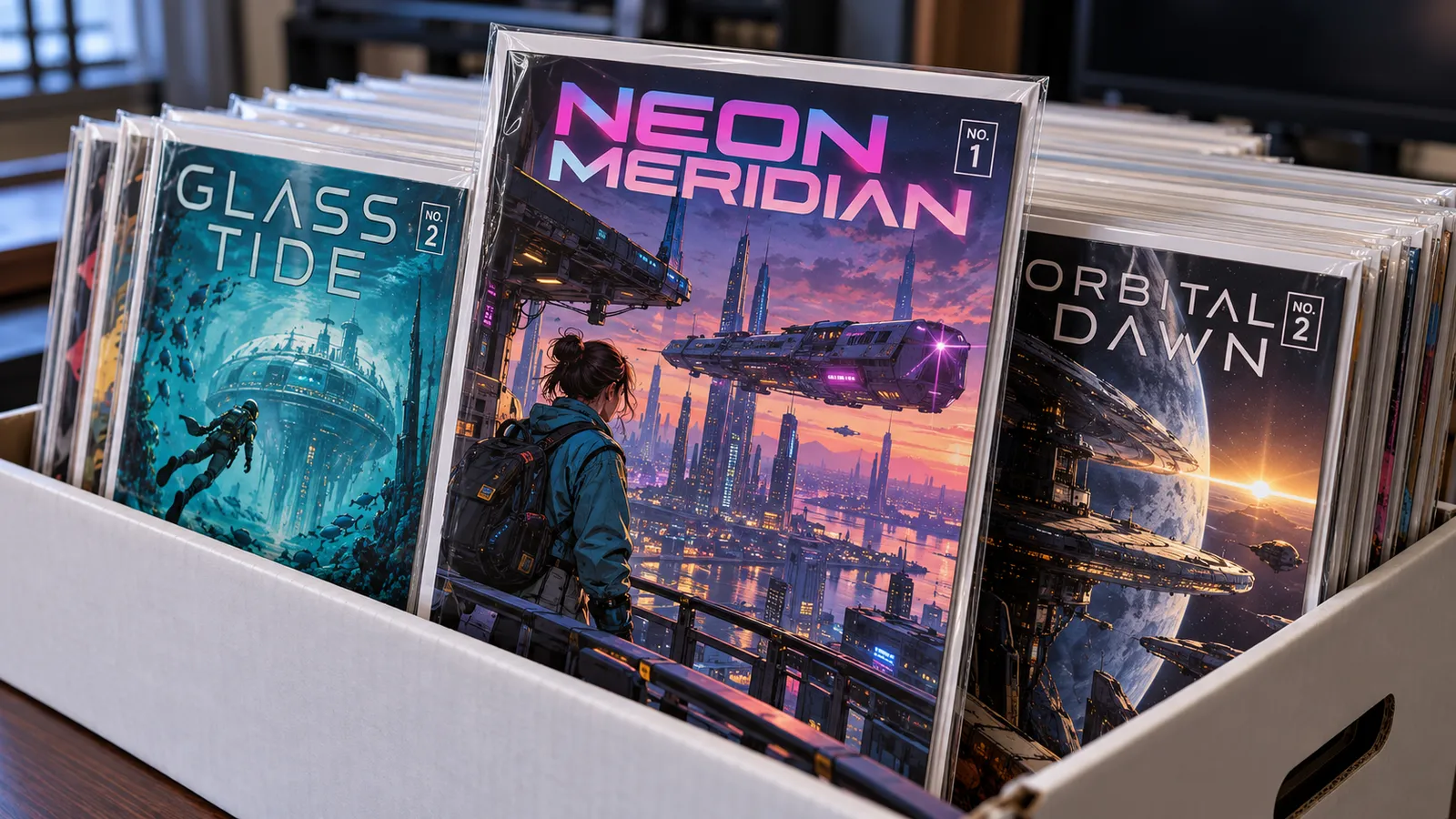
Modern Age comics, here meaning books from 2000 on, are worth money mainly when two things line up: the issue has a documented reason for demand, such as a first appearance, a sold-out first printing or a scarce cover, and your copy is in top condition. So many modern copies survive in high grade that small flaws decide where a copy stands.
This guide covers books published in 2000 or later; the 1990s need their own checks. It gives no prices. Compare recent sold listings for copies that match yours in issue, printing, cover and grade.
Why condition decides more on a modern book
Three things keep modern copies in good shape. Pulp paper went out of use around 1990, and the published page-quality scale notes that most books printed after 1990 have white pages. Comic shops had become the main outlet for new comics, and many buyers bagged and boarded their books from the day they bought them. And less time has passed for wear to build up.
So buyers can choose among many clean copies of the same issue, and they compare them near the top of the scale. There, the published grade descriptions separate the grades by flaws you find only up close:
| Grade | Corners | Bends, tears and stress lines |
|---|---|---|
| 9.8 NM/MT | Cut square and sharp | Flat cover, no surface wear |
| 9.6 NM+ | One corner almost imperceptibly blunted | No creases, bends or color break, and no bindery tears |
| 9.4 NM | Ever-so-slight blunting | A 1/16-inch bend with unbroken color, bindery tears under 1/16 inch, almost no stress lines |
| 9.2 NM- | Ever-so-slight blunting | A 1/16- to 1/8-inch bend with unbroken color, almost no stress lines |
One corner that is almost imperceptibly blunted is enough to move a copy from the 9.8 description to the 9.6 one. Pages matter too: with rare exceptions, the page-quality scale requires at least off-white pages for 9.8 or better, and only white pages fit 10.0. For the tier names, see what VF, FN and NM actually mean.
Five reasons a modern book deserves a closer look
Being modern does not make a book valuable. These five reasons can, and each is a fact you can check.
A documented first appearance
A first appearance is a character's first time in print, and it is a common reason a modern issue is sought. Check the claim on the publisher's own page where one exists. A cameo and a first full appearance count as separate keys, so note which one a seller means.
A sold-out or short first printing
A first printing that sold out before release, or a small publisher's first issue, can leave fewer first-print copies than later demand wanted. Image reported that Saga #1 sold out of its first printing before its March 14, 2012 release. A second printing was set for April 11 and a third for April 25.
A ratio variant
A ratio variant, also called an incentive variant, is a cover a shop could order only in proportion to its order of the issue, such as one copy for every 25. The ratio comes from the publisher's solicitation, not from a listing title. The key status belongs to the issue; the cover sets the version.
A newsstand copy
Marvel's newsstand editions ended in 2013, and DC's at the end of August 2017. Before then, many issues came in two editions. On a modern direct edition, the barcode box usually carries words such as "Direct Edition"; the newsstand copy lacks them. Some buyers treat newsstand copies of modern keys as scarcer, so record which one you hold and confirm any premium from matched sales.
A later printing that differs
A later printing is a new press run of the same issue, and modern publishers often give it new cover art or a printing note. A hot first issue can go back to press many times. As of October 2026, Image's page for Transformers #1, first published on October 4, 2023, listed a 14th printing back in stores on September 16, 2026. To a buyer, each printing is its own book.
Modern keys and printings, from publisher records
These examples come from the publishers' own pages, as of October 2026. They show claims to check, not a buying list.
| Issue | Publisher, date | What the publisher's record says |
|---|---|---|
| The Walking Dead #1 | Image, October 8, 2003 | First issue; Rick Grimes wakes in a hospital |
| Batman #655 | DC, 2006 | DC's character page lists it as Damian Wayne's first appearance |
| Ultimate Fallout #4 | Marvel, August 3, 2011 | "The first appearance of Miles Morales" |
| Saga #1 | Image, March 14, 2012 | First issue; the first printing sold out before release |
| Edge of Spider-Verse #2 | Marvel, September 17, 2014 | Gwen Stacy as Spider-Woman; Marvel's Spider-Gwen #1 listing calls the story her origin |
| Convergence: Superman #2 | DC, 2015 | DC's character page lists it as Jon Kent's first appearance |
Dates with a day are release dates; DC's character pages give a year. A record confirms the issue, not your copy's printing, cover or condition.
Identification traps, in brief
Most modern mix-ups involve a copy that shares a title and a number with the key but is a different book.
- Variant or printing. A cover with different art can be a variant of the first printing or the cover of a later printing. Read the indicia and the cover for a printing note before you name the cover.
- Same title, new series. Marvel's site lists Edge of Spider-Verse series from 2014, 2022, 2023 and 2024, so check the year in the indicia before you treat a copy as the 2014 book.
- The same story in a new format. Image's The Walking Dead Deluxe #1 (October 7, 2020) reprints the first issue's story in full color, with variant covers. The 2003 original was printed in black and white with gray tones.
- Facsimiles and reprints. A facsimile edition is a new printing that copies an original issue, often ads and all. Its indicia usually gives the reprint's own, later date.
- Barcode digits. Marvel's listing for Ultimate Fallout #4 shows the add-on 00411, which fits the usual pattern of issue 004, cover 1, printing 1. Treat the add-on as a lead, not proof.
Condition checks that decide a modern grade
With white paper and little age, the flaws that separate modern copies are small. Check them out of the bag, under one lamp, with the flash off.
- Corners. A ding is a small dent at a corner tip, and careless bagging or stacking can leave one. Shoot each corner from 3 to 4 inches away.
- Spine. A stress tick is a short crease across the spine fold. On a dark cover, a tick that breaks the color shows as a white line; see spine tick or color break.
- Surface. Tilt the book under the lamp. Scratches, scuffs and fingerprints show on gloss, foil and card covers as the highlight crosses them.
- Production flaws. Off-center cuts, miswraps and small bindery tears come from the factory, and the near-mint descriptions allow them only in small numbers. For an older trimming flaw and the checks that separate factory chips from handling wear, see Marvel chipping.
- Pages. Expect white. Tan page edges are unusual on a modern book, and they limit the grade: the page-quality scale caps light tan to off-white pages at 8.5.
- Newsstand copies. They passed through more hands before sale, so look harder at their corners and spine.
How to compare a modern copy with sold copies
Price a modern copy only against sold copies that match it on every point that changes value:
- The issue and the year the series began.
- The printing, from the indicia or the cover.
- The cover: its letter or artist, and its ratio if it had one.
- The edition, for a Marvel or DC book from before 2013 or 2017: newsstand or direct.
- The condition: raw with raw, and graded with graded at the same grade.
- Several recent sold prices with their dates, not asking prices.
If the copy looks like a top-grade key, run the break-even math for professional grading with your own numbers before you pay to submit.
Where a photo report fits before you submit or sell
NuGrade, an AI-assisted grading app for raw comics, grades a book from seven photos, four of them corner close-ups, plus a slow spine video and a page flip. The report gives a grade on the 10-point scale with a plausible range, findings that each cite the photo or frame behind them, and a "why not higher" explanation. A short survey asks what the camera cannot see, such as pressing, cleaning and trimming. Record the printing, cover and edition yourself, because the report covers condition.
Each report is a fixed snapshot with a public link, a short report ID, a QR code and a PDF, and a regrade makes a new report.
Near the top of the scale the findings are small. The E-Man #1 sample report, a 1973 book rather than a modern one, graded 9.2 NM-, with a range of 8.5 VF+ to 9.4 NM. Its only two findings are production flaws: "Slight miswrap: a narrow unprinted strip runs along the front spine edge" and "Small dark mark at the left edge of the back cover, likely a bindery or printing artifact."
At the very top, the flaw that separates two grades can be smaller than a phone photo resolves, which is one reason a grade estimate comes as a range. The grade is an opinion limited to the photos and video, and it does not predict what a grading service would assign. For a high-value modern key, professional grading is still the right choice. A buyer can open any report at the report lookup with no app or account.
Frequently asked questions
Which modern comics are worth money?
The modern comics most likely to be worth money are documented first appearances, sold-out first printings and scarce covers of issues that buyers want, in top condition. Condition matters more than on older books, because so many modern copies survive in high grade.
Is a second printing worth less than a first printing?
Often, but not always. Each printing is its own book with its own sales record, so compare sold prices for the same printing and grade instead of assuming.
Are modern newsstand comics worth more than direct editions?
Not automatically. Marvel and DC sold newsstand editions until 2013 and 2017, and some buyers treat those copies of modern keys as scarcer, but only matched sales for one issue at one grade show a premium.
Why does condition matter so much on modern comics?
Modern books were printed on white paper, and many were bagged and boarded when new, so high-grade copies are common. Buyers compare copies at the top of the scale, where one almost imperceptibly blunted corner separates the published 9.8 and 9.6 descriptions.
Should I get a modern comic professionally graded?
Do the math first: what the book sells for in the grade you expect, against the fees, shipping and wait. For a high-value modern key, professional grading is still the right route, and a photo-based report can show you the flaws before you ship.