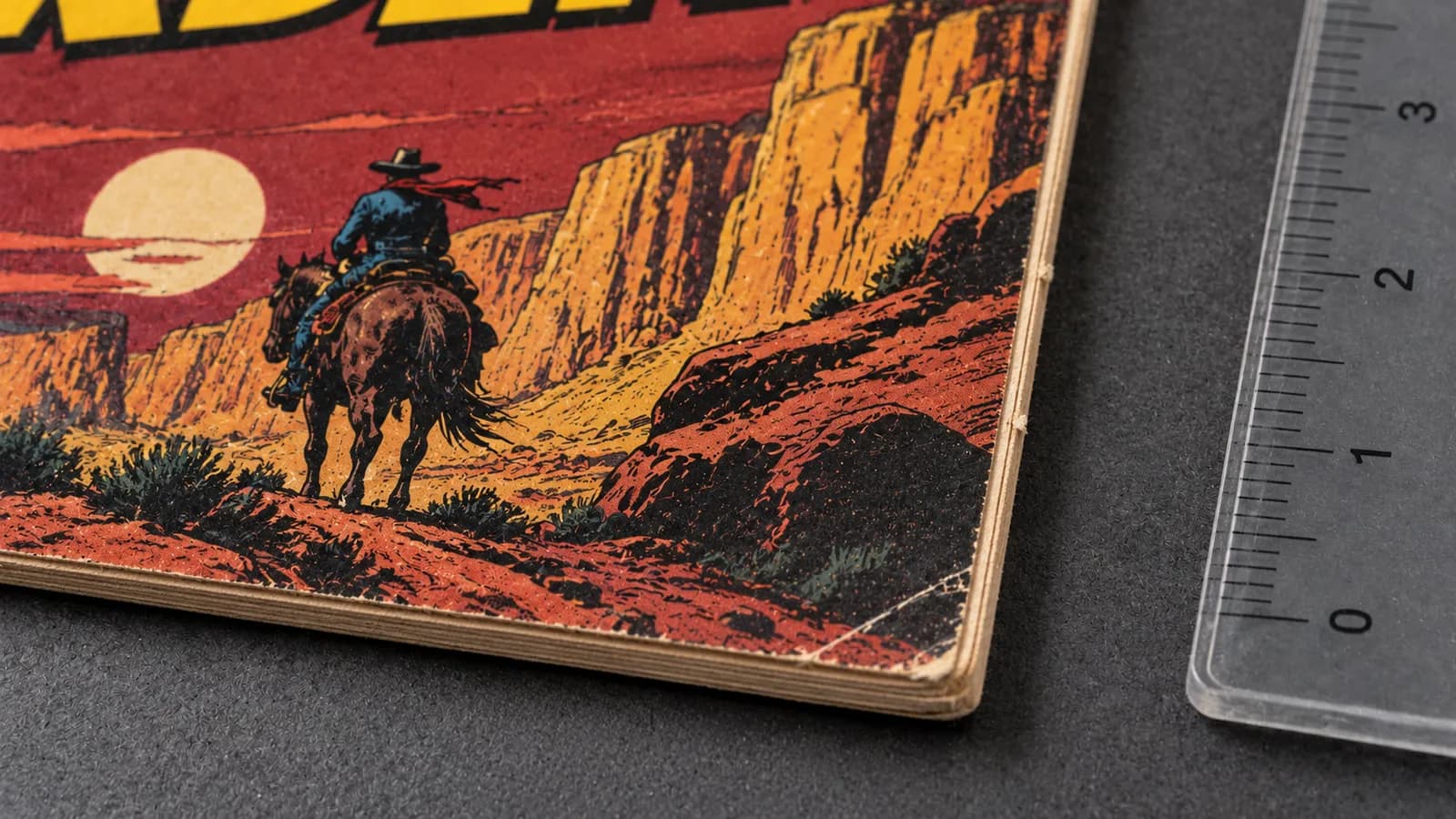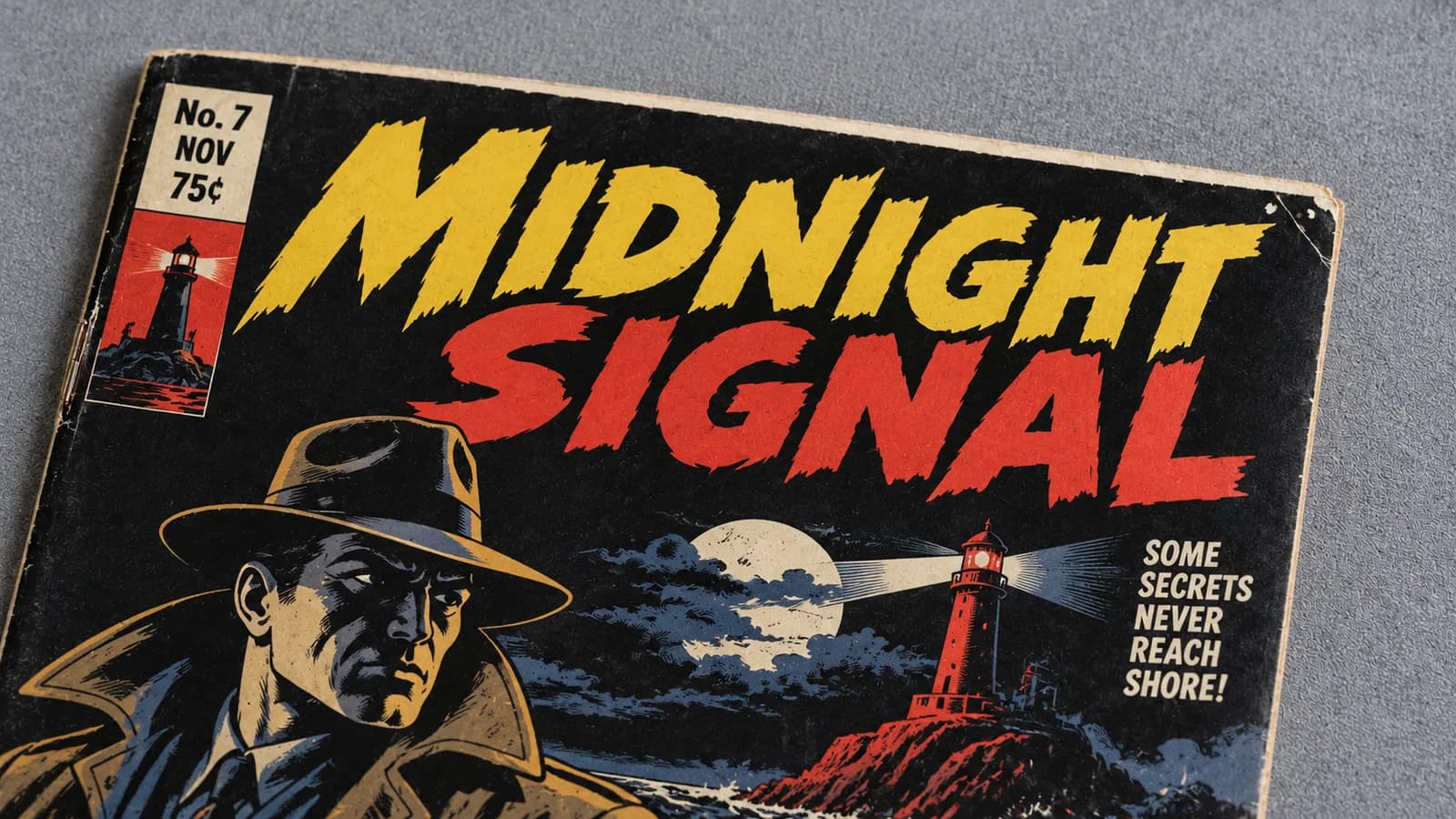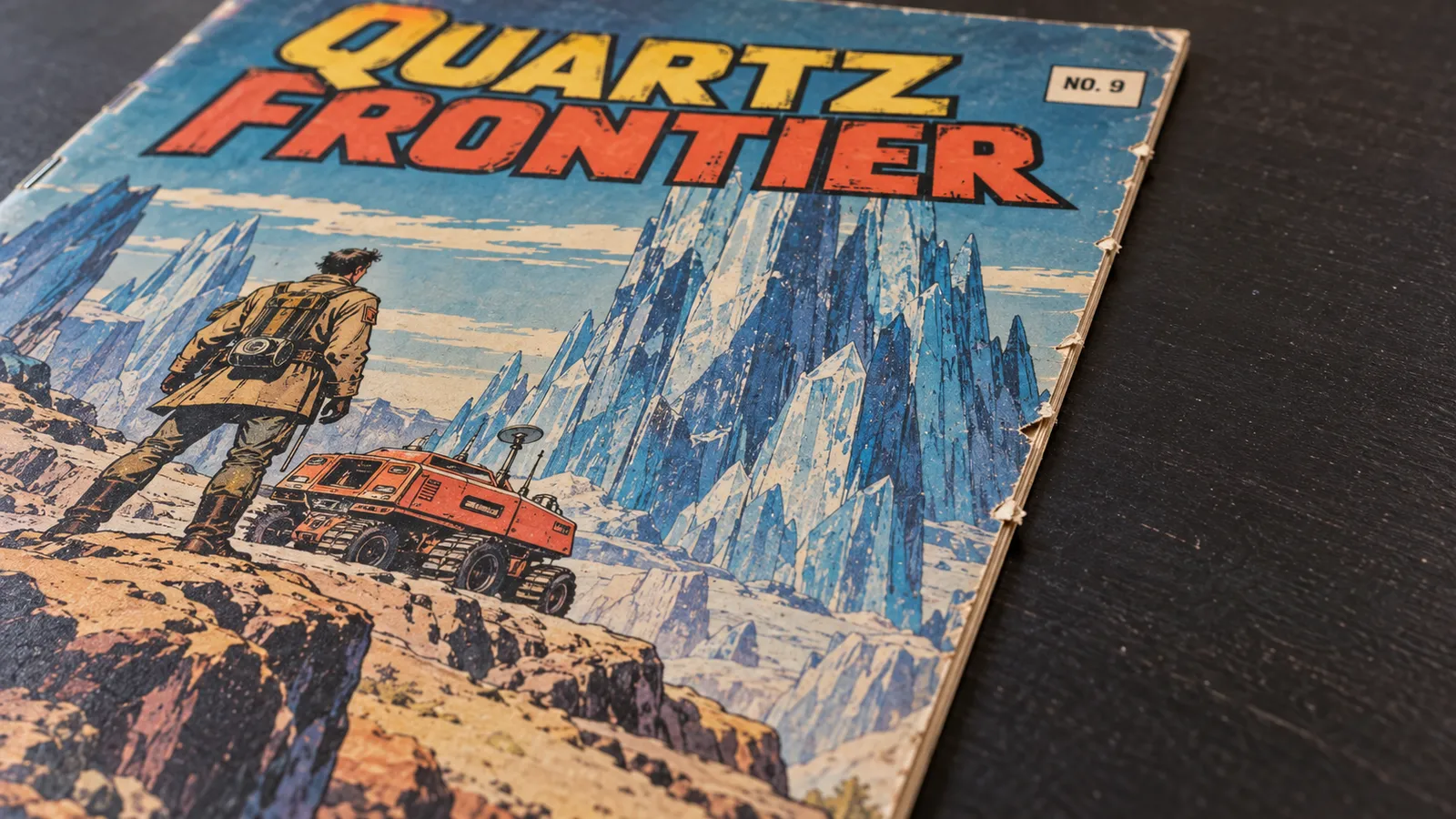
Marvel chipping is the collector name for a row of small chips and short tears along a comic cover's cut edges, most visibly the right edge. A dull blade on the printer's trimmer caused it, most often on Atlas and Marvel books of the late 1950s and early 1960s. It began as a production defect, but missing paper still lowers the grade.
The name tells you where a flaw came from, not what it costs. The size of the chips, their number and the rest of the book decide that.
What Marvel chipping is, and what caused it
A comic is printed, folded and stapled, then trimmed, many copies at a time, along its top, bottom and right edges. A sharp blade cuts the stack clean. A dull one tears at the paper as it cuts and leaves the edge ragged: a row of shallow bites, short tears, and weak spots where a chip has cracked but not yet fallen out.
A cracked chip can hold for years, then drop out with handling, so a copy can lose paper long after it left the printer. The blade still started it.
Three terms keep the rest of this guide clear:
- A chip is a piece of the edge that is gone, so it counts as missing paper.
- A tear is a split that runs in from the edge, with no paper gone.
- A production defect is a flaw made at the printer or bindery before sale. Handling damage is everything after.
For the other factory flaws, see the production defect terms in the grading glossary.
Which books show Marvel chipping
It shows up most on Atlas and Marvel books of the late 1950s and early 1960s; Atlas is the name collectors use for Marvel's 1950s comics. A dull trimmer blade can chip any publisher's comics, and the name stuck because Marvel copies of that period show it so often.
Within that window, a few nicks along the right edge are common, and some copies are chipped along its whole length.
Outside that window, be careful with the label. Later books can have rough or nicked edges too, and collectors do not agree on how far the name stretches, so describe the flaw by its size and place. Books from 2000 on raise different questions, covered in Modern Age comics worth checking.
How the published grade descriptions treat edge chips
The published grade descriptions never name Marvel chipping. Two of their rules meet it: an allowance for bindery and printing defects that shrinks toward the top of the scale, and set sizes for missing paper lower down. The table paraphrases them.
| Grade | What the descriptions allow |
|---|---|
| 9.8 NM/MT | Only subtle bindery or printing defects |
| 9.6 NM+ | Only subtle bindery or printing defects, and no bindery tears (tears up to 1/8 inch have been noted on Golden Age books) |
| 9.4 NM | Subtle bindery or printing defects; bindery tears under 1/16 inch on Silver Age and later books |
| 9.2 NM- | A limited number of minor bindery or printing defects |
| 9.0 VF/NM | A limited number of bindery or printing defects |
| 8.0 VF to 5.0 VG/FN | A growing accumulation of them, from limited at 8.0 to an accumulation at 5.0 |
| 4.0 VG | Up to a 1/4-inch triangle missing from a corner or edge, or a 1/8-inch square |
| 3.0 GD/VG | A 1/4- to 1/2-inch triangle missing, or a 1/8- to 1/4-inch square |
| 2.0 GD | Usually up to a 1/2-inch triangle or a 1/4-inch square missing from either cover |
One or two tiny nicks can fit a high grade. They can be the kind of subtle production flaw the near-mint descriptions leave room for, as long as they stay subtle.
A visible run of chips is missing paper. The descriptions size missing paper without asking where it went, and they first size it at 4.0 VG. They do not say how high a book with one tiny chip can go, so graders weigh its size and how much it shows.
The cause does not put the paper back. None of the descriptions gives Marvel chipping an allowance of its own. One published grading guide calls bindery chips, a common Golden Age defect, printing defects that are "relatively acceptable in the market," but it sets no size at which a chip stops counting.
The standard 10-point scale agrees: from 9.8 down, it weighs manufacturing and handling defects together. For the tier names, see what VF, FN and NM actually mean.
How to tell Marvel chipping from handling damage and brittle paper
No single clue settles the cause, so check all four in the table.
| Clue | Points to the trimmer | Points to handling | Points to brittle paper |
|---|---|---|---|
| Where | Cut edges, mostly the front cover's right edge, spaced along it | Corners, spine ends and spots where hands and boxes touch | Interior page edges and corners as well as the cover |
| Around it | An otherwise clean edge, with no crease or rub nearby | A crease, a bend, rubbed ink or soiling nearby | Tan or brown page edges, small splits at the spine of interior pages |
| Shape | Small, shallow bites or short tears in a row | One larger piece, a torn flap or a long tear | Flaking along the edges, with several small losses |
| Book | Atlas or Marvel, late 1950s and early 1960s | Any book | Older pulp paper from any publisher |
Then check the book in this order:
- Lay the book flat on a dark, matte surface, under one lamp with the flash off.
- Look straight down at the right edge. Where the dark surface shows through a notch, paper is missing. Count the notches, and measure the largest with a ruler beside the book, never on it.
- Lower the lamp so its light skims the cover. A tear that still holds its flap lifts a little and casts a thin shadow. A crease or bend that runs in from a chip catches the light as a ridge, which points to handling.
- Check the rest of the cover. When the corners are sharp and the cover is flat, a chipped right edge points to the trimmer. When the chips sit among creases and rubbed ink, handling is the likelier cause. A book can have both.
- Look at the page edges. Chips on the interior pages, with tan or brown page edges, point to brittle paper. The published page-quality scale counts corner and edge chipping among its signs of brittleness, and caps a book at 6.5 for slightly brittle pages and 3.5 for brittle ones. Never bend a corner to test the paper.
- Write down the cause as likely trimming, likely handling, or unknown. A buyer can judge size and place from a photo, but the cause is a judgment.
For the corners and the other edges, see comic corners and edges: blunt, chipped or torn?
How to photograph a chipped right edge
Two photos carry most of the evidence: the right edge up close, and the front cover in low, raking light. Raking light is light that skims a surface from a low angle, so anything raised, torn or creased catches a highlight.
- The right edge, up close. Shoot the front cover's right edge in three or four overlapping close-ups from top to bottom, 3 to 4 inches away, with a ruler beside the book. A dark background behind the edge makes each notch show.
- The front cover in raking light. Set the lamp low to one side so its light skims the cover. Lifted tears, creases and dents show here. A fill can show too, as a patch whose surface or shine differs from the paper around it, though skilled work can be invisible.
- The top, the bottom and the back cover's right edge, if the chipping reaches them.
For framing and focus, see how to photograph comics so the flaws actually show.
A NuGrade capture takes the four corners up close and the rest of each edge at full-cover scale. Small chips in the middle of the right edge can be smaller than that photo resolves, so add your own edge close-ups to a listing.
Why filling or trimming the chips makes it worse
Marvel chipping lowers a grade, but a repair can cost more, because the published restoration scale counts even a small one.
- Piece fill. Filling a chip with new paper is restoration. The scale puts piece fill no larger than two bindery chips at its smallest amount, so even two filled chips make the book restored.
- Color touch. Coloring the white of a chip or a tear is restoration too, and the same scale lists light color touch on a bindery chip fill at its smallest amount. Pen, marker and white paper sit in its lowest quality class.
- Trimming. Cutting the right edge again to remove the chipping is restoration as well. An edge too clean and square for the wear on the rest of the book, or a book narrower than untouched copies, is a warning sign, not proof.
One published grading guide adds that restoring a bindery chip by itself would usually be considered excessive. So leave the chips as they are, keep the book flat in a bag and board, and disclose any work you know about when you sell.
NuGrade's survey asks the owner about color touch or piece fill and about trimming, because good work can hide in photos. A report reads "None detected" for restoration, with the note "Photos can miss skilled work.", when its check found nothing, and "Unverified" when the photos cannot establish it. "None detected" is not a clearance.
What a photo report shows, and how to describe the chipping
NuGrade, an AI-assisted grading app for raw comics, groups a report's findings by area, and production flaws sit under their own heading, apart from edge wear. The public Green Lantern #59 sample report (DC, March 1968) shows the split. The book has no Marvel chipping, but under Edges the report records "a small nick on the right edge of the back cover," and under Production it records that "the cover edge sits slightly proud of the page block at the top-right, consistent with a mild bindery overhang."
"Consistent with" names a likely cause without claiming proof. The copy graded 5.5 FN-, with a range of 5.0 VG/FN to 6.5 FN+, and the report names color-breaking stress ticks along the spine, not the edges, as the reason the grade is not higher. Its restoration read is "None detected", with the note "Photos can miss skilled work." It also notes that defects too small for the photos may exist.
When you sell, describe the chipping the same way: place, kind, size and likely cause.
EDGE CHIP LOG (example rows, not a real book)
Book:                      Cover date:

Edge           Chips   Largest    Tears   Likely cause
Front, right   5       1/16 in    2       trimming
Front, top     1       tiny       0       trimming
Back, right    0       -          0       -

Photos: right edge close-ups (4), front cover in raking light
Repairs known: none / describe
A listing line from that log could read: "Marvel chipping along the front cover's right edge: five small chips, the largest about 1/16 inch, and two short tears. No repairs known."
A buyer can open a NuGrade report by its ID at the report lookup, with no app or account, and see each finding next to the photo or frame it came from. The grade is an opinion limited to the photos and video. For a valuable early Marvel book, professional grading is still the right choice, because restoration and tiny edge flaws are easier to settle in hand.
Frequently asked questions
What is Marvel chipping on a comic?
Marvel chipping is the collector name for a row of small chips and short tears along a cover's trimmed edges, most visibly the right edge. A dull blade on the printer's trimmer caused it, most often on Atlas and Marvel books of the late 1950s and early 1960s.
Does Marvel chipping lower a comic's grade?
Yes. The published grade descriptions allow only subtle factory defects near the top of the scale, and they size missing paper without regard to its cause.
How can you tell Marvel chipping from handling damage?
Small chips spaced along the right edge of an otherwise clean, flat cover point to the trimmer. One larger chip with a crease, rubbed ink or blunted corners nearby points to handling.
Can a 1970s or 1980s comic have Marvel chipping?
It can, because a dull trimmer blade can chip any book, but collectors use the name most often for Atlas and Marvel books of the late 1950s and early 1960s. On a later book, describe the chips by size and place instead of leaning on the label.
Should you repair Marvel chipping?
No. Piece fill, color touch and trimming are all restoration, even in small amounts, and a restored book is graded and sold as restored.