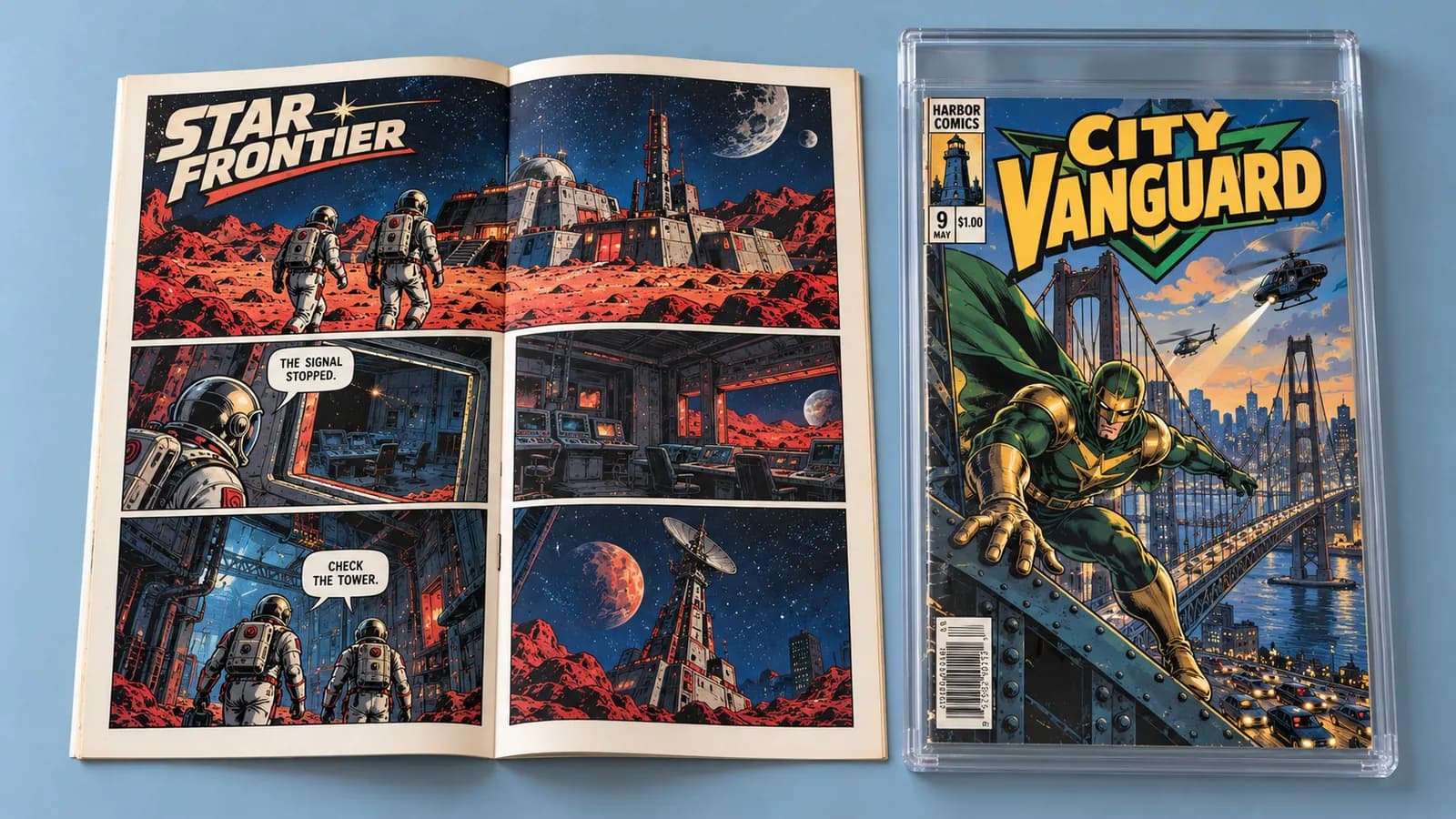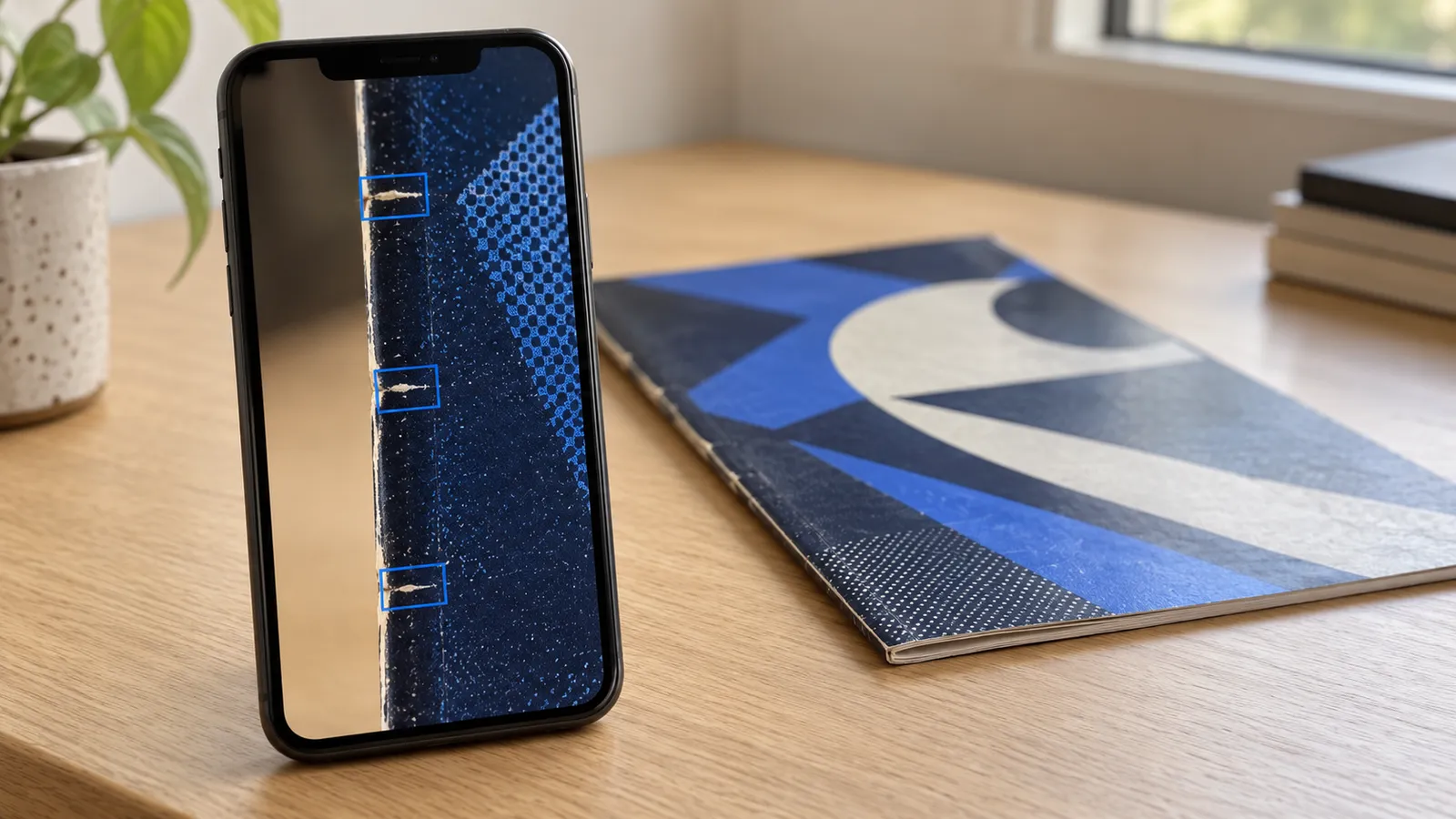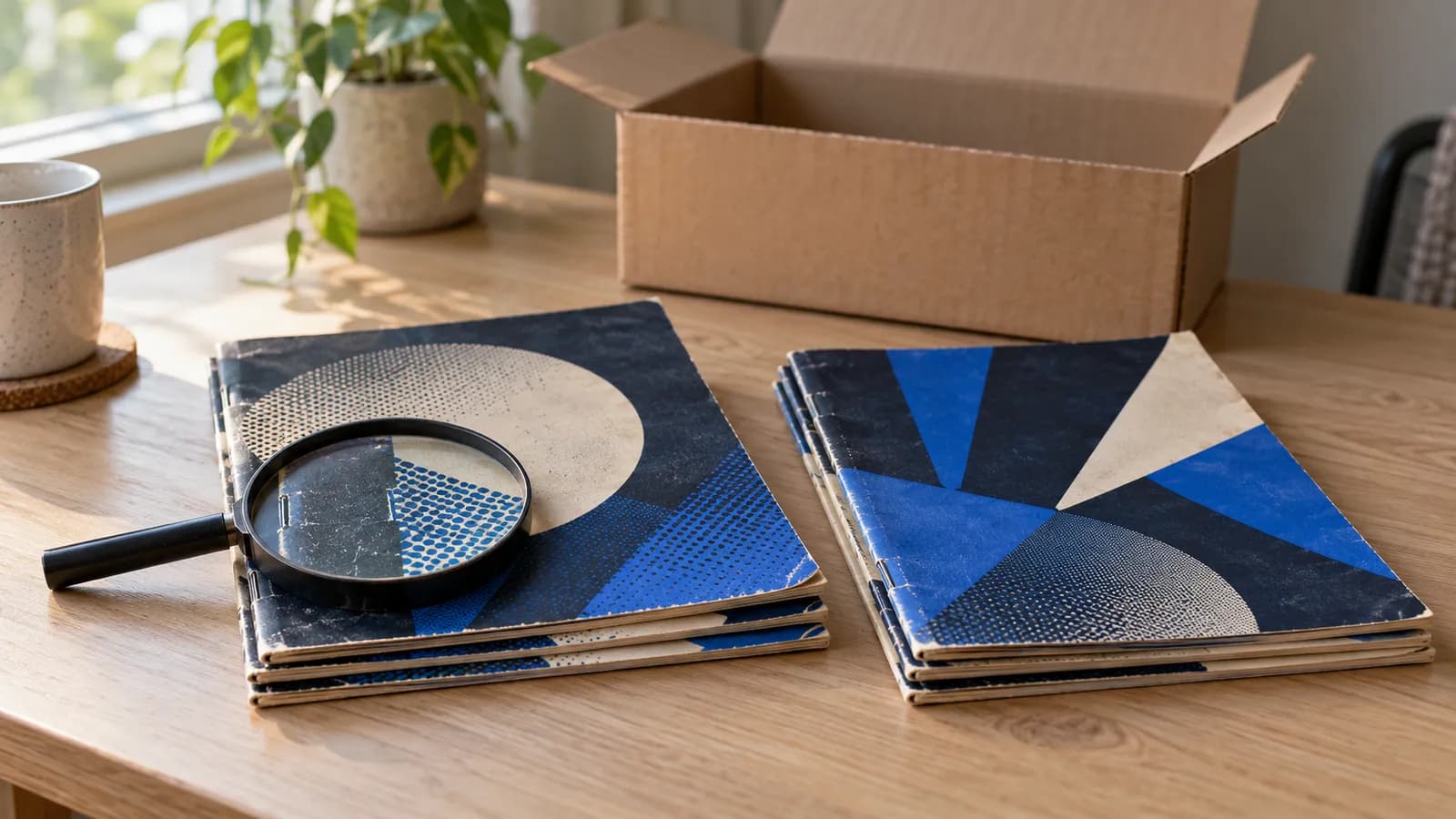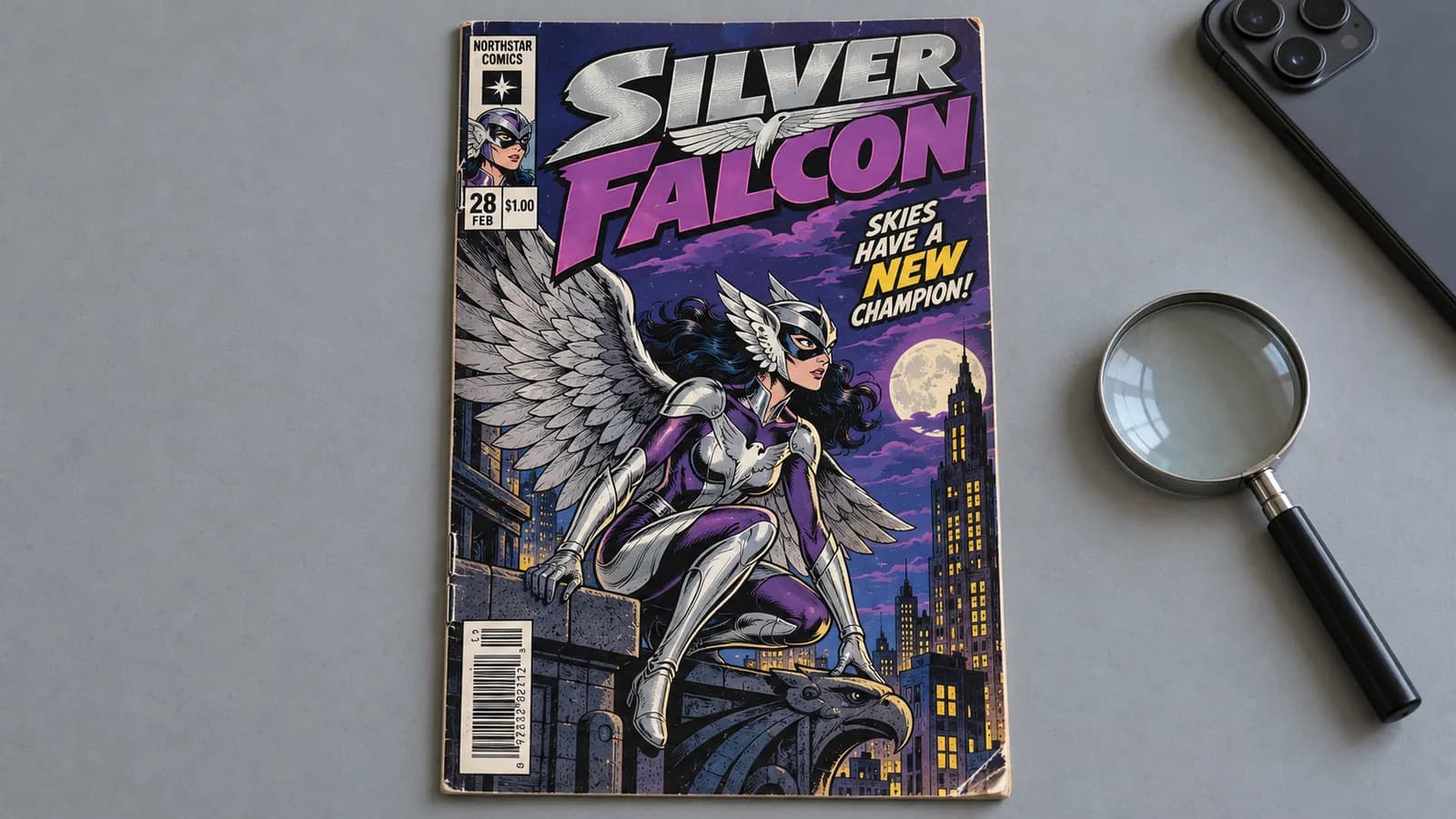
Photos can reveal obvious or poor-quality restoration on a comic book: a smooth patch of color over a crease, fill paper that does not match, edges cut too clean for a worn copy, or a cover that does not belong with its pages. Skilled restoration is made to be invisible in ordinary light, so a clean photo never proves a comic is unrestored.
The question matters because restoration changes what a book is. A grading service that finds restoration says so on the label, and buyers usually pay less for a restored copy than for an unrestored copy that looks the same.
What counts as restoration on a comic book
Restoration is any work that improves how a comic looks by adding material to it or changing the original. Conservation is work that preserves a comic's structure or chemistry without trying to improve its looks, and some grading services label it separately from restoration.
- Color touch is ink, paint, pencil or marker added to hide color breaks, spine stress or worn spots.
- Piece fill is paper added where a piece is missing: paper from a donor copy, new paper, or pulp cast into the gap, a process called leafcasting.
- Trimming is cutting a book's edges to remove wear or to square them up.
- Re-glossing is a coating applied to bring back lost cover shine.
- A married cover is a cover taken from another copy of the same issue and joined to this copy's pages. Married pages work the same way.
- Conservation work includes tear seals, spine reinforcement, reattached pieces, cleaning with water or solvent, deacidification, and cleaned or replaced staples.
Color touch, piece fill and re-glossing count as restoration. Services differ on trimming and married parts: some file them under restoration, and some note them separately. Pressing is a separate question, covered in what pressing can and cannot fix.
The published restoration grading scale rates each type of work for quantity and quality. Quantity runs from slight, such as light color touch on spine stress, to extensive, such as fill larger than 2 by 2 inches or a recreated cover. Quality covers the materials and how well the work hides. On that scale, conservation earns its own label only at the top quality level and the slightest quantity level.
Restoration signs a photo can show
A sharp photo can show restoration that disagrees with the book around it: color, print grain, shine, paper or edges that do not match. Whether the work shows depends mostly on its quality.
| Quality of the work | Typical materials | What a sharp photo is likely to show |
|---|---|---|
| Poor | Glue, pen, marker, white-out, plain white paper | Usually visible; the scale describes fill seen at arm's length |
| Fine | Pencil, crayon, chalk, a re-gloss coating, fill from donor copies | Sometimes; fill at this level shows on close inspection and to the touch, and a photo offers only the first |
| Excellent | Rice paper, wheat paste, acrylic or watercolor, leafcasting | Often nothing; the color match is close to perfect and nothing bleeds through |
Each sign below has an innocent look-alike, so treat it as a reason to ask, not as a verdict.
| Work | Sign in a photo | Why it is only a clue |
|---|---|---|
| Color touch | A smooth, flat patch without the grain of printed ink, often on a spine tick, crease or corner, a shade off from the ink beside it | Glare and a phone's noise reduction can also smooth away print grain |
| Piece fill | Paper of a different tone or texture at a corner or edge, with a boundary that follows the damage instead of the artwork | A stain or a lamp shadow can look like a tone change |
| Trimming | Razor-sharp, square edges on a book worn everywhere else, a cover flush with or smaller than the pages, or one edge straighter than the opposite edge | Factory cuts vary, and a photo cannot measure size without a known reference |
| Married cover | Cover wear or tone that does not match the interior pages, or cover staple holes that miss the centerfold staples | Cover stock and interior paper age differently, so some tone difference is normal |
| Re-glossing | In a video, a patch that stays bright while the shine around it moves with the light | Finger oils and residue also change shine |
| Cleaned or replaced staples | Bright staples beside old rust stains | A photo cannot tell cleaning from replacement |
To screen a set of photos, work in this order:
- Start at the damage. Color touch usually sits on top of a defect, so a smooth patch that tracks a spine tick, crease or corner deserves more attention than one in open artwork.
- Compare both sides of every boundary. Check grain, color and paper tone inside and outside the suspect area.
- Check the edges against the wear. Sharp, square edges belong on a book that is sharp everywhere.
- Match the cover to the interior. Compare wear and tone, and line up the cover's staple holes with the centerfold staples.
- Watch the shine move. In a video of the book tilting under one lamp, original gloss travels with the light.
- Write down what you saw. Record "signs seen" or "no signs seen", with the photo for each.
Better photos make every step easier, and how to photograph comics so the flaws actually show covers the setup.
Restoration that photos usually miss
Photos usually miss three kinds of restoration: work done well, work that leaves nothing on the surface, and changes that need a measurement or a touch to find.
- Excellent work. Archival fill and color touch matched to the original can leave nothing a camera records in flat, even light, the light most phone photos are taken in.
- Sealed tears, glue and reinforcement. A sealed tear or a reattached piece can lie flat like untouched paper, and the paste, glue or tissue behind it seldom shows.
- Cleaning, deacidification and page lightening. They leave a clean-looking book or no visible change at all, and a well-kept copy looks the same. Phone cameras also shift page color, so page tone proves little either way.
- A thin trim. A 1/16-inch cut (an example size) changes a comic's size by under 1 percent, too little for a photo to show without a known reference and the true size of untouched copies.
- A well-matched married cover. A cover from another copy of the same issue, with similar wear and staple holes that line up, can look original.
- Anything outside the frame. Many listings show the front cover and little else, and filters or heavy editing can hide a color mismatch.
History is the last gap. Restoration done decades ago travels with the book, and an honest owner may never have learned of it.
Why a clean photo does not prove a comic is unrestored
"No signs seen" and "unrestored" are different claims. Photos can support the first; only an in-hand examination can support the second.
Competent restoration is designed to pass the exact test a photo applies: a look at the surface in ordinary light. So an absence of clues is what you would see on an unrestored book, and also on a well-restored one. Honest wording reflects that:
Say:    No restoration signs seen in the photos.
        Restoration not verified in hand.
Avoid:  Unrestored. No restoration. Restoration-free.
The three public NuGrade sample reports follow that rule on real books: E-Man #1 (Charlton, 1973) at 9.2 NM-, Marvel Presents: Guardians of the Galaxy #4 (Marvel, April 1976) at 7.5 VF-, and Green Lantern #59 (DC, 1968) at 5.5 FN-. Each has zero findings in its restoration area. Each reads None detected for restoration, with the note that photos can miss skilled work, and none calls the book unrestored.
E-Man #1 is the clearest case. Its only findings are a slight miswrap and a small dark mark on the back cover, likely from the bindery or printing, and the report still does not call the book unrestored. On the other two, the owners disclosed nothing in the survey, and the reports still claim only that no restoration was detected, because a survey answer is a statement, not an inspection. These are examples of what photo evidence can settle, not proof of accuracy.
The same limit applies to authenticity, in the sense of a book that is all original. Photos can show that the cover, pages and staples look consistent. They cannot prove that nothing was swapped or replaced, or that the copy in the photos is the one that ships.
How restoration is checked in hand
An examiner with the book in hand can do what a photo cannot: change the light, measure the book, touch the surface and look at both sides of a repair.
- Ultraviolet light. Ultraviolet light often exposes old paper repairs, since replaced areas and added backing tend to look different from the original sheet under it, as a December 2000 National Park Service leaflet on ultraviolet examination explains. The same leaflet cautions that not every repair shows.
- Measurement. A trim shows as a book shorter or narrower than untouched copies of the same issue.
- Touch and low light. Fill can often be felt, and a lamp held low shows texture and gloss changes that flat light hides.
- Both sides of a repair. With the book open, an examiner can look for bleed-through, tissue behind a tear, and staple holes that do not line up.
Reading these results takes training and the book itself. For a valuable book, that is the case for professional grading, where a service examines the book in hand and seals it in a tamper-evident holder. The difference between raw, slabbed and certified comics explains what each kind of grade gives you, and the grading companies compared shows how each service labels restored books.
What to ask a seller about restoration
Ask about each kind of work by name, ask in writing, and ask how the seller knows. A vague question invites a vague answer.
RESTORATION QUESTIONS FOR A RAW COMIC
1. Any color touch, piece fill or ink retouch that you know of?
2. Have any edges been trimmed?
3. Is the cover, or any page, from another copy?
4. Has the book been cleaned, deacidified or pressed? By whom?
5. Has tape been removed, or have any tears been sealed?
6. Are the staples original?
7. How long have you owned it, and what do you know of its history?
8. If a grading service finds undisclosed restoration, can I return it?
"Not that I know of" is an honest answer, but it describes the seller's knowledge, not the book. If restoration would change the price, run the numbers again with a restored copy's price as the downside, as the break-even math for slabbing a comic shows.
Where a photo grade fits
A photo grade can screen and document a book. It cannot clear one.
NuGrade, an AI-assisted grading app for raw comics, works from seven photos (both covers, four corner close-ups and the centerfold staple seam) and two short videos (a slow spine pass and a page flip-through). If the photos show a restoration sign, it becomes a finding that cites its photo or frame. Competent work can be invisible in these photos too, so when they cannot establish the answer, the report marks restoration Unverified instead of guessing.
Its survey asks what the camera cannot see, including color touch or piece fill, trimmed edges, a married cover or pages, cleaning or deacidification, professional pressing and tape removal. "Nothing that I know of" is an answer the owner must select, and the report shows the answers under "What the owner told us".
A buyer can open any report by its ID at the report lookup, with no app or account, and check the photo behind each finding. For a key or another high-value book, in-hand professional grading is still the right route, and what an AI grade from photos can miss covers the method's other limits.
Frequently asked questions
Can you tell if a comic is restored from photos?
Only in part. Photos can show obvious or poor-quality work, such as a flat patch of color over a crease or fill paper that does not match, but skilled restoration can be invisible in ordinary light. A clean photo means no signs were seen, not that the book is unrestored.
What is the difference between restoration and conservation on a comic?
Restoration improves how a comic looks, with work such as color touch, piece fill or re-glossing. Conservation preserves the book's structure or chemistry, such as tear seals, spine reinforcement, cleaning or deacidification, and some grading services label it separately when the work meets their quality and quantity limits.
Can a black light detect comic book restoration?
Ultraviolet light helps trained examiners, because replaced paper and many old repairs often look different from original paper under it. It does not catch everything, since some adhesives do not glow under it, so it is one part of an in-hand professional examination.
Can a seller's photos prove a comic is unrestored?
No. Photos can show that no restoration signs were seen, but a thin trim, a careful cleaning, a sealed tear or well-matched color touch can leave no trace in them. Treat "unrestored" in a raw-book listing as the seller's belief unless an in-hand examination backs it.