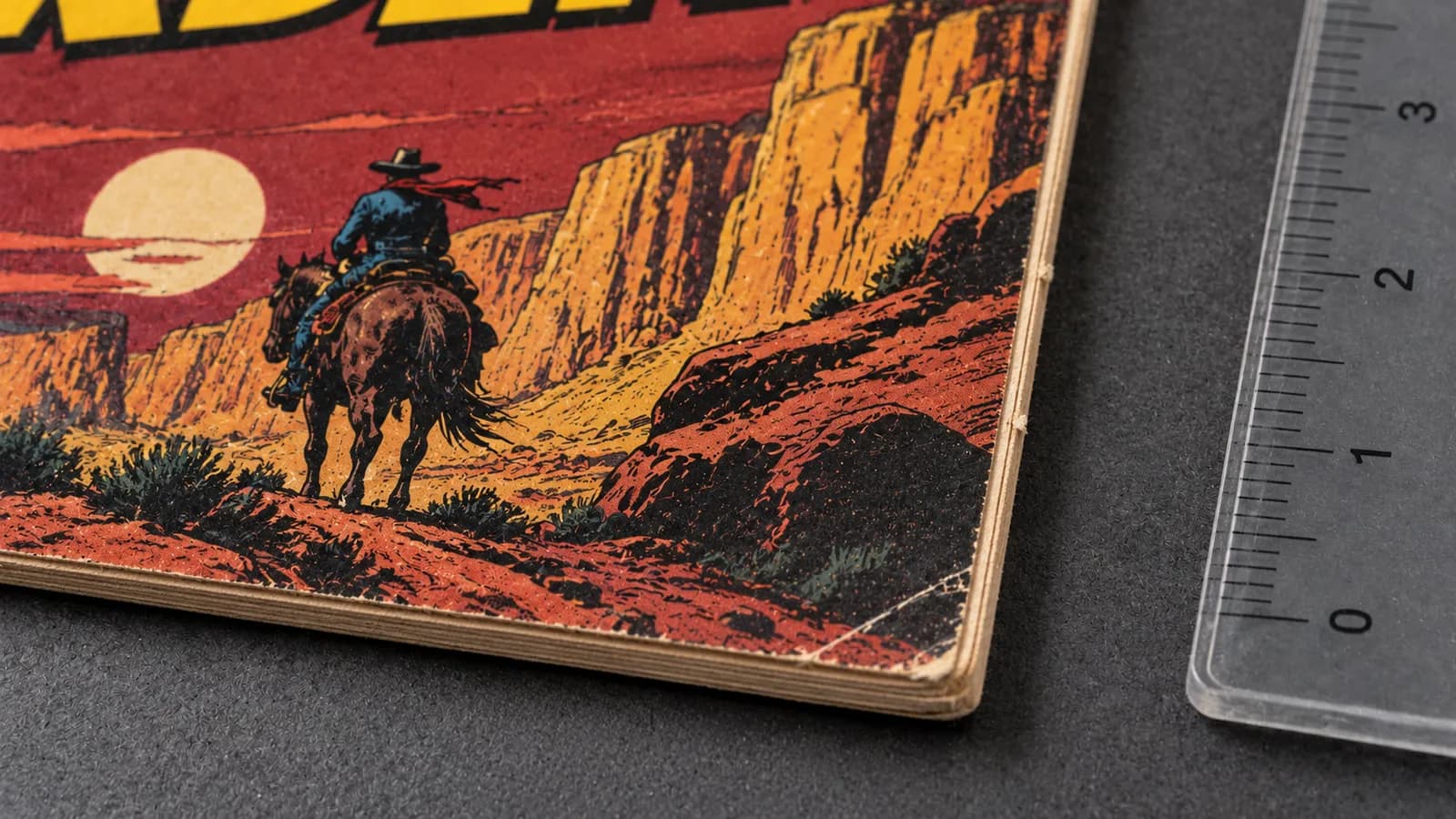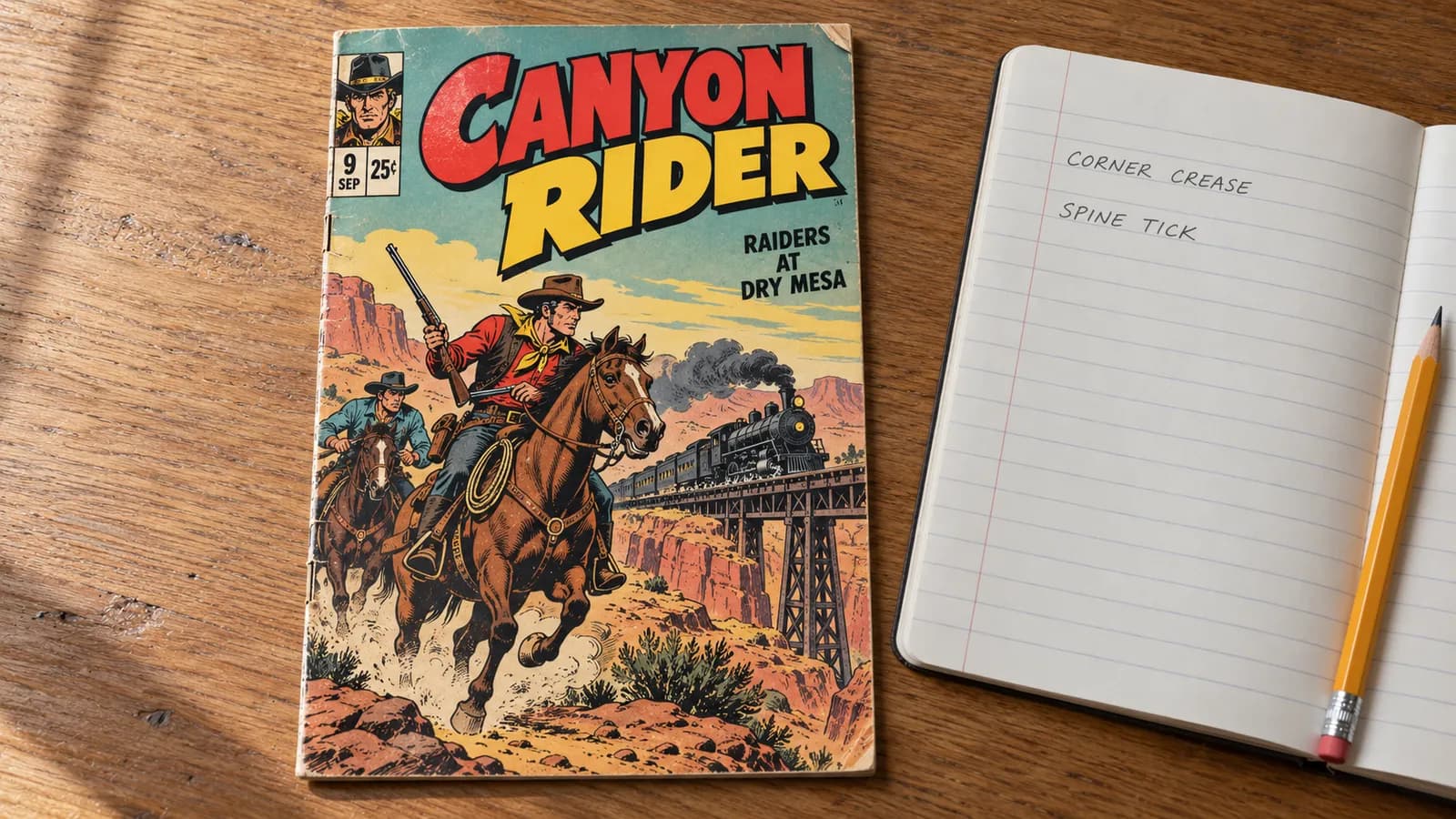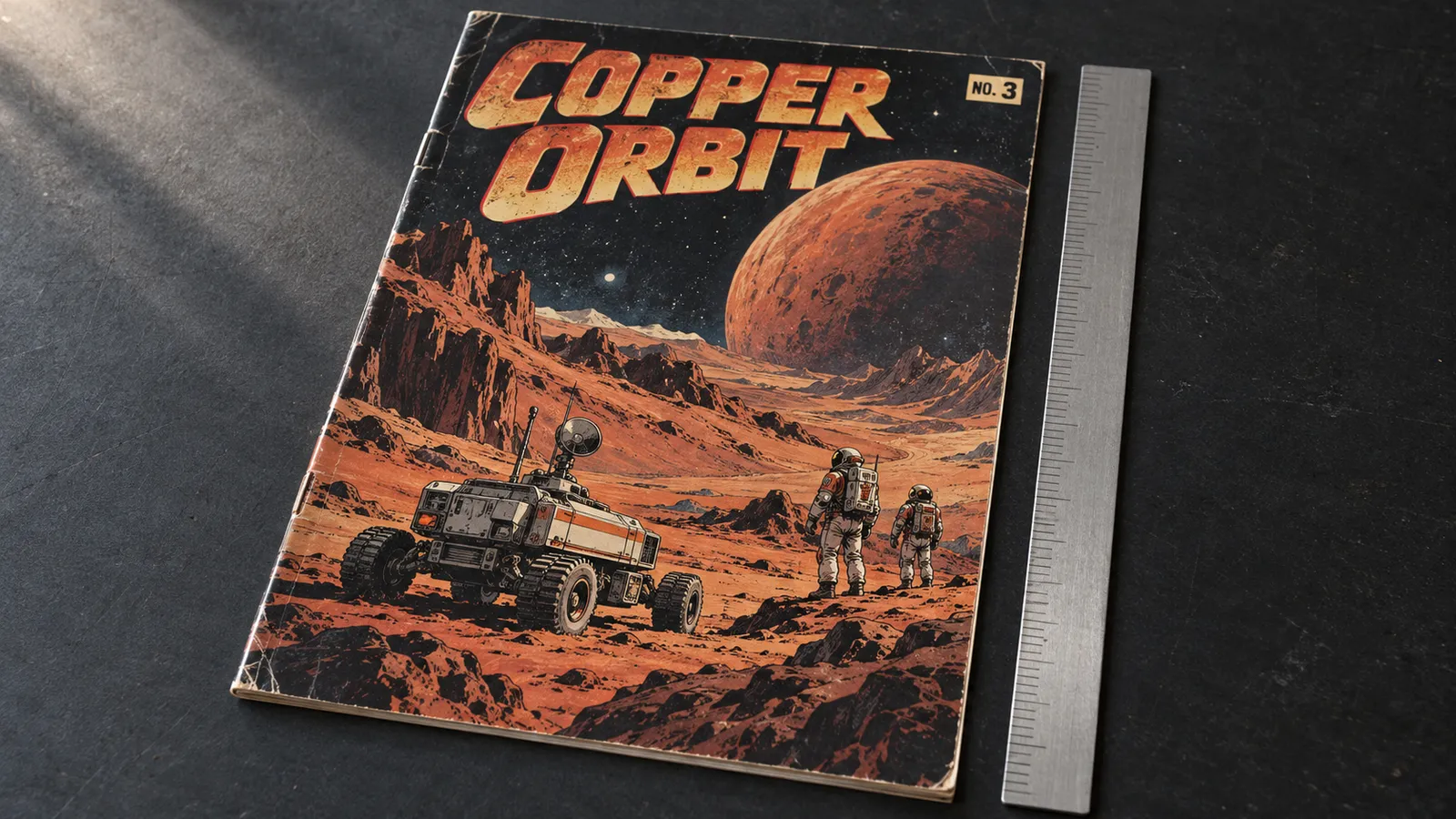
To tell if a comic is trimmed, compare its size with untouched copies of the same issue, then read the edges under a low lamp. Warning signs are edges too sharp and square for the book's other wear, one edge straighter than the others, a cover flush with or shorter than the pages, and wear that stops dead at an edge. No single sign proves a trim.
The stakes are real, because grading practice counts a trim as restoration and a trim cannot be undone. A light trim is also hard to see in photos, so the honest goal is to gather clues, ask good questions and describe exactly what you found.
What trimming is, and why graders count it as restoration
A comic leaves the bindery cut on three sides: the top, the bottom and the outer edge. The spine is a fold, not a cut. Trimming is any cut made after that, usually to take off chipped or worn edges, blunted corners or a factory miscut so the book looks sharper.
The grading service that publishes the restoration grading scale, called the scale's publisher below, lists trimming among its restoration techniques. Its restoration page notes that, unlike the others, trimming improves a book's look by taking paper away, and it describes amateur techniques such as trimming as usually irreversible or harmful. As of October 2026, its help pages say a trimmed book gets an apparent grade, a grade for how the book looks now, on a restored label. They name no minimum size.
The scale itself grades added work, such as color touch and piece fill, by its materials and its size, so it has no size line for a trim. That does not make a trim minor. Some restoration can be removed later, but cut paper cannot be put back. A published grading guide also notes that a restored copy is worth less than an unrestored copy at its apparent grade, and that more restoration means a bigger gap.
Not every odd edge is a trim. An off-center cut, a miswrap, bindery chips and a cover that overhangs the pages are factory flaws, graded as production defects rather than restoration.
Compare the size with other copies of the same issue
A trim makes a book smaller, so size is the first check. Lay the book flat on a dark, non-glossy surface and set a ruler beside it, not on it. Measure the height along the spine and along the outer edge, then the width at the top, middle and bottom, each to the nearest 1/16 inch.
Then measure other copies of the same issue the same way, ideally several, borrowed from a friend or a shop if you own only one. A book that is clearly smaller in one direction than every untouched copy deserves questions. So does a book that is out of square, with heights or widths that disagree, though a factory cut can run crooked too.
Compare like with like. Comics changed size over the decades, and sizes could vary between publishers and printers within one era, so a book from another decade tells you little. Even copies of one issue can differ slightly, because factory cuts were never exact.
Check where the art sits, too. Note how close the logo, the price and the cover art come to each edge, and compare that with another copy. An off-center factory cut moves the cut without shrinking the book: the art runs short at one edge and extra margin shows at the opposite one. A trim takes margin away and adds none, so the art crowds an edge with no wide margin anywhere, and the book measures small.
Covers can also shrink. In a 2013 article, the scale's publisher described covers that shrink from side to side with humidity or repeated pressing, and sometimes with age alone. It named Marvel books from 1960 to 1968 as the most prone, and it wrote that it is difficult or impossible to always tell natural shrinkage from shrinkage in a press.
So a narrow cover is a clue, not proof. The partner guide on how to tell if a comic was pressed covers the other marks a press can leave.
Read the edges in low, raking light
Raking light skims across a surface at a low angle, so texture casts small shadows. Set one lamp near table height, aim it along one cut edge at a time, and look from above and from the side. Check the front cover, the back cover and the edges of the pages.
- Edges too sharp and square for the wear. On an old book, the cut edges usually soften along with the corners and the spine, with small nicks, fuzz and flecks of lost ink. Needle-sharp corners and knife-straight edges on a book with a rolled spine and color-breaking ticks do not add up.
- One edge straighter or cleaner than the others. A trim can take a single edge, such as a chipped outer edge. Compare the three cut edges: one that looks fresher, straighter or whiter than the other two deserves a second look.
- A cover flush with or shorter than the pages. Look at each cut edge from the side. A cover cut back to the line of the pages, or short of it, is a clue. A short cover can also come from the factory or from shrinkage, so this sign counts only next to others.
- Page edges that look fresher than the book's age. Pages often age from the outer edges inward, as the published page-quality descriptions note. A recent cut can expose paper lighter than the aged edge it replaced, though a trim done decades ago has had time to age as well.
A cover that stands past the pages is the opposite sign, and it usually comes from the factory. The Green Lantern #59 sample report files "the cover edge sits slightly proud of the page block at the top-right, consistent with a mild bindery overhang" under production, not under wear.
Look for wear that stops abruptly at an edge
Handling wear builds up toward the edges, so on an untouched book it usually runs off the edge. A trim cuts that wear off partway, and what is left stops in a clean, straight line.
- A corner crease or color break that ends at a needle-sharp tip, where the tip itself shows no wear.
- Spine stress lines that reach the top or bottom edge and end in a crisp cut, with no softening.
- A tear, stain or tide line cut straight across at the edge.
- A sharp corner tip with creased, dented or soiled paper just behind it.
- Chips and nicks along two cut edges and none along the third.
Wear does not always reach an edge, and a crease can end where the bend ended. The clue is a crisp cut through the end of a defect, not the defect alone. For what blunting, chips and color flecks look like on an untouched book, see comic corners and edges: blunt, chipped or torn.
Weigh the clues together
| Clue | Points to a trim when | Other causes |
|---|---|---|
| Smaller than other copies | Several untouched copies of the issue measure larger | Factory variation, a shrunken cover |
| Art crowding an edge | No extra margin shows at the opposite edge | An off-center factory cut |
| Edges sharper than the wear | The spine, corners and pages show real age | Reading wear that never reached the edges |
| One edge cleaner than the rest | The other two edges show normal wear | Uneven handling |
| Cover flush with or short of the pages | The book is also small, or the edge is crisp | A factory short cover, shrinkage |
| Wear that stops at an edge | The cut through it is crisp and fresh | A defect that simply ended there |
Two or three clues that agree are a reason to ask questions, or to have the book checked in hand. One clue alone is a note, not a verdict.
What photos can and cannot show about a trim
Photos can show proportions, edge character and wear cut off at an edge, when they are taken for it: the full book square on with space around all four sides, each corner close and sharp, and each edge under a low lamp. How to photograph comics so the flaws actually show covers the setup.
Photos cannot measure a book reliably. A slight tilt changes the proportions and a lens can bend straight lines near the edge of the frame, so a ruler in the same plane as the book is the minimum. Even then, a thin trim changes the size by less than a phone photo can show. Photos also cannot show how an edge feels, and a trim done long ago can age to match the book.
NuGrade's guided capture includes both full covers and four corner close-ups, plus a slow spine pass and a page flip-through, and each finding in the report cites the photo or frame it came from. The survey asks the owner directly about trimmed edges, and the answer appears in the report under "What the owner told us".
The restoration read says "Unverified" when the photos cannot establish restoration. When the check found nothing, it says "None detected" with the note "Photos can miss skilled work." That is not a clearance, because a clean trim can leave nothing a photo records. For a book with a high value, in-hand professional grading is still the right choice.
What to ask a seller about trimming
Ask in writing, ask for measurements, and ask how the seller knows.
TRIMMING QUESTIONS FOR A RAW COMIC
1. Do you know of any trimming? How do you know?
2. What are the height and width? Please measure at the
   spine, at the outer edge, and at the top and bottom.
3. Can you send both full covers, square on, with a ruler
   beside the book?
4. Can you send each cut edge under a low side light, and
   the page edges from the side?
5. Have you compared it with another copy of the same issue?
6. If a grading service finds trimming, can I return it?
"Not that I know of" is an honest answer, but it describes the seller's knowledge, not the book. On a book where a trim would change the price, measurements and edge photos are a fair request.
Why to disclose a trim when you sell, and how to word it
Disclose a trim you know about, and say so when you suspect one. A buyer who sends the book to a grading service can learn about the trim from the label. A published grading guide notes that the stigma around restoration grew because some sellers concealed it, and it calls disclosure of all restoration imperative.
Price a known trim as a restored copy, because a trimmed book priced like an untouched one invites a return and a dispute. Show the edges in the listing too: both full covers square on, and each edge under a low lamp. The full shot list is in what photos a raw-comic listing should include.
TRIMMING: EXAMPLE WORDING (not a real book)
Known:      Trimmed along the outer edge. Priced as a
            restored copy.
Suspected:  Possible trim. Outer edge sharper than the wear
            elsewhere; about 1/16 in narrower than my other
            copy. Not checked in hand by a grading service.
Unknown:    No trimming that I know of. Edges not checked
            in hand by a grading service.
Avoid:      Untrimmed. Never trimmed. Original edges.
For the rest of a listing, see how to write condition notes buyers trust. And do not try to fix an edge yourself: cutting away even a sliver of a chipped edge turns a flaw into restoration.
Frequently asked questions
Is a trimmed comic considered restored?
Yes, in grading practice. The grading service that publishes the restoration grading scale lists trimming among its restoration techniques and, as of October 2026, gives a trimmed book an apparent grade on a restored label.
Can you tell if a comic is trimmed from photos?
Sometimes. Square-on, close and low-light photos can show edges too sharp for the wear, a cover short of the pages or wear cut off at an edge, but a thin trim can leave nothing a photo can measure.
Do comics of the same issue vary in size?
Slightly, yes. Factory cuts were never exact, and covers can shrink from side to side with age or humidity, so a small difference in size is a clue to check, not proof of a trim.
Can trimming be reversed?
No. A trim removes paper, and the paper cannot be put back. Some other kinds of restoration can be removed later, but a trim stays with the book.
How much trimming makes a comic restored?
Grading practice sets no allowance. The grading service that publishes the restoration scale gives a trimmed book a restored label and names no minimum size.