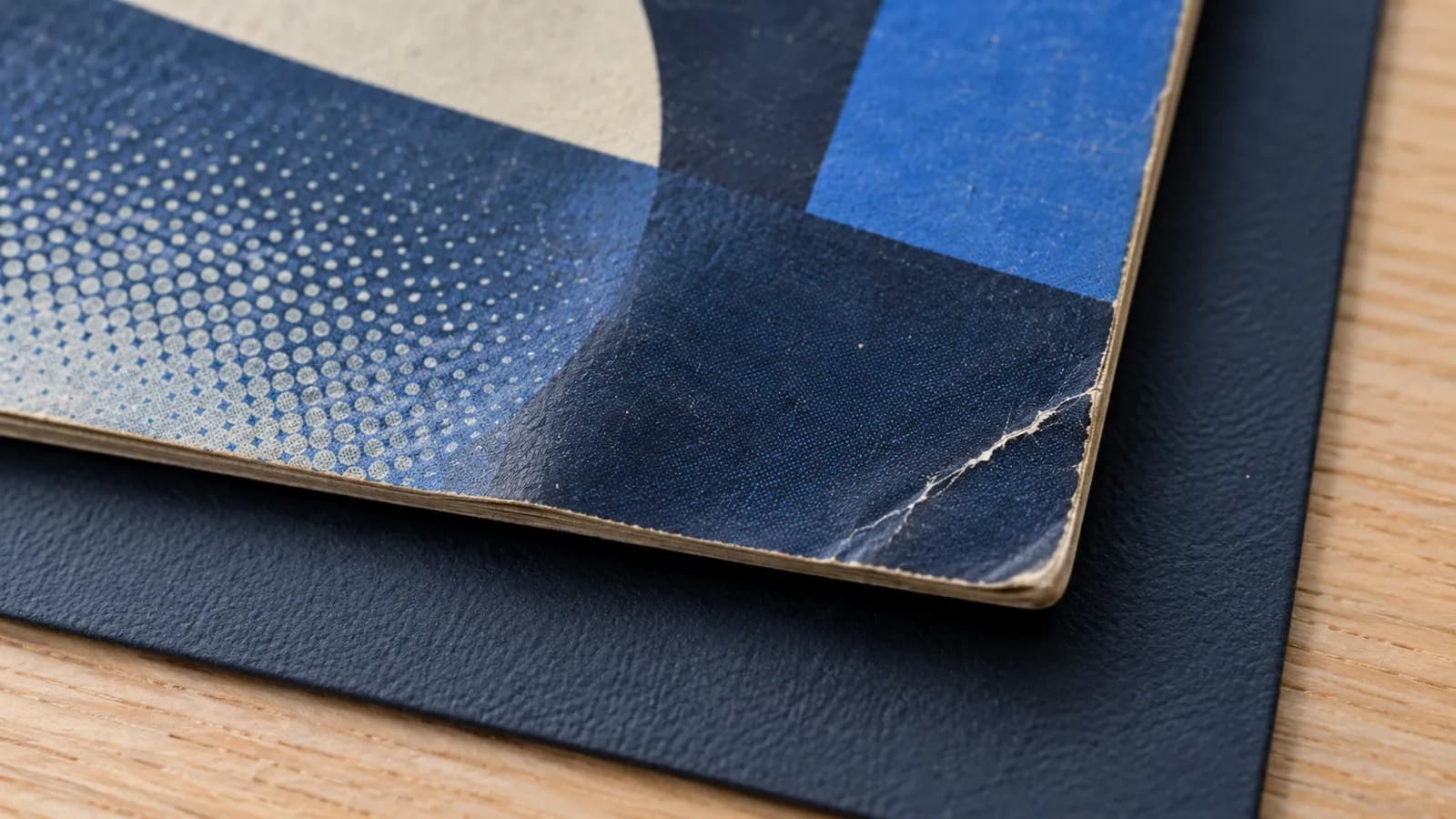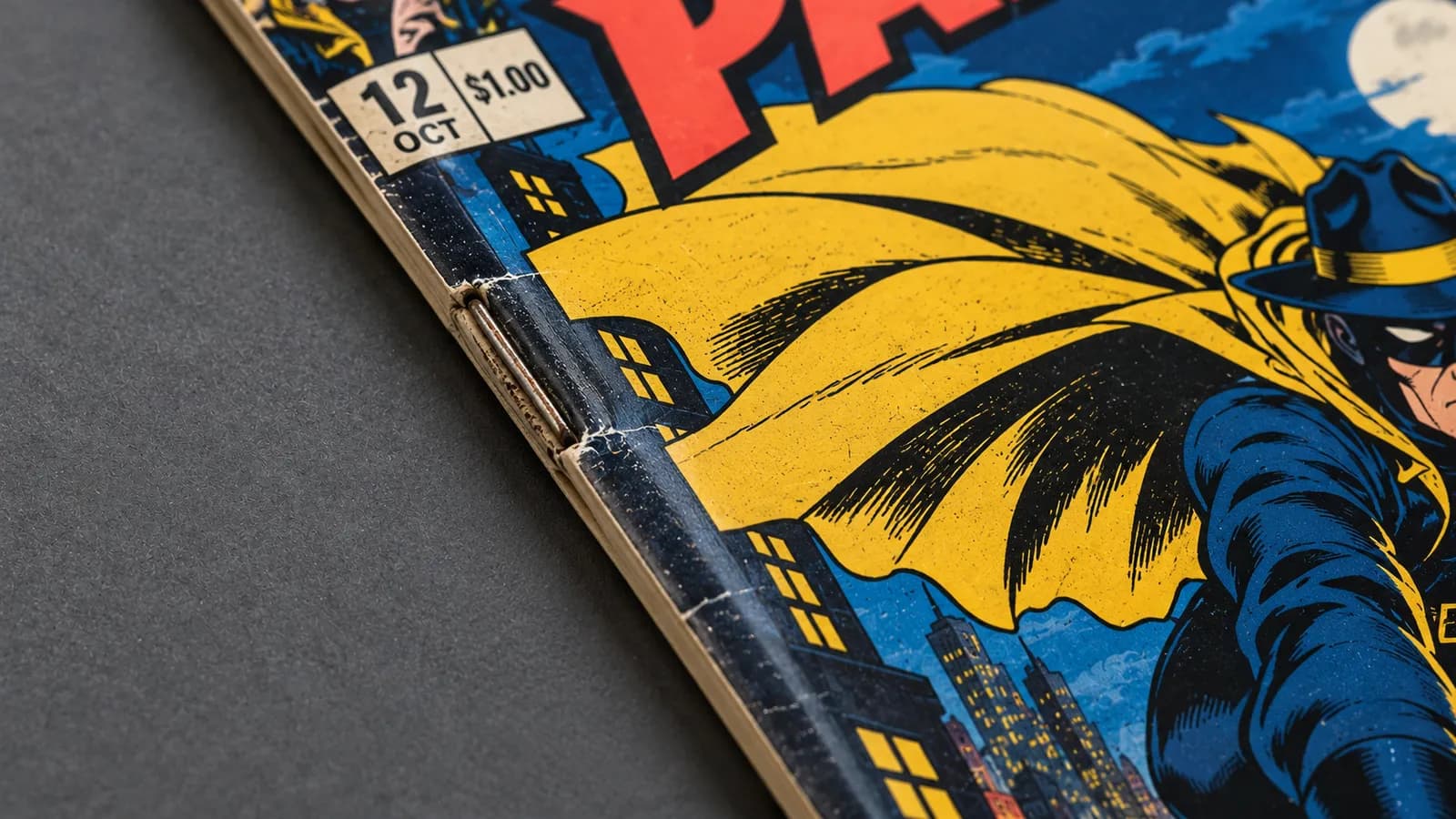
Often you cannot tell if a comic has been pressed. A press flattens bends, dents and waves that did not break the color, and it adds and removes nothing, so a good press can leave no trace, even in hand. The clues are indirect: color breaks with no bend around them, the waves or streaks of a poor press, and older photos of the same copy.
That limit matters less for the label than you might expect, because the published restoration scale does not count a press by itself. It matters more for disclosure. Buyers still ask, and a press often comes with other work that the scale does count.
Why a good press often leaves no trace
Pressing works on the shape of the paper, not on its material. Under controlled pressure, sometimes with humidity or heat, a bend or a wave relaxes until the cover lies flat. The defects a press can and cannot remove are covered in what pressing can and cannot fix, so this guide starts after the press.
Most restoration leaves something to find: added color, fill paper, glue, or a cut edge like the ones in the partner guide on how to tell if a comic is trimmed. A press leaves the same paper and ink in a flatter shape. A flat cover is also what a well-kept book looks like, so flatness proves nothing either way.
Grading staff face the same limit. The grading service that publishes the restoration grading scale, called the scale's publisher below, wrote in 2013 that it is difficult or impossible to always tell whether a cover shrank naturally or in a press. Treat every clue in this guide as a reason to ask, not as proof.
Clues that can suggest a press, and the limit of each
Some clues come from what a press cannot undo. A press relaxes paper, but it cannot put back lost ink or take out a stain, so the leftovers of an old defect can sit on a book that is now flat.
| Clue | Why it can suggest a press | Limit |
|---|---|---|
| A color break with its white line intact and no bend or ridge around it | A press can relax a bend but cannot replace lost ink | A light break can lie flat without a press |
| A faint line or a change of shine where a bend would be, seen only in raking light | A press can diminish a bend without removing all of it | A light bend that relaxed in storage looks the same |
| A tide line or moisture stain on a cover that lies dead flat | A press can flatten ripples but cannot remove the stain | A book can dry flat under weight |
| A very flat book with real wear at the corners, edges and spine | The bends that often come with that wear are gone | Careful storage keeps a handled book flat |
| An older photo or report of the same copy showing a bend that is gone now | The book changed between the two dates | It must be the same copy |
The last clue is the strongest, because it shows a change instead of suggesting one. Match the copy by marks that a press does not move: an arrival date, the position of each spine tick, a small stain or a chip. To tell a broken tick from an unbroken one, use the two-light check for spine ticks.
Signs a poor press can leave
A good press leaves little behind. A poor one can, and the scale's publisher described the side effects in a series of articles on improper pressing, published from 2013. Each is a visible defect, so it can lower the grade whether or not anyone proves a press.
- Cockling: waves through the cover from too much heat or humidity during the press. The series notes that it may not show until some time after the press.
- Pebbling: a pebbled texture where damp paper dried against a rough surface, in one spot or across the cover.
- Gloss streaks: matte streaks in the cover gloss, visible in raking light and most often on white areas and the inside covers, from water used in a spot press.
- Spine indents: dent-like marks along the spine, a side effect of aggressive dent removal, sometimes with a line of lost gloss just beside the spine. The series warns not to confuse them with ordinary spine stress lines.
- Cover shrinkage: a cover that has narrowed from side to side, from humidity or repeated pressing, though covers can also shrink with age.
- Staple impressions: marks pushed into the paper around the staples, most visible at the centerfold, from a press used without a protective barrier.
- Signs of disassembly: enlarged staple holes, crooked staples or a loosened centerfold, when a book was taken apart to press it.
The series also lists staining, warping, edge rippling, crushed spines, reverse spine roll, flaring, gloss stains and melted inks. Every sign has an innocent look-alike, such as waves from damp storage or gloss worn away by handling. A sign tells you that something flattened, wet or squeezed the book, not when it happened or who did it.
How the published restoration scale treats pressing
The published restoration grading scale does not mention pressing at all. It grades work that adds material or color by its quality and its quantity, and it lists conservation repairs, such as tear seals and cleaned or replaced staples, on their own. The comic grading glossary defines these terms in plain English.
A press adds no material and no color, so the scale has nothing to grade. The scale's publisher says the same in plain words: as of October 2026, it does not consider pressing to be restoration, and it says a press will not make a book "restored". It puts dry cleaning and tape removal in the same group of non-additive processes.
That is why a pressed book is not a restored book by itself. A press can still move the grade: up when it removes the bend that set the grade, and down when it leaves one of the defects above.
When pressing comes with other work
A press is often one step in a larger job, and the other steps can change the answer. A professional press may include a dry cleaning of the covers to lift dirt and pencil. The scale's publisher lists that step in its own pressing service and does not count it as restoration, but other steps go further.
| Work done with the press | How the scale's publisher treats it | What to ask |
|---|---|---|
| Dry cleaning of the covers | Not restoration | Was any water or solvent used? |
| Water or solvent cleaning | Restoration work, which can earn the separate conserved designation when it is professional and slight (quality A, quantity 1) | Who cleaned it, and how? |
| Taking the book apart at the staples | Not on the scale by itself, but cleaned or replaced staples are a conservation repair | Are these the original staples? |
| Color touch over a break the press could not remove | Restoration, even light touch on spine stress | Was anything added to the cover? |
| Tear seals or reinforcement | Conservation repairs | What was sealed or reinforced? |
The scale's quality levels also describe what poor cleaning leaves behind, which gives a buyer something to look for. A cleaned cover can look slightly faded or too white, and at the lowest level its colors look washed out or speckled, with cockling or ripples. Cleaned interior pages can look slightly puffy, cockled or too white.
So "pressed" is one question, and "cleaned how?" is another. Ask both, and ask who did the work.
Disclosure: why buyers ask, and how to answer
Why buyers ask
- The easy gain may be gone. A buyer who plans to press a book before submitting it is paying for bends a press could remove. If a press already removed them, that upside is gone.
- "Pressed" leads to "cleaned". Water or solvent cleaning can change how a book is labeled, so the follow-up question matters more than the first one.
- A poor press can show late. Cockling may not appear until some time after the press, so recent work is worth knowing about.
- Views differ. One published grading guide files non-additive fixes, including fixes for warping and spine roll, under "preventative restoration". It says to disclose all restoration work, and it notes that some collectors do not view such simple repairs as restoration at all. A clear disclosure lets each buyer decide.
How a seller answers honestly
Say what you know, how you know it, and what you do not know.
PRESSING AND CLEANING: EXAMPLE WORDING (not a real book)
Known:    Professionally pressed in 2025 to remove a bend
          at the top-right corner. Dry cleaned only.
          Staples original.
Told:     Pressed before I owned it, per the previous
          owner. No paperwork. Cleaning not known.
Unknown:  Pressing history not known. I have not pressed
          or cleaned it.
Avoid:    Unpressed. Never pressed. Untouched.
Write "not pressed" only when you know the book's whole history. Keep receipts and before photos, and pass them on with the book. For the rest of a listing, see how to write condition notes buyers trust.
What a NuGrade report records about pressing
NuGrade's survey asks what the camera cannot see, and two of its options are "Pressed professionally" and "Cleaned or deacidified". Nothing is pre-selected: the owner must choose an answer, and "Nothing that I know of" is one of them. The report shows the answers under "What the owner told us".
On the Marvel Presents: Guardians of the Galaxy #4 sample report, that section reads "Nothing disclosed". That records the owner's knowledge, not proof that the book was never pressed.
The photos cannot settle pressing either way, and the grade is an opinion limited to what the photos and video show. A bend that shows in the captures can appear as a finding that cites its photo or frame. A bend pressed out before the photos leaves nothing to cite.
Each report is a fixed snapshot with a public ID. If a book is pressed after a report, make a new one. The old report stays as it was, so a buyer can open both at the report lookup and compare the book before and after.
Frequently asked questions
Can a grading service tell if a comic was pressed?
Not always. A good press adds and removes nothing, and the publisher of the restoration grading scale has written that it cannot always tell whether a cover shrank naturally or in a press. A poor press can leave visible defects, such as cockling or gloss streaks.
Is a pressed comic considered restored?
Not by itself. The published restoration grading scale does not list pressing, and as of October 2026 its publisher says a press does not make a book restored. Work done along with the press, such as water or solvent cleaning, replaced staples or color touch, is a separate question.
What is the difference between pressing and cleaning a comic?
Pressing changes the shape of the paper and adds nothing. Cleaning removes dirt or stains: the publisher of the restoration grading scale does not count dry cleaning as restoration, while water or solvent cleaning is restoration work that can count as conservation when it is professional and slight.
Does a flat comic mean it was pressed?
No. Flatness is the normal state of a well-kept comic, so it proves nothing either way. A color break with no bend around it, or an older photo of the same copy, says more.
How should I describe a comic whose pressing history I do not know?
Write "pressing history not known" and say whether you pressed it yourself. Avoid "unpressed" or "never pressed" unless you know the book's whole history.